

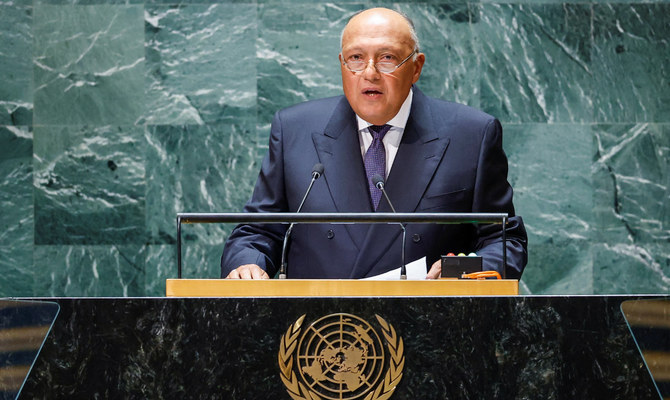

NEW YORK: The international community must honor the climate action pledges it made at last year’s COP27 summit, Egyptian Foreign Minister Sameh Shoukry said on Saturday.
During his speech at the 78th UN General Assembly in New York, Shoukry warned about the future effects of climate change and said that at the UN Climate Change Conference in Sharm Al-Sheikh last year, Egypt “managed to mobilize international consensus to achieve climate justice.”
He said: “We reached balanced decisions based on the agreed-upon responsibilities and principles as per the UNFCCC (United Nations Framework Convention on Climate Change) and Paris Agreement.”
Shoukry called for the improvement of access to development funding for developing countries, and the creation of a “sustainable and comprehensive mechanism to look into the debts of low-income and middle-income countries in addition to looking into the restructuring of the complex structure of debts.”
The minister criticized what he described as an inadequate response to the climate crisis, saying that “certain countries have reneged on their pledges,” and urged the international community to commit to pledges and agreements reached at COP27, particularly the Loss and Damage Fund.
Water and climate change are undoubtedly linked, Shoukry said, adding that Egypt is in the midst of a severe water crisis that has forced the country to reuse water.
In the same vein, he added that Egypt depends on the Nile River to sustain itself, and strongly condemned any unilateral actions taken regarding transnational bodies of water.
“We refuse any unilateral procedures regarding the management of transboundary water, for example, the Ethiopian Renaissance Dam, which was created without consultation and without previous adequate studies or even any studies for the impact of other states,” he said.
However, Shoukry expressed his country’s desire to reach an agreement on the operation and filling of the dam that would take into account the needs of Ethiopia, Egypt and Sudan.
He also expressed concern over the humanitarian situation in Palestine, saying that Egypt supports “the legitimate right of the Palestinian people to establish their independent state … with eastern Jerusalem as its capital.”
Regarding its southern neighbor, the minister called on countries neighboring Sudan to “settle the current crisis and to mitigate the humanitarian repercussions thereof,” adding that Egypt is working to negotiate a cease-fire and political solution to the conflict.
On the global economic stage, Shoukry said that Egypt “looks forward to playing an active role in BRICS to advocate for the interests and aspirations of 30 percent of the global economy in the global south.”
Egypt applied to join the economic bloc this year and will become a full member of BRICS in early 2024.


