

Pakistani FM ‘hopeful’ flood aid promises will be fulfilled

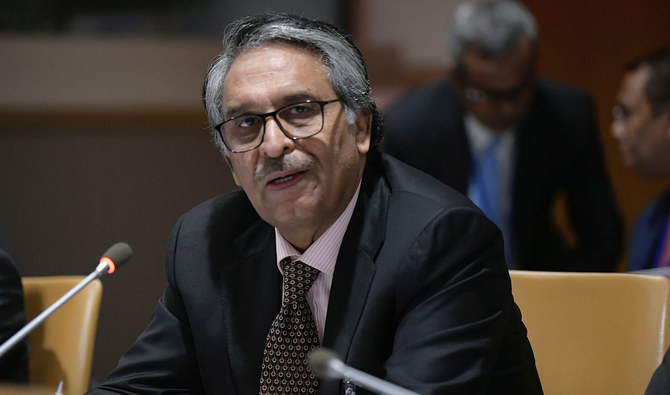
Pakistan interim foreign minister Jalil Abbas Jilani speaks during the UNAOC Group of Friends meeting at UN Headquarters in New York on September 22, 2023. (Photo courtesy: X/UNAOC)
Short Url
Updated 23 September 2023
Follow

Pakistani FM ‘hopeful’ flood aid promises will be fulfilled

  • Floods last year inflicted over $30bn in damage, economic losses on Pakistan
  • While donors have pledged around $10bn in aid, it has yet to be disbursed

NEW YORK: Pakistan is “hopeful” that pledged reconstruction funding to rebuild parts of the country damaged by floods last year will be disbursed soon, Foreign Minister Jalil Abbas Jilani said on Friday.

At a press conference during the UN General Assembly in New York, he told Arab News: “Pakistan is one of the worst affected as far as climate change is concerned because it has affected about 33 million people.

“One-third of the country was inundated with water, and about $30 billion worth of losses were suffered.”

Pakistan was devastated by the 2022 floods, which were the world’s deadliest since those in southern Asia in 2020.

About a month after last year’s disaster, Pakistan and other countries attending the UN Climate Change Conference in Egypt decided to establish the Loss and Damage Fund to assist countries in dealing with the effects of climate change.

Many donors have pledged funds to help Pakistan rebuild flood-affected areas. The Islamic Development Bank pledged more than $4 billion, the World Bank $2 billion and Saudi Arabia $1 billion.

“So far, there has been very little which has trickled down from the international community as far as the rehabilitation and reconstruction work that has to be carried out. Pakistan is doing that from its own resources,” Jilani told Arab News.

“Our banks are issuing loans on easy terms to all those people who were affected. But then obviously, there are limits to what the banking industry can do.

“This is the kind of situation we’re in. I think we’re hopeful that most of the promises which were made by the donors will be fulfilled shortly.”

Regarding foreign policy, Jilani described the formation of new blocs and rivalries in the Asia-Pacific region as “a very uncomfortable situation” for Pakistan.

“Asia-Pacific has been a very peaceful region, a prosperous region, and it has made great economic strides in the last 40-50 years. Any tension within the Asia-Pacific region, from our point of view, is certainly not good for peace and stability in the region,” he said, adding that Pakistan prioritizes good relations with all countries, specifically mentioning China and the US.

When asked about Islamabad’s potential to confront the Pakistani Taliban, which operates along the border with Afghanistan, Jilani said: “Afghanistan is a sovereign country. Pakistan follows a policy of non-interference … while respecting the sovereignty of other countries.

“At the same time, we have expectations that the Afghan side would take action against all groups who are violating Afghanistan’s soil to carry out terrorist activities against other countries.”

Jilani added that during a meeting between the foreign ministers of China, Pakistan and Afghanistan in May, “there was a reiteration of this commitment by the Afghan side that they won’t allow Afghan soil to be used against other countries.”

Jilani also praised Pakistan’s commitment to democracy and free elections. “We’re a democratic country. There’s absolutely no doubt about it. In Pakistan, when parliament has completed its full term, it’s a constitutional requirement that there’s a caretaker setup which is meant to ensure neutrality in the next elections,” he said.

“This is meant to ensure that the elections are free and fair, and is meant to ensure that people are able to participate in the voting process without any violence.”

Jilani said Pakistan is heavily involved in efforts to tackle Islamophobia in Europe, and had made a case for the criminalization of religious-based hate speech in the Organisation of Islamic Cooperation’s Contact Group on Muslims in Europe.

“We also appreciated the introduction of a bill by the government of Denmark which would criminalize such offenses, either the burning of holy books or insulting the prophets of any religion. I think this is a good step they’ve taken,” he added, saying he is hopeful that if such a bill passed in Demark, other European nations may follow suit.


Pakistan inflation could cross 7 percent if Middle East war pushes oil to $130, economists warn

Updated 5 sec ago
Follow

Pakistan inflation could cross 7 percent if Middle East war pushes oil to $130, economists warn

  • Petrol prices could climb to Rs392 ($1.40) per liter if crude surges, advisory note says
  • LPG prices rise 13 percent amid Gulf conflict as industry expects fresh shipments before Eid

KARACHI: Pakistan’s fragile economic recovery could face renewed inflationary pressure if global oil prices surge to $130 per barrel amid the escalating Middle East conflict, economists and industry stakeholders warned this week.

The warning comes after crude prices briefly spiked above $110 per barrel following hostilities involving the United States, Israel and Iran, raising fears of disruptions to energy shipments through the Strait of Hormuz, a strategic waterway that carries roughly one-fifth of the world’s oil supply.

Although prices have since retreated from their recent highs, analysts say continued volatility could quickly translate into higher fuel costs in Pakistan, which imports most of its energy needs.

On Friday, Pakistan raised consumer prices for diesel and petrol about 20 percent, citing the higher oil prices caused by the Iran war. Last week, the central bank said headline inflation accelerated to 7 percent in February from 5.8 percent in January, while core inflation reached about 7.6 percent.

It said inflation could remain above 7 percent through the rest of the fiscal year ​ending in June and ​into the next fiscal ⁠year, though improved food supply and better agricultural prospects may partly offset pressure from higher energy prices.

“If global oil reaches $130 per barrel, petrol in Pakistan could approach Rs392 ($1.4) per liter with inflation rising by 7.11 percent,” Karachi-based tax and corporate advisory firm Tola Associates said in a note to its clients.

The projection highlights the vulnerability of Pakistan’s import-dependent energy sector at a time when the country is still recovering from a prolonged economic crisis marked by high inflation, currency depreciation and rising fuel costs.

Pakistan imported petroleum products worth about $16 billion last year, accounting for the largest share of the country’s $58.4 billion import bill, according to official data.

Ashfaq Tola, chairman of Tola Associates and a former tax adviser to several Pakistani governments, said his firm had modeled how different global oil price scenarios could affect domestic fuel prices and inflation.

“If oil is priced at $88 per barrel, we have an indicative price of Rs313 ($1.1) per liter. If it reaches $130, its inflationary impact on the overall economy will be 7.11 percent,” Tola said.

He noted that global oil prices had recently eased from their peak and expressed hope markets would stabilize.

“The oil prices are settled today. We are seeing prices at $88. The prices will reach the same level at $65-$66. The economy will recover.”

However, Tola said Pakistan’s recent decision to raise fuel prices by Rs55 ($.20) per liter had come too quickly given the country’s fuel reserves.

“I don’t see any rationale for this knee-jerk Rs55 per liter increment in the prices of fuel given the fuel stock we had in reserves. You should have waited,” he asked the government.

Pakistan’s petroleum ministry spokesperson Zafar Abbas did not respond to requests for comment. Nazir Abbas Zaidi, secretary general of the Oil Companies Advisory Council (OCAC), also declined to comment.

Finance adviser Khurram Schehzad said on social media platform X that oil prices had already started declining.

“Oil continues plummeting,” the official said, noting Brent crude had fallen 16 percent to about $83 per barrel while US benchmark WTI declined 17 percent to around $78.

LPG PRICE HIKE

Even as crude prices fluctuate, rising energy costs are already beginning to ripple through Pakistan’s retail markets, particularly in liquefied petroleum gas (LPG), which is widely used in households, restaurants and vehicles across the country, especially in areas without piped natural gas.

Khubaib Sabir, an LPG retailer in Karachi’s Keamari neighborhood, said prices had climbed sharply since the conflict intensified.

“Before this war started it stood at Rs310 ($1.1) per kilogram. Now the LPG prices have increased by Rs40 to Rs350 ($1.3),” he told Arab News while filling gas cylinders for customers.

Sabir said the price of a 42-kilogram LPG cylinder had risen by Rs400 to Rs14,600 ($52) since Monday.

“It would cross the Rs400 ($1.4) limit if the war persisted,” said the father of six.

Pakistan consumes roughly 8,000 tons of LPG daily, according to industry estimates, of which about 2,200 tons are produced locally while the rest is imported.

Irfan Khokhar, chairman of the LPG Industries Association of Pakistan, said panic buying had increased demand but insisted supplies remained adequate.

“Two ships namely Aries and Atlantic carrying 11,000 tons and 12,000 tons LPG consignments have already anchored at Port Qasim,” Khokhar told Arab News, referring to Pakistan’s second-largest seaport. “Gas will be available in the market and there will be no shortage in Pakistan.”

He added that additional cargoes were expected before the Eid Al-Fitr holiday.

“Two more LPG consignments are expected to arrive in Pakistan before Eid-ul-Fitr, 3,700 tons via a ship named Ullswater and 3,500 tons via MD23,” he said.

Despite the supply outlook, Khokhar said LPG prices had climbed due to uncertainty in the Middle East and rising freight costs linked to disruptions near the Strait of Hormuz.

“The gas mafia has been selling LPG at Rs350 to Rs450 ($1.6) per kilogram, using the energy crisis and the sharp rise in global crude oil prices as justification,” he lamented.

ECONOMIC RISKS

Economists say Pakistan’s heavy reliance on imported fuel means geopolitical tensions often translate quickly into domestic economic pressure, pushing up transportation costs, food prices and broader inflation.

“If you are talking about oil and LPG prices, it’s anybody’s guess. It’s all dependent on this conflict,” said energy expert Muhammad Saad Ali, head of research at Lucky Investments Limited.

Ali said sustained oil prices above $110 per barrel could trigger economic stress globally.

“That’s the kind of level that can force recession in these developed economies. And you saw that yesterday it was going up to $120,” he said.

Ali noted that Pakistan still has alternative options to manage gas supply disruptions.

“It’s not a shortage like it was after the Ukrainian war,” he said, adding that Islamabad could secure additional cargoes through spot purchases or suppliers such as the State Oil Company of the Republic of Azerbaijan (SOCAR).