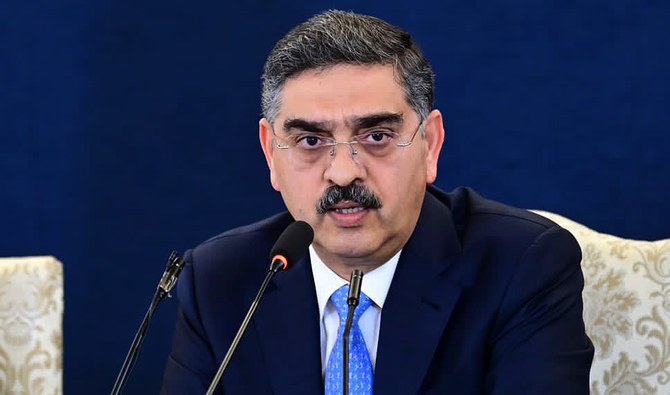
ISLAMABAD: Caretaker Prime Minister Anwaar-ul-Haq Kakar said the “gruesome murder” of a Sikh separatist leader in Canada months ago had jolted the West, which was now questioning the involvement of the Indian state in the incident, the state-run Associated Press of Pakistan (APP) said in a report on Saturday.
Canadian Prime Minister Justin Trudeau last Monday infuriated New Delhi when he said his country had “credible intelligence” Indian agents were involved in Sikh separatist leader Hardeep Singh Nijjar’s killing in June this year.
Trudeau’s comments sparked off a diplomatic row between Ottawa and New Delhi, with both states expelling senior diplomats from each other’s countries following the accusations. Pakistan’s foreign ministry said on Wednesday that Nijjar’s killing was a violation of international law and showed New Delhi’s “network of extra-territorial killings” had gone global.
“Caretaker Prime Minister Anwaar-ul-Haq Kakar on Friday said that the gruesome murder of Khalistan Movement Sikh leader in Canada had jolted the West that raised serious questions about the role of Indian state,” the APP said, adding that the prime minister was speaking at the Pakistan Mission in New York.
Kakar said Pakistan had been a victim of such “state-sponsored terrorism” and that he had shared evidence of the same at different global and multilateral fora. The Pakistani prime minister said it was probably the first incident of its kind after World War I in which an Asian country had staged a “physical murder” on European soil.
The Pakistani premier said the killing’s impact was being felt across Western countries which were now realizing the extent to which India targets its minorities.
“The prime minister opined that an alliance should be formed to check such ‘rough behavior’ of India,” APP said.
During his address to the UN General Assembly on Friday, Kakar spoke about Pakistan’s relations with its nuclear-armed neighbor, saying that his country desired “peaceful and productive” relations with all neighbors including India.
“Global powers should convince New Delhi to accept Pakistan’s offer of mutual restraint on strategic and conventional weapons,” he said, adding that the disputed Kashmir region provided the key to peace between the two neighboring states.
He also spoke about the rising threat posed by “far-right extremist and fascist groups such as Hindutva inspired extremists threatening genocide against Indian Muslims and Christians alike.”


![]()

Pakistan PM says Sikh separatist leader’s killing, linked to India, ‘jolted’ West
Short Url
https://arab.news/php2n
Pakistan PM says Sikh separatist leader’s killing, linked to India, ‘jolted’ West
- Canada’s PM said last week his government has ‘credible intelligence’ Indian agents were involved in Sikh activist’s killing
- Pakistan’s Caretaker PM Anwaar-ul-Haq Kakar says an alliance should be formed to check India’s ‘rough behavior’
Latest updates


© 2026 SAUDI RESEARCH & PUBLISHING COMPANY, All Rights Reserved And subject to Terms of Use Agreement.