US says it expects India to work with Canada on murder case

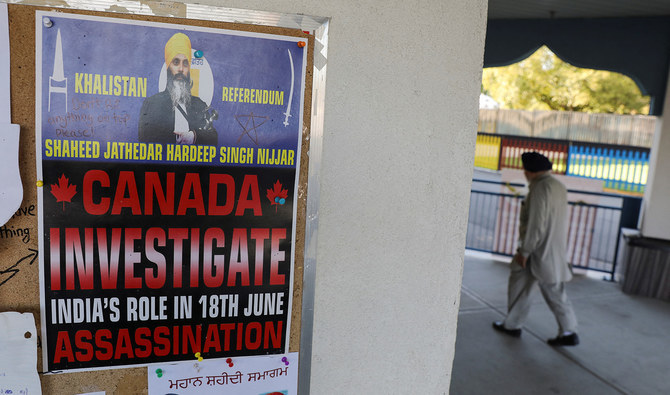
A sign asking for an investigation on India's role in the killing of Sikh leader Hardeep Singh Nijjar is seen at the Guru Nanak Sikh Gurdwara temple, in Surrey, British Columbia, Canada on September 20, 2023. (REUTERS)
Short Url
Updated 23 September 2023
Follow

US says it expects India to work with Canada on murder case

  • Canada said last week it had ‘credible intelligence’ linking Indian agents to murder of Sikh separatist leader 
  • Canadian Prime Minister Justin Trudeau said Ottawa had shared intelligence with New Delhi ‘many weeks ago’

WASHINGTON/OTTAWA: The United States made clear on Friday that it expected the Indian government to work with Canada on efforts to investigate the possible involvement of New Delhi agents in the murder of a Canadian citizen in June.
Prime Minister Justin Trudeau said on Monday that Ottawa had credible intelligence linking Indian agents to the murder of Sikh separatist leader Hardeep Singh Nijjar, prompting an angry reaction from New Delhi, which denies the allegation.
“We are deeply concerned about the allegations that Prime Minister Trudeau has raised,” US Secretary of State Antony Blinken told reporters in a press briefing.
 “It would be important that India work with the Canadians on this investigation. We want to see accountability.”
The White House has spoken of its concerns over the allegations, but Blinken is the most senior US official to have commented thus far.
Traditional Canadian allies, including the United States, appeared to take a cautious approach to the matter earlier this week.
Political analysts said this was partly because the United States and other major players see India as a counterweight to the growing influence of China.
“We have been consulting throughout very closely with our Canadian colleagues, not just consulting but coordinating with them on this issue,” Blinken said.
During a press conference Trudeau was asked about the allegations, and he repeated his call for the Indian government to cooperate.
“We are there to work constructively with India. We hope that they engage with us so that we can get to the bottom of this very serious matter,” Trudeau said.
On Friday, Trudeau also said Canada shared its concerns with New Delhi some time ago.
“Canada has shared the credible allegations that I talked about on Monday with India. We did that many weeks ago,” Trudeau told reporters.
The Canadian government has amassed both human and signals intelligence in a months-long investigation into the Sikh separatist leader’s murder, CBC News reported separately on Thursday citing sources.
The report said the intelligence included communications of Indian officials present in Canada, adding some of the information was provided by an unidentified ally in the Five Eyes alliance.
Five Eyes is an intelligence-sharing network that includes the US, the UK, Canada, Australia and New Zealand.
However, Trudeau has not provided any details about what Canada’s spy agencies have collected, and his office has not confirmed or denied the CBC report.
Senior Canadian government sources have said that Trudeau would not have spoken publicly without having a high level of confidence in the intelligence.



Trump administration reaches a trade deal to lower Taiwan’s tariff barriers

Updated 3 sec ago
Follow

Trump administration reaches a trade deal to lower Taiwan’s tariff barriers

  • The gap reached nearly $127 billion in the first 11 months of 2025. US officials attended the signing through the American Institute in Taiwan
  • The deal comes ahead of President Donald Trump’s planned visit to China in April and suggests a deepening economic relationship between the US and Taiwan
WASHINGTON: The Trump administration reached a trade deal with Taiwan on Thursday, with Taiwan agreeing to remove or reduce 99 percent of its tariff barriers, the office of the US Trade Representative said.
The agreement comes as the US remains reliant on Taiwan for its production of computer chips, the exporting of which contributed to a trade imbalance of nearly $127 billion during the first 11 months of 2025, according to the Census Bureau.
Most of Taiwan’s exports to the US will be taxed at a 15 percent rate, the USTR’s office said. The 15 percent rate is the same as that levied on other US trading partners in the Asia-Pacific region, such as Japan and South Korea.
Trade Representative Jamieson Greer and Commerce Secretary Howard Lutnick attended the signing of the reciprocal agreement, which occurred under the auspices of the American Institute in Taiwan and the Taipei Economic and Cultural Representative Office in the United States. Taiwan’s Vice Premier Li-chiun Cheng and its government minister Jen-ni Yang also attended the signing.
“President Trump’s leadership in the Asia-Pacific region continues to generate prosperous trade ties for the United States with important partners across Asia, while further advancing the economic and national security interests of the American people,” Greer said in a statement.
The Taiwanese government said in a statement that the tariff rate set in the agreement allows its companies to compete on a level field with Japan, South Korea and the European Union. It also said the agreement “eliminated” the disadvantage from a lack of a free trade agreement between Taiwan and the US
The deal comes ahead of President Donald Trump’s planned visit to China in April and suggests a deepening economic relationship between the US and Taiwan.
Taiwan is a self-ruled democracy that China claims as its own territory, to be annexed by force if necessary. Beijing prohibits all countries it has diplomatic relations with — including the US — from having formal ties with Taipei.
Cheng said Taiwan hopes the agreement will make it a strategic partner with the US “so as to jointly consolidate the democratic camp’s leading position in high technology.”
The agreement would make it easier for the US to sell autos, pharmaceutical drugs and food products in Taiwan. But the critical component might be that Taiwanese companies would invest in the production of computer chips in the US, possibly helping to ease the trade imbalance.
In a separate but related deal, Taiwan will make investments of $250 billion in US industries, such as computer chips, artificial intelligence applications and energy. The Taiwanese government says it will provide up to an additional $250 billion in credit guarantees to help smaller businesses invest in the US
The investments helped enable the US to reduce its planned tariffs from as much as 32 percent initially to 15 percent.
Taiwan’s government said it will submit the reciprocal trade deal and investment plans to its legislature for approval.
In Taipei, President Lai Ching-te told reporters that Taiwan had agreed to reduce tariffs on imports from the US but stressed that the rate on 93 items would remain unchanged to protect important agriculture and industrial sectors such as rice farming.
The US side said the deal with Taiwan would help create several “world-class” industrial parks in America in order to help build up domestic manufacturing of advanced technologies such as chips. The Commerce Department in January described it as “a historic trade deal that will drive a massive reshoring of America’s semiconductor sector.”
In return, the US would give preferential treatment to Taiwan regarding the possible tariffs stemming from a Section 232 investigation of the importing of computer chips and semiconductor manufacturing equipment.
TSMC, the chip-making giant, is expected to be the key investor. It has committed to $165 billion in investments in the US, including not only fabrication plants but also a major research and development center that would help build a supply chain to power US artificial intelligence ambitions. Major US tech companies such as Nvidia and AMD rely on TSMC for manufacturing highly advanced chips.
When asked whether investing in the US would endanger Taiwan’s most advanced industries, Lai said: “Whether it’s TSMC or other industries, as long as their R&D centers are in Taiwan, their advanced manufacturing processes are in Taiwan and their largest production volume is in Taiwan, Taiwan can continue to develop steadily.”
Taiwan said the investments will be two-way, with US companies also investing in key Taiwanese industries. Nvidia this week signed a land deal in Taipei to build a headquarters office there.