US, UK signal support for EU windfall tax plan on using frozen Russian assets for Ukraine reconstruction

1 / 2
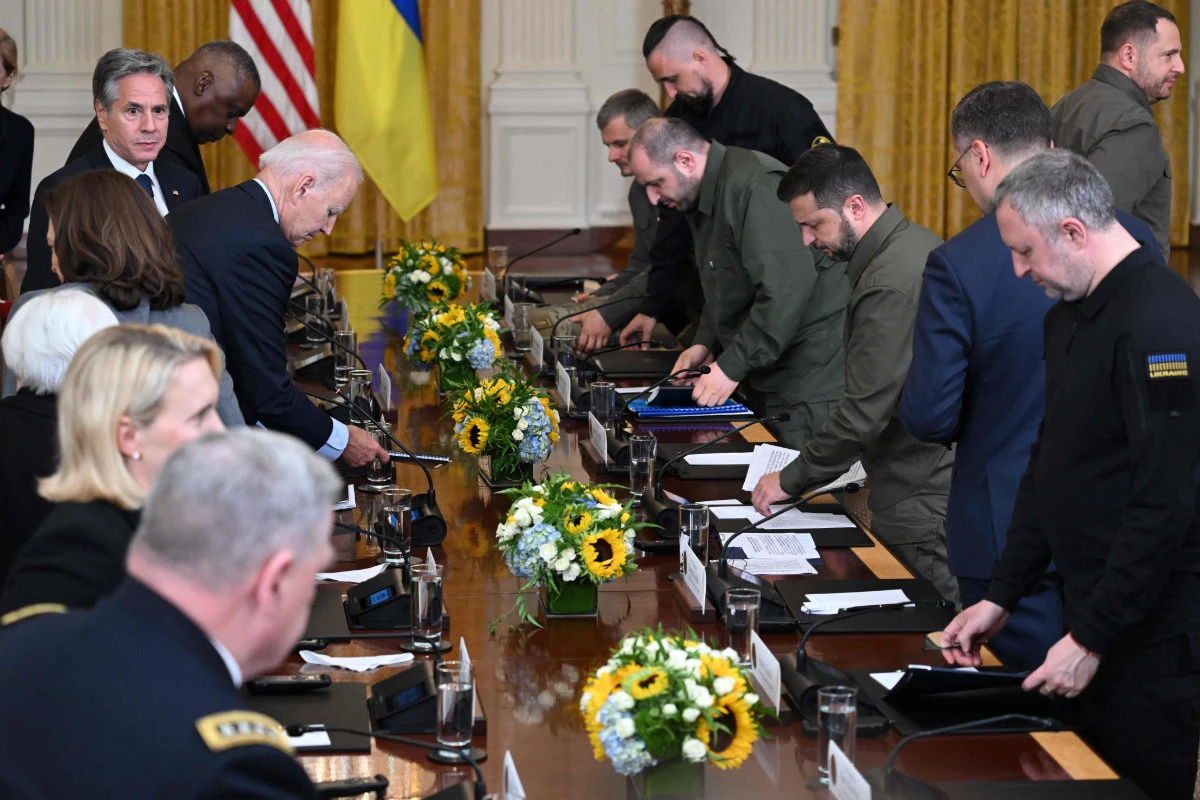
US President Joe Biden and Ukrainian President Volodymyr Zelensky arrive for an expanded bilateral meeting at the White House in Washington on September 21, 2023. (AFP)
2 / 2
Defense Secretary Lloyd Austin, top left, arrives with President Joe Biden, Vice President Kamala Harris, second from right, Secretary of State Antony Blinken, right, and Treasury Secretary Janet Yellen, bottom left, for a meeting with Ukrainian President Volodymyr Zelenskyy, not pictured, at the White House on Sept. 21, 2023, in Washington. (AP)
Short Url
Updated 22 September 2023
Follow

US, UK signal support for EU windfall tax plan on using frozen Russian assets for Ukraine reconstruction

  • Per EU estimates, windfall profit from Russia’s frozen assets in Europe could provide $3.27 billion a year to rebuild Ukraine
  • British FM says Russia must be made to bear the costs of reconstruction of Ukraine as a consequence of its invasion

WASHINGTON: US Treasury Secretary Janet Yellen and British Finance Minister Jeremy Hunt signaled support on Thursday for a European Union plan to impose a windfall tax on profits generated by frozen Russian sovereign assets to help finance the reconstruction of Ukraine.

A Treasury spokesperson said Yellen called the EU plan a “sensible” proposal.

Yellen, who discussed frozen Russian assets with Ukrainian officials during her visit to Kyiv in February, told Bloomberg News reporters and editors that Washington was discussing the idea with the EU, the spokesperson said.
Hunt told Reuters in a telephone interview from Los Angeles that he supported the EU’s idea of diverting interest earnings from the assets to Ukraine’s reconstruction.
“We have to find a way that doesn’t have unintended consequences,” Hunt said. “And I think the most interesting discussions are really about how to use the interest income generated by (frozen) assets to go toward that reconstruction without actually seizing the assets themselves.”
But Hunt said it was important to ultimately force Russia to bear the costs of reconstruction of Ukraine as a consequence of its invasion and “to make it clear to Russia that those assets are frozen until there’s a fair settlement made with the reconstruction costs.”
Yellen has repeatedly voiced support for Ukrainian demands that Russia should pay for the damage it has done to Ukraine, but has also pointed to significant legal obstacles halting moves to fully seize the $300 billion in Russian central bank assets frozen by sanctions.
EU officials have estimated that the windfall profit from Russia’s frozen assets in Europe could provide 3 billion euro ($3.27 billion) a year to rebuild Ukraine.

British FM says it was important to ultimately force Russia to bear the costs of reconstruction of Ukraine as a consequence of its invasion
Modi starts Mideast-Africa tour as India-Oman free-trade pact nears completion

Updated 6 sec ago
Follow

Modi starts Mideast-Africa tour as India-Oman free-trade pact nears completion

  • Oman’s Shoura Council approved the trade deal’s draft last week
  • Modi begins trip in Amman, heading to Addis Ababa and Muscat

NEW DELHI: Prime Minister Narendra Modi left New Delhi on Monday for a tour covering Jordan, Oman and Ethiopia, as his government looks to strengthen partnerships with West Asia and Africa and finalize a free-trade deal with Muscat.

Modi’s four-day trip will start in Amman, at the invitation of King Abdullah.

“I am sure this visit will boost bilateral linkages between our nations,” Modi said on social media upon his arrival in Jordan, where he was received by Prime Minister Jafar Hassan.

On Tuesday, he is scheduled to arrive in Addis Ababa for his first state visit to Ethiopia. A day later, he will be in Muscat, where the Shoura Council last week approved the draft Comprehensive Economic Partnership Agreement with India.

“If it is signed during this visit, it will significantly deepen the economic ties between India and Oman. And it will open up a new chapter in the history of India-Oman trade and commercial relationship,” Ministry of External Affairs Secretary Arun Chatterjee told reporters ahead of Modi’s departure.

He said Modi would be accompanied by a high-level delegation for his second visit to Oman, after his last trip in February 2018. It also follows the visit of Oman’s Sultan Haitham bin Tariq to India in December 2023.

Free-trade negotiations between India and Oman began in November 2023, with the first round in New Delhi and the second in Muscat.

When the talks concluded in March 2024, Oman sought revisions on market-access terms and the final signature was postponed.

Announcements of the deal’s possible finalization have been made in the past few months by India’s Commerce and Industry Minister Piyush Goyal and the Omani ambassador to New Delhi, Issa Saleh Al-Shibani.

It would be its second with a GCC country after a 2022 trade deal with the UAE, as India has been trying to reach a similar agreement with the whole bloc.

“The framework is expected to be the same as the UAE’s, that is, a Comprehensive Economic Partnership Agreement. This is significant given that the progress on India-GCC FTA has been slow and non-consequential so far,” said Muddassir Quamar, associate professor at the School of International Studies, Jawaharlal Nehru University.

While Oman is one of Delhi’s smaller GCC trading partners — trailing behind the UAE and Saudi Arabia, with bilateral trade about $10 billion — it remains strategically important, particularly in energy and logistics.

“The FTA is likely to give a boost to India-Oman economic and trade relations, especially of goods and services. (It is) important given India has worked to enhance its trade and economic relations with the Gulf countries that are (among) the most dynamic and fast-expanding global economies,” Quamar told Arab News.

“It is also important because there is immense potential for Indian businesses and industries to partner with their Gulf and Omani partners in contributing to the diversification and economic growth plans.”