PIF-backed Lucid Motors gets permit to operate manufacturing unit in KAEC

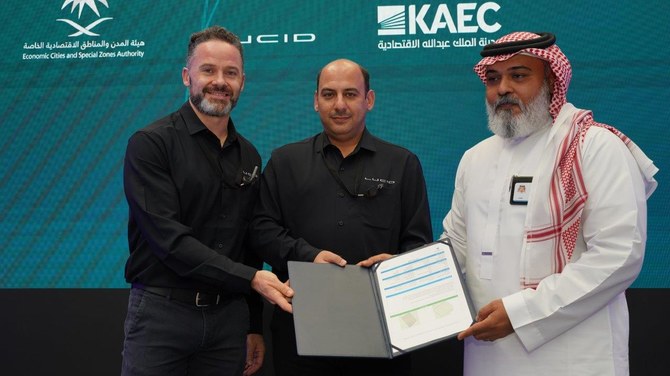
A ceremony was organized at the authority’s offices in KAEC to mark the development, according to an official press release. Photo/Supplied
Short Url
Updated 21 September 2023
Follow

PIF-backed Lucid Motors gets permit to operate manufacturing unit in KAEC

RIYADH: In a significant move toward economic diversification and revolutionizing the national transportation landscape, the Economic Cities and Special Zones Authority has granted Lucid Motors a permit to operate a manufacturing unit in King Abdullah Economic City.

A ceremony was organized at the authority’s offices in KAEC to mark the development, according to an official press release.

Lucid Motors, backed by the Public Investment Fund, is delivering its first factory outside the US, which will make up half of the Kingdom’s plan to produce 300,000 vehicles annually by 2030.

The megacity has a ready-built residential infrastructure for the future employees of Lucid Motors, which includes schools and recreational and entertainment avenues.

The city has also heavily invested in sustainability which could be a destination of choice for companies conscious of their environmental commitments.

Commenting on the development, ECZA Secretary-General Nabil Khojah said: “The establishment of a world-class e-vehicle manufacturing unit at KAEC SEZ in a short time frame demonstrates the efficiency, capabilities, and strengths of the special economic zones in the Kingdom.”

He said it is also a testament to the Kingdom’s environment conducive to business activities. “Today, we take a step toward

creating a futuristic transportation landscape while reducing emissions and promoting clean and sustainable mobility.”

Faisal Sultan, Lucid vice president, and Middle East managing director, said: “As the Kingdom’s first-ever e-vehicle manufacturing facility and Lucid’s first international plant, the facility will pave the way and set the standard for the automotive industry and provide the Saudi Arabian market with game-changing, advanced Saudi-assembled e-vehicles. As we collectively work toward Vision 2030 and a more sustainable and diversified economy, we look forward to attracting, training, and retaining a brand-new workforce of automotive professionals.”

The EV manufacturer aims to export 85 percent of its production outside the Kingdom, benefiting from the city’s port located on the Red Sea.

Cyril Piaia, CEO of Emaar, The Economic City – master developer of KAEC, said: “We are very confident that Lucid will play a major role in helping us to achieve our goal of becoming the automotive capital of the region and will also have a positive impact on the local economy, creating jobs, promoting technological advancements, and attracting new investments to KAEC.”

The state-of-the-art facility spans an expanse of over 1.35 million sq. meters, occupying about 31 percent of the total area of the KAEC SEZ’s auto hub, a designated area allocated for the automotive industry.


Industry leaders highlight Riyadh’s Metro, infrastructure as investment catalysts

Updated 29 December 2025
Follow

Industry leaders highlight Riyadh’s Metro, infrastructure as investment catalysts

RIYADH: Saudi Arabia’s capital, Riyadh, is experiencing a transformative phase in its real estate sector, with the construction market projected to reach approximately $100 billion in 2025, accompanied by an anticipated annual growth rate of 5.4 percent through 2029.

The Kingdom is simultaneously advancing its data center capacity at an accelerated pace, with an impressive 2.7 GW currently in the pipeline. This expansion underscores the critical role of strategic land and power planning in establishing national infrastructure as a cornerstone of economic growth.

These insights were shared by leading industry experts during JLL’s recent client event in Riyadh, which focused on the city’s macroeconomic landscape and emerging trends across office, residential, retail, hospitality, and pioneering sectors, including AI infrastructure and Transit-Oriented Development.

Saud Al-Sulaimani, Country Lead and Head of Capital Markets at JLL Saudi Arabia, commented: “Riyadh is positioned at the forefront of Saudi Arabia’s Vision 2030, offering unparalleled opportunities for both investors and developers. National priorities are continuously recalibrated to ensure strategic alignment of projects and foster deeper collaboration with the private sector.”

He added: “Recent regulatory developments, including the introduction of the White Land Tax and the rent freeze, are designed to stabilize the market and are expected to drive renewed focus on delivering premium-quality assets. This dynamic environment, coupled with evolving construction cost considerations in select segments, is fundamentally reshaping the market landscape while accelerating progress toward our national objectives.”

The event further underscored the transformative impact of infrastructure initiatives. Mireille Azzam Vidjen, Head of Consulting for the Middle East and Africa at JLL, highlighted Riyadh’s transit revolution. She detailed the Riyadh Metro, a $22.5 billion investment encompassing 176 kilometers, six lines, and 84 stations, providing extensive geographic coverage, with a depth of 9.8 km per 100 sq. km. This strategic development generates significant TOD opportunities, with properties in proximity potentially commanding a 20-30 percent premium. JLL emphasized the importance of implementing climate-responsive last-mile solutions to enhance mobility and accessibility, particularly given Riyadh’s extreme temperatures.

Gaurav Mathur, Head of Data Centers at JLL, emphasized the rapid expansion of the Kingdom’s AI infrastructure, signaling a critical area for technological investment and innovation.

Focusing on the construction sector, Maroun Deeb, Head of Projects and Development Services, KSA at JLL, explained that the industry is actively navigating complexities such as skilled labor availability, material costs, and supply chain dynamics.

He highlighted the adoption of Building Information Modeling as a key driver for enhancing operational efficiency and project delivery.