

Canada and United States worked closely on possible India link to Sikh leader’s assassination

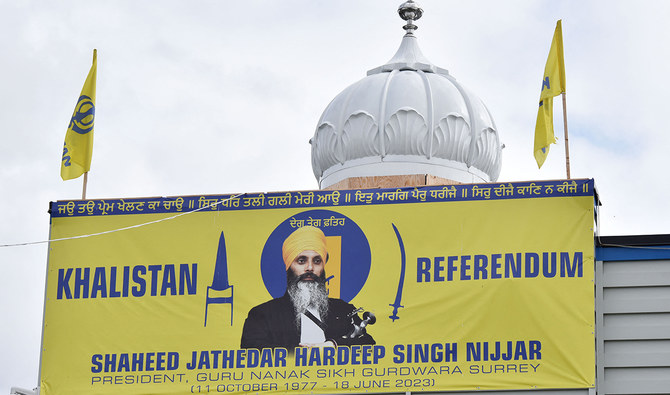
An image of former Gurdwara President Jathedar Hardeep Singh Nijjar is displayed at the Guru Nanak Sikh Gurdwara temple in Surrey, British Columbia, Canada, on September 19, 2023. (AFP)
Short Url
Updated 20 September 2023
Follow

Canada and United States worked closely on possible India link to Sikh leader’s assassination

  • A Canadian official says his country will share the evidence in its possession ‘in due course’ after politicians demand to see it
  • The Canada-India spat has already thrown cold water on trade talks in October which Trudeau’s administration called off last week

OTTAWA: Canada worked “very closely” with the United States on intelligence that Indian agents had been potentially involved in the murder of a Sikh leader in British Columbia earlier this year, a senior Canadian government source said on Tuesday.

Prime Minister Justin Trudeau announced on Monday that domestic intelligence agencies were actively pursuing credible allegations tying New Delhi’s agents to the shooting of Hardeep Singh Nijjar, 45, in June.

“We’ve been working with the US very closely, including on the public disclosure yesterday,” the source said. The evidence in Canada’s possession would be shared “in due course,” said the official who spoke on condition of anonymity due to the sensitivity of the information.

Trudeau on Tuesday told reporters that the case had far-reaching consequences in international law, and urged the Indian government to take the matter seriously and help Canada fully investigate the matter.

India quickly dismissed Trudeau’s assertion as absurd, and said it was expelling a Canadian diplomat, a tit-for-tat move after Canada expelled India’s top intelligence figure on Monday.

The dispute deals a fresh blow to diplomatic ties that have been fraying for years, with New Delhi unhappy over Sikh separatist activity in Canada.

“I would expect that normal discussions between the two governments will be difficult while this issue is being resolved,” said Roland Paris, Trudeau’s former foreign policy adviser and a professor of international affairs at the University of Ottawa.

US authorities, earlier on Tuesday, said they supported Canada’s investigation.

“We have been in close contact with our Canadian colleagues about this. We’re quite concerned about the allegations. We think it’s important there is a full and open investigation, and we would urge the Indian Government to cooperate with that investigation,” a senior State Department official said.

Now some, including Canada’s Conservative opposition leader, Pierre Poilievre, are urging Trudeau to show the evidence that the government has in hand.

Jesse Singh, founder and chairman of the community group, Sikhs of America, told an event hosted by Washington’s Hudson Institute think tank that Trudeau has failed to provide any proof.

“It’s just something that he said is a ‘credible allegation,’ with no proof at all. And I think we’ll have to wait to see if there is any proof there and then I think further decisions can be taken,” Singh added.

The spat has already thrown cold water on trade talks, which have been paused, and Canada last week called off a major trade mission scheduled for October.

A second Canadian source familiar with the situation said that both the pause in the trade talks and the delay of the trade mission were due to the concerns surrounding the murder of the Canadian.

New Delhi, which has urged Ottawa to act against anti-Indian elements, has long been unhappy over Sikh separatist activity in Canada.

Nijjar supported creating a Sikh homeland in the form of an independent, so-called state of Khalistan in India’s northern state of Punjab, the birthplace of the Sikh religion, which borders Pakistan. India designated him as a “terrorist” in 2020.


Cuba says attacking speedboat had nearly 13,000 rounds of ammunition

Updated 9 sec ago
Follow

Cuba says attacking speedboat had nearly 13,000 rounds of ammunition

  • Firefight took place at a range of 20 meters, Cuba says
  • Incoming crew originally ‌set out on two vessels but ditched one
HAVANA: A commando of Cuban exiles who intended to infiltrate Cuba on a speedboat was armed with nearly 13,000 rounds of ammunition, 13 rifles and 11 pistols, Cuban officials said on Friday, providing new details about Wednesday’s deadly exchange of gunfire at sea. The government in Havana has said 10 Cuban nationals coming from the United States entered Cuban waters and opened fire on a border guard vessel, leading Cuban forces to return fire killing four and wounding six others, who were taken into custody.
In an attempt to dispel doubts about its account to date, senior Cuban Interior Ministry officers displayed the captured armaments from the studio on a special television program, including bins full of at least some of the 12,846 recovered rounds. They also showed pictures of the vessels, each peppered with bullet holes from ‌the firefight they ‌said took place at a range of 20 meters (66 feet).
The confrontation took place ‌at ⁠a fraught moment ⁠in US-Cuban relations, with US President Donald Trump pressuring the island by imposing a virtual oil blockade after capturing and ousting Venezuelan President Nicolas Maduro, a crucial Cuban ally, on January 3.
Cuba has identified the assailants as Cuban exiles, some of whom had been previously placed on a list of accused terrorists, who came from the United States with the intent to sow chaos and attack military units on the Communist-ruled island.
“The intent of this group is to infiltrate, to promote public disorder. To incite the people to unite. To carry out something violent. Attack military units ⁠in order to incite social unrest and to unite the people in order to ‌steal the revolution. That has been duly proven,” said Col. Victor Alvarez ‌of the Interior Ministry.
Cuba says response ‘proportional’
US politicians have expressed skepticism over Cuba’s version of events. Secretary of State Marco ‌Rubio on Wednesday said his government would independently investigate, adding that it was not a US operation and ‌that no US government personnel were involved.
Cuban officers said the infiltrators set out from Marathon in the Florida Keys on two vessels but ditched one at some point due to technical difficulties. They united on one speedboat, which a US official said was reported stolen in Florida. Cuba said it recovered a drone, radios, knives, a portable power plant, bolt cutters and ‌other materiel. They also found emblems of the November 30th Movement and People’s Self-Defense, anti-communist groups that oppose the Cuban government.
Cuba says a patrol of five ⁠border guard members on ⁠a 9-meter boat spotted the incoming vessel shortly after 7 a.m., with some members of the incoming crew in the water, about one nautical mile off a cay on the Caribbean island’s northern coast, about 100 miles (160 km) from Marathon.
The infiltrators opened fire at a distance of 185 meters, striking the captain of the Cuban vessel in the abdomen, Cuba said. Bleeding heavily, the wounded captain remained at the helm and steered toward the enemy vessel, leading to a firefight at a distance of about 20 meters, the officers said.
Cuba called its response “proportional.”
“It is a defensive model that practically never uses firearms, and the use of firearms is proportional to the type of action being carried out against our force,” said Interior Ministry Col. Ybey Carballo.
The captured Cuban nationals were receiving medical care and face charges including armed aggression, illegal entry into national territory, crimes associated with terrorist acts, and arms trafficking, prosecutor Edward Robert Campbell told the program. He said they face prison terms of up to 10 to 15 years for the lesser offenses and 20 to 30 years — or even the death penalty — for the more serious charges.