

Pakistani foreign minister briefs Saudi counterpart on special body to attract investment from Middle East

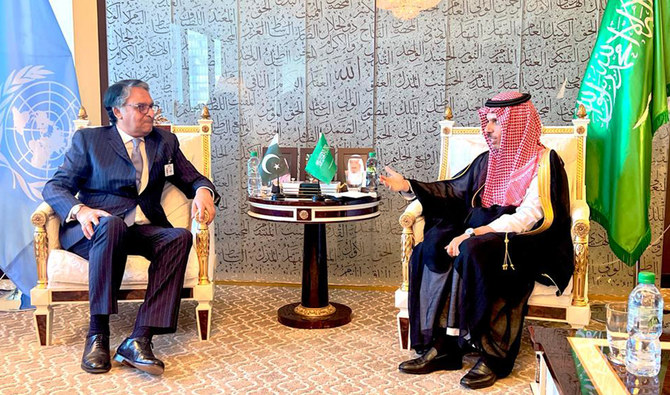
Pakistan’s foreign minister Jalil Abbas Jilani (right) meets Prince Faisal bin Farhan Al Saud, Foreign Minister of Saudi Arabia, on the sidelines of the 78th United Nations General Assembly session in New York, USA, on September 19, 2023. (Photo courtesy: Foreign Office)
Short Url
Updated 20 September 2023
Follow

Pakistani foreign minister briefs Saudi counterpart on special body to attract investment from Middle East

  • Jalil Abbas Jilani says the two countries should fast-track cooperation in areas like IT, energy, infrastructure and labor
  • The foreign minister also says his country eagerly looks forward to the visit of Crown Prince Mohammed bin Salman

ISLAMABAD: Pakistan’s foreign minister Jalil Abbas Jilani briefed his Saudi counterpart about his country’s initiative to set up a special body to attract investment from the Middle East and other regions while holding a meeting on the sidelines of the 78th United Nations General Assembly session on Tuesday.

The formation of the Special Investment Facilitation Council (SIFC) was announced by the office of former prime minister Shehbaz Sharif in June to get investment in various sectors, including energy, information technology, minerals, defense and agriculture.

The council seeks to adopt a “unified approach” to the national economy by bringing the top civilian and military leaders, including the army chief, on board to steer the country out of perennial financial crisis.

Jilani explained the working of SIFC to Prince Faisal bin Farhan Al Saud during the conversation while emphasizing the need to fast-track mutually rewarding cooperation in areas like IT, energy, infrastructure and labor.

“Both Foreign Ministers emphasized the vital importance of Pakistan-Saudi Arabia relations and agreed to further deepen mutual cooperation in all fields, especially economy, trade, energy and investment,” the foreign office of Pakistan said in a statement released after the meeting.

“The Foreign Minister [Jilani] apprised His Highness about formation of Special Investment Facilitation Council (SIFC) to facilitate and fast-track potential investments from GCC [Gulf Cooperation Council] Member States, especially the Kingdom of Saudi Arabia,” it added.

The Pakistani FM also thanked Saudi Arabia for its generous and unwavering support, saying it was instrumental in securing a $3 billion bailout package from the International Monetary Fund (IMF) amid a major dollar liquidity crunch.

He also thanked the Saudi foreign minister for hosting over two million strong Pakistani diaspora and reiterated that his country eagerly looked forward to the visit of Crown Prince Mohammed bin Salman.

Pakistan and Saudi Arabia have always enjoyed close defense and diplomatic relations.

The two countries agreed to broaden and deepen their bond by setting up the Saudi-Pakistan Supreme Coordination Council to provide a strategic direction to their relationship.


Pakistan president meets UAE counterpart, explores trade, investment opportunities

Updated 27 January 2026
Follow

Pakistan president meets UAE counterpart, explores trade, investment opportunities

  • Asif Ali Zardari is in UAE on four-day visit to strengthen bilateral ties, review bilateral cooperation
  • Both sides discuss regional, international developments, reaffirm commitment to promote peace

ISLAMABAD: President Asif Ali Zardari met his UAE counterpart Sheikh Mohammed bin Zayed Al-Nahyan in Abu Dhabi on Tuesday during which both sides explored new opportunities in trade, investment, energy and other sectors, Zardari's office said. 

Zardari arrived in Abu Dhabi on Monday evening with a high-level delegation on a four-day official visit to the UAE to review trade, economic and security cooperation. 

"The leaders discussed ways to further deepen the longstanding and brotherly relations between Pakistan and the UAE," a statement from Zardari's office said about his meeting with the UAE president. 

"They reviewed the full spectrum of bilateral cooperation and explored new opportunities in trade, investment, energy, infrastructure, technology, and people-to-people exchanges, highlighting the significant potential for expanding economic and strategic partnership.

Zardari highlighted the significance of Al-Nayhan's visit to Pakistan last month, the statement said, expressing appreciation for the UAE's continued support for strengthening bilateral ties.

It said both sides also exchanged views on a range of regional and international developments, reaffirming their commitment to promoting peace, stability and sustainable development.

The meeting was also attended by Pakistan's First Lady Aseefa Bhutto-Zardari, the Pakistani president's son Bilawal Bhutto-Zardari, who is also the chairman of the Pakistan Peoples Party, Interior Minister Mohsin Naqvi and Pakistan's ambassador to the UAE. 

ZARDARI MEETS AD PORTS CEO

Zardari earlier met AD Ports Group CEO Captain Mohamed Juma Al-Shamisi to discuss the group's investment initiatives in Karachi. 

"Both sides agreed that the expansion and modernization of port infrastructure would strengthen trade flows and support Pakistan’s broader economic development and country’s seaborne trade," the President's Secretariat said in a statement.

It added that Zardari described the AD Ports Group's long-term investment and expanding role in Pakistan's maritime and logistics sector as a key pillar of Pakistan–UAE economic cooperation.

Pakistan and the UAE maintain close political and economic relations, with Abu Dhabi playing a pivotal role in supporting Islamabad during periods of financial stress through deposits, oil facilities and investment commitments. 

The UAE is Pakistan's third-largest trading partner, after China and the United States, and a key destination for Pakistani exports, particularly food, textiles and construction services.

The Gulf state is also home to more than 1.5 million Pakistani expatriates, one of the largest overseas Pakistani communities in the world, who contribute billions of dollars annually in remittances, a crucial source of foreign exchange for Pakistan’s economy.

Beyond trade and labor ties, Pakistan and the UAE have steadily expanded defense and security cooperation over the years, including military training, joint exercises and collaboration in counter-terrorism and regional security matters.