How Saudi business environment was reinvigorated by structural and legal reforms

1 / 7
Multinational companies (MNCs) receive licenses to move their regional headquarters to Riyadh. (RCRC)
2 / 7
As a response to Riyadh’s position as the region’s largest city economy: 44 multinational companies choose to open regional headquarters in the capital. (RCRC)
3 / 7
FII 2022. (AN Photo/Basheer Saleh)
4 / 7
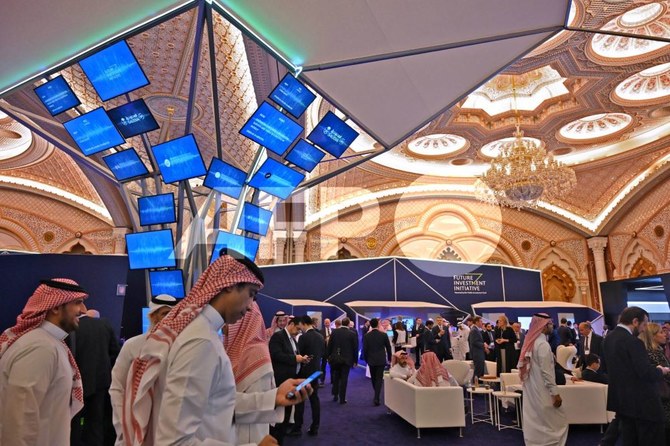
Saudi and foreign journalists are pictured at the Future Investment Initiative (FII) forum at the King Abdulaziz Conference Centre in Saudi Arabia's capital Riyadh on October 29, 2019. (AFP)
5 / 7
Amazon’s offices in Riyadh. (Supplied)
6 / 7
Amazon’s offices in Riyadh. (Supplied)
7 / 7
Microsoft’s offices in Riyadh. (Supplied)
Short Url
Updated 23 September 2023
Follow

How Saudi business environment was reinvigorated by structural and legal reforms

  • Incentives and new rules encourage foreign companies to establish their headquarters in the Kingdom
  • Saudi Arabia is determined to become one of the most sought-after destinations for businesses

RIYADH: Saudi Arabia is all set to become one of the most sought-after destinations for businesses thanks to the ongoing structural and legal reforms led by economic goals outlined in the Kingdom’s Vision 2030 blueprint.

From providing tax benefits for foreign companies establishing their headquarters in the Kingdom to offering special incentives, Saudi Arabia is slowly but steadily emerging as the hot spot for businesses in the Middle East and North Africa region.

According to official figures, 44 international companies have already moved their regional headquarters to Saudi Arabia. The prospects are improving, with at least 80 firms being issued regulatory clearances to establish their offices in the Kingdom.

According to Talat Hafez, an economic and financial analyst, Saudi Arabia’s regional headquarters program aims to increase foreign direct investments and bolster the economy.

“It will help the Saudi treasury by a number of factors. It will widen the business market in the Kingdom, create purchasing power and enhance Saudi Arabia’s export capabilities, especially when considering the diversity of the businesses these companies are bringing,” said Hafez.

In recent months, several noted firms, including PwC Middle East and Egypt’s Intella, inaugurated their regional headquarters in Saudi Arabia, indicating Saudi Arabia’s investment-friendly evolution.

Hafez added that establishing regional headquarters by foreign companies in Saudi Arabia could help local talents hone their skills.

“Saudi economy will benefit from the transfer of the know-how and job creation for Saudi nationals, while the companies will benefit from the increase in their businesses and sales, especially since more than 80 percent of their revenues in the region are generated from Saudi Arabia,” Hafiz said.

According to Hafiz, Riyadh is the most preferred location for foreign companies that wish to open their regional headquarters in Saudi Arabia, as the capital city contributes over 45 percent to the non-oil gross domestic product of the Kingdom.

Hafiz further noted that companies that wish to open their regional headquarters in Saudi Arabia will not face any challenges.

“I don’t believe that they will face any difficulties or challenges, simply because most of the companies, if not all who are considering moving their regional offices to the Kingdom, they were already operating in Saudi Arabia and they have longstanding experience of the way of doing business in the Kingdom,” added Hafiz.

To further accelerate the inflow of foreign direct investments to Saudi Arabia, Prime Minister Crown Prince Mohammed bin Salman, in May, announced the launch of four special economic zones in Riyadh, Jazan, Ras Al-Khair and King Abdullah Economic City, north of Jeddah.

These economic zones will be crucial in providing foreign investors with the support required for vital and promising sectors, such as technology, logistics and industry.

“These zones provide and grant foreign investors with a number of business opportunities and concessions that allow them to do business smoothly in the Kingdom, which includes the relaxation of Saudization requirements and other investment motivations,” added Hafez.

Affirming Saudi Arabia’s evolution in emerging as a global trade hub, total anchor investments in its four special economic zones reached SR47.2 billion ($12.6 billion) as of May,

Even though Saudization requirements are relaxed in these zones, foreign companies that employ Saudis will get special incentives.

“The incentives were decided after a very careful study of regional and global benchmarks. One of these incentives, which is very important, probably to investors, is the exemption from Saudization requirements. Yet, they will receive the requirements from HRDF if they choose to hire Saudis,” said Minister of Human Resources and Social Development Ahmed Al-Rajhi.


Cruise Saudi strengthens global ties as Celestyal makes maiden calls to Jeddah

Updated 10 December 2025
Follow

Cruise Saudi strengthens global ties as Celestyal makes maiden calls to Jeddah

JEDDAH: Saudi Arabia is accelerating its push to become a global cruise hub, with Cruise Saudi — a wholly owned Public Investment Fund subsidiary — expanding international partnerships to draw more travelers to the Kingdom’s Red Sea and Arabian Gulf ports.

The latest milestone came as award-winning Greek cruise line Celestyal completed its first-ever calls to Jeddah, signaling rising global interest in Saudi Arabia’s cultural and natural attractions.

The visits form part of Cruise Saudi’s strategy to build a year-round cruise ecosystem that supports tourism growth, boosts local supply chains, and contributes to the Kingdom’s broader economic diversification.

Three UNESCO World Heritage Sites — AlUla, Jeddah Historic District, and Al-Ahsa Oasis — are now accessible by sea, with curated shore excursions designed to deepen visitor engagement.

Cruise Saudi aims to welcome 1.3 million cruise passengers annually by 2035, creating 50,000 direct and indirect jobs and positioning the Kingdom as a premier international cruise destination.

The 1,360-passenger Celestyal Discovery arrived in Jeddah on Dec. 5, following the 1,260-passenger Celestyal Journey, which made its maiden call on Nov. 29. The Journey concluded a seven-night Athens–Jeddah itinerary with stops in Turkiye and Egypt, marked by a traditional plaque exchange ceremony attended by Cruise Saudi executives, port officials and Celestyal representatives.

Passengers were welcomed with traditional Saudi hospitality and toured Jeddah’s historic Al-Balad district, bustling souks, and cultural sites. Some Muslim travelers also visited Makkah to perform Umrah.

“We are honored to celebrate our maiden call in Jeddah alongside our partners at Cruise Saudi, marking the beginning of a long and effective relationship,” said Lee Haslett, chief commercial officer at Celestyal.

He added that Jeddah’s role as “the cultural heart of Saudi Arabia” presents strong potential for cruise tourism.

Barbara Buczek, chief destination experiences officer at Cruise Saudi, told Arab News: “This maiden Red Sea sailing highlights the strong appeal of the region and aligns with Cruise Saudi's commitment to developing seamless, high-quality cruise experiences in Saudi Arabia.”

She noted that Celestyal’s expanded itineraries reflect rising demand for distinctive Red Sea and Arabian Gulf voyages.

Since its launch in 2021, Cruise Saudi has activated five cruise ports, introduced Aroya Cruises, the Kingdom’s first homegrown cruise line, and established Aman at Sea, an ultra-luxury JV with Aman Group set to launch in 2027. The company manages the full value chain — from terminals and berths to curated excursions — and has already welcomed more than 600,000 passengers of over 120 nationalities.

Celestyal, which carries more than 140,000 passengers annually across two refurbished vessels, is aligning with the Kingdom’s Vision 2030 ambition to transform coastal tourism. After departing Jeddah, both Celestyal ships continued to Abu Dhabi to begin the company’s second Arabian Gulf season.

Aroya Cruises has also launched a new seasonal program featuring stops in Mykonos, Athens, Crete, and coastal cities in Turkiye, expanding on a successful inaugural season that attracted over 95,000 guests.

The growing activity underscores Saudi Arabia’s emergence as a world-class cruise destination, supported by modern infrastructure, expanding routes, and experiences that highlight the Kingdom’s culture, heritage and hospitality.