

How Saudi business environment was reinvigorated by structural and legal reforms

1 / 7
Multinational companies (MNCs) receive licenses to move their regional headquarters to Riyadh. (RCRC)
2 / 7
As a response to Riyadh’s position as the region’s largest city economy: 44 multinational companies choose to open regional headquarters in the capital. (RCRC)
3 / 7
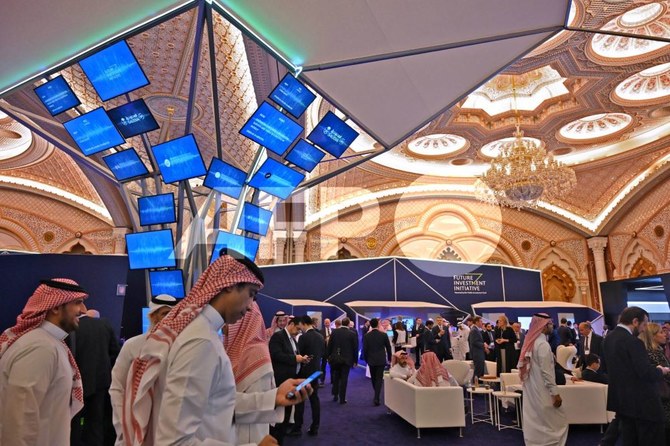
FII 2022. (AN Photo/Basheer Saleh)
4 / 7
Saudi and foreign journalists are pictured at the Future Investment Initiative (FII) forum at the King Abdulaziz Conference Centre in Saudi Arabia's capital Riyadh on October 29, 2019. (AFP)
5 / 7
Amazon’s offices in Riyadh. (Supplied)
6 / 7
Amazon’s offices in Riyadh. (Supplied)
7 / 7
Microsoft’s offices in Riyadh. (Supplied)
Short Url
Updated 23 September 2023
Follow

How Saudi business environment was reinvigorated by structural and legal reforms

  • Incentives and new rules encourage foreign companies to establish their headquarters in the Kingdom
  • Saudi Arabia is determined to become one of the most sought-after destinations for businesses

RIYADH: Saudi Arabia is all set to become one of the most sought-after destinations for businesses thanks to the ongoing structural and legal reforms led by economic goals outlined in the Kingdom’s Vision 2030 blueprint.

From providing tax benefits for foreign companies establishing their headquarters in the Kingdom to offering special incentives, Saudi Arabia is slowly but steadily emerging as the hot spot for businesses in the Middle East and North Africa region.

According to official figures, 44 international companies have already moved their regional headquarters to Saudi Arabia. The prospects are improving, with at least 80 firms being issued regulatory clearances to establish their offices in the Kingdom.

According to Talat Hafez, an economic and financial analyst, Saudi Arabia’s regional headquarters program aims to increase foreign direct investments and bolster the economy.

“It will help the Saudi treasury by a number of factors. It will widen the business market in the Kingdom, create purchasing power and enhance Saudi Arabia’s export capabilities, especially when considering the diversity of the businesses these companies are bringing,” said Hafez.

In recent months, several noted firms, including PwC Middle East and Egypt’s Intella, inaugurated their regional headquarters in Saudi Arabia, indicating Saudi Arabia’s investment-friendly evolution.

Hafez added that establishing regional headquarters by foreign companies in Saudi Arabia could help local talents hone their skills.

“Saudi economy will benefit from the transfer of the know-how and job creation for Saudi nationals, while the companies will benefit from the increase in their businesses and sales, especially since more than 80 percent of their revenues in the region are generated from Saudi Arabia,” Hafiz said.

According to Hafiz, Riyadh is the most preferred location for foreign companies that wish to open their regional headquarters in Saudi Arabia, as the capital city contributes over 45 percent to the non-oil gross domestic product of the Kingdom.

Hafiz further noted that companies that wish to open their regional headquarters in Saudi Arabia will not face any challenges.

“I don’t believe that they will face any difficulties or challenges, simply because most of the companies, if not all who are considering moving their regional offices to the Kingdom, they were already operating in Saudi Arabia and they have longstanding experience of the way of doing business in the Kingdom,” added Hafiz.

To further accelerate the inflow of foreign direct investments to Saudi Arabia, Prime Minister Crown Prince Mohammed bin Salman, in May, announced the launch of four special economic zones in Riyadh, Jazan, Ras Al-Khair and King Abdullah Economic City, north of Jeddah.

These economic zones will be crucial in providing foreign investors with the support required for vital and promising sectors, such as technology, logistics and industry.

“These zones provide and grant foreign investors with a number of business opportunities and concessions that allow them to do business smoothly in the Kingdom, which includes the relaxation of Saudization requirements and other investment motivations,” added Hafez.

Affirming Saudi Arabia’s evolution in emerging as a global trade hub, total anchor investments in its four special economic zones reached SR47.2 billion ($12.6 billion) as of May,

Even though Saudization requirements are relaxed in these zones, foreign companies that employ Saudis will get special incentives.

“The incentives were decided after a very careful study of regional and global benchmarks. One of these incentives, which is very important, probably to investors, is the exemption from Saudization requirements. Yet, they will receive the requirements from HRDF if they choose to hire Saudis,” said Minister of Human Resources and Social Development Ahmed Al-Rajhi.


Saudi Arabia set to attract $500bn in private investment, Al-Falih tells conference

Updated 09 December 2025
Follow

Saudi Arabia set to attract $500bn in private investment, Al-Falih tells conference

RIYADH: Sustainability, technology, and financial models were among the core topics discussed by financial leaders during the first day of the Momentum 2025 Development Finance Conference in Riyadh.

The three-day event features more than 100 speakers and over 20 exhibitors, with the central theme revolving around how development financial institutions can propel economic growth.

Speaking during a panel titled “The Sustainable Investment Opportunity,” Saudi Investment Minister Khalid Al-Falih elaborated on the significant investment progress made in the Kingdom.

“We estimate in the midterm of 2030 or maybe a couple of years more or so, about $1 trillion of infrastructure investment,” he said, adding: “We estimate, as a minimum, 40 percent of this infrastructure is going to be financed by the private sector, so we’re talking in the next few years $400 (billion) to $500 billion.”

The minister drew a correlation between the scale of investment needs and rising global energy demand, especially as artificial intelligence continues to evolve within data processing and digital infrastructure in global spheres.

“The world demand of energy is continuing to grow and is going to grow faster with the advent of the AI processing requirements (…) so our target of the electricity sector is 50 percent from renewables, and 50 percent from gas,” he added.

Al-Falih underscored the importance of AI as a key sector within Saudi Arabia’s development and investment strategy. He made note of the scale of capital expected to go into the sector in coming years, saying: “We have set a very aggressive, but we believe an achievable target, for AI, and we estimate in the short term about $30 billion immediately of investments.”

This emphasis on long-term investment and sustainability targets was echoed across panels at Momentum 2025, during which discussions on essential partnerships between public and private sectors were highlighted.

The shared ambition of translating the Kingdom’s goals into tangible outcomes was particularly essential within the banking sector, as it plays a central role in facilitating both projects and partnerships.

During the “Champions of Sectoral Transformation: Development Funds and Their Ecosystems” panel, Saudi National Bank CEO Tareq Al-Sadhan shed light on the importance of partnerships facilitated via financial institutions.

He explained how they help manage risk while supporting the Kingdom’s ambitions.

“We have different models that we are working on with development funds. We co-financed in certain projects where we see the risk is higher in terms of going alone as a bank to support a certain project,” the CEO said.

Al-Sadhan referred to the role of development funds as an enabler for banks to expand their participation and support for projects without assuming major risk.

“The role of the development fund definitely is to give more comfort to the banking sector to also extend the support … we don’t compete with each other; we always complement each other” he added.