

Voter numbers in Pakistan surge to 127 million ahead of upcoming polls — election regulator

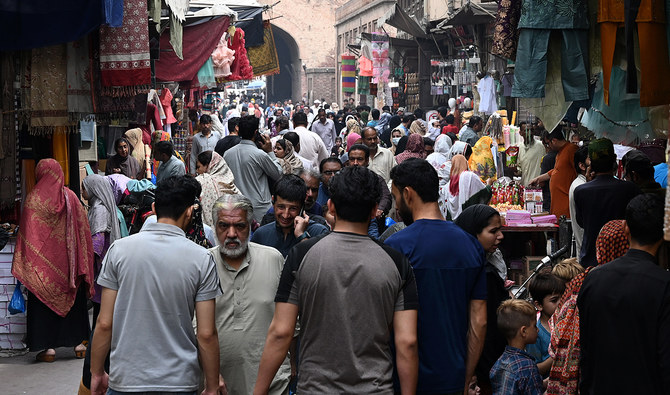
In this picture taken on April 16, 2023, people throng a market area during shopping in Lahore. (AFP/File)
Short Url
Updated 19 September 2023
Follow

Voter numbers in Pakistan surge to 127 million ahead of upcoming polls — election regulator

  • Pakistan’s voter count increased from 105.95 million in 2018 to 127 million by July 2023, per election regulator 
  • It added that a significant majority of voters, 59.10 million (59,095,197), were between the ages of 18 and 35 

ISLAMABAD: Pakistan’s election regulator announced on Tuesday that the number of voters in the country had increased by 22 million as compared to 2018, amid preparations for the upcoming general elections.
Elections in Pakistan were originally scheduled to be held by November after the outgoing government of prime minister Shehbaz Sharif dissolved the National Assembly on August 9.
However, the Election Commission of Pakistan (ECP) opted to delimit the electoral constituencies based on the results of a digital census conducted in April this year, delaying the polls to next year.
On Tuesday, the ECP revealed the updated “province-wise voter statistics from 2018 to 2023” as of July 25, 2023 and revealed that the number of voters had increased to 126.9 million from 105.95 million in 2018.

The overall number of male voters had risen from 59.22 million in 2018 to 68.50 million in 2023, according to the ECP. Likewise, the count of female voters had gone up from 46.73 million to 58.47 million.
The election regulator also unveiled age-wise voter statistics as of July 25, highlighting that a significant majority of voters, 59.10 million, fell between 18 years and 35 years.
Among these young voters, the majority 31.74 million individuals lived in the Punjab province. Sindh followed with 11.58 million voters, Khyber Pakhtunkhwa with 10.79 million, Balochistan with 2.53 million, and Islamabad Capital Territory with 0.46 million registered voters.
Earlier this month, Pakistan’s President Dr. Arif Alvi wrote to the chief election commissioner (CEC), suggesting that polls in the country should be held on November 6.
“WHEREAS in terms of Article 48(5) the general election to the National Assembly should be held by the eighty-ninth day of the date of dissolution of the National Assembly, i.e. Monday, 6th Day of November 2023,” Alvi wrote in his letter to CEC Sikandar Sultan Raja.
Alvi has maintained that as per Pakistan’s constitution, the president must fix a date for polls within 90 days of the dissolution of the National Assembly.
On August 23, the president had also invited the chief election commissioner to a meeting to fix a date for the impending elections, but Raja snubbed the offer and pointed out that after amendments to the Elections Act in June by the outgoing government, fixing a date for elections was the sole prerogative of the election regulator.
Previously, the constitution mandated the president to consult the election commission before determining a date for polls.


Pakistan to begin first phase of Hajj 2026 trainings from today

Updated 31 December 2025
Follow

Pakistan to begin first phase of Hajj 2026 trainings from today

  • Training programs to be held in phases across Pakistan till February, says religion ministry
  • Saudi Arabia allocated Pakistan a total quota of 179,210 pilgrims for Hajj 2026

ISLAMABAD: Pakistan’s religious affairs ministry has said that it will begin the first phase of mandatory Hajj 2026 training for pilgrims intending to perform the pilgrimage from today, Thursday.

The one-day Hajj training programs will be held in phases across the country at the tehsil level until February. The ministry directed intending pilgrims to bring their original identity cards and the computerized receipt of their Hajj application to attend the training sessions.

“Pilgrims should attend the one-day training program according to their scheduled date,” Pakistan’s Ministry of Religious Affairs (MoRA) said in a statement.

The ministry said training schedules are being shared through the government’s Pak Hajj 2026 mobile application as well as via SMS. It added that details of the schedule are also available on its website.

According to the ministry, training programs will be held in Abbottabad on Jan. 2; Ghotki, Thatta and Kotli on Jan. 3; and Tando Muhammad Khan and Khairpur on Jan. 4.

Hajj training sessions will be held in Rawalakot, Badin and Naushahro Feroze on Jan. 5, while pilgrims in Fateh Jang, Dadu and Tharparkar will receive the training on Jan. 6.

The ministry said training programs will be conducted in Umerkot and Larkana on Jan. 7, followed by sessions in Mirpurkhas, Shahdadkot and Mansehra on Jan. 8.

Pakistan’s religious affairs ministry has previously said these trainings will be conducted by experienced trainers and scholars using multimedia.

It said the training has been made mandatory to ensure that intending pilgrims are fully aware of Hajj rituals and administrative procedures.

Saudi Arabia has allocated Pakistan a quota of 179,210 pilgrims for Hajj 2026, of which around 118,000 seats have been reserved under the government scheme, while the remainder will be allocated to private tour operators.

Under Pakistan’s Hajj scheme, the estimated cost of the government package ranges from Rs1,150,000 to Rs1,250,000 ($4,049.93 to $4,236), subject to final agreements with service providers.