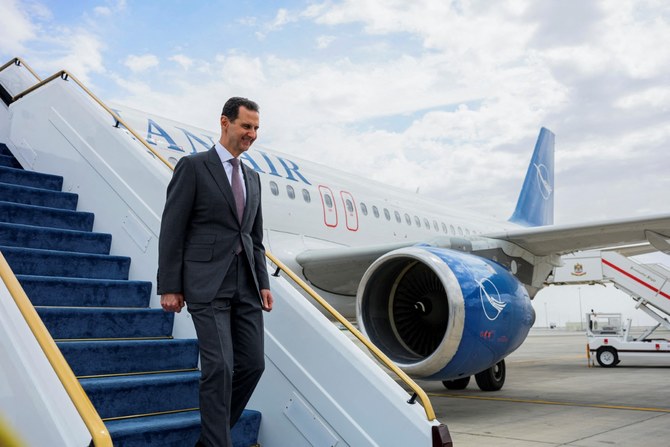
Syria’s Assad to travel to China for summit with Xi — presidency

Assad has come in from the diplomatic cold this year, with the Arab League reinstating Syria as a fully-fledged member after more than a decade of suspension (AFP)
Short Url
Updated 19 September 2023
Follow

Syria’s Assad to travel to China for summit with Xi — presidency

  • Assad, Syrian first lady Asmaa Assad and a senior delegation will travel to China on Thursday for a string of meetings in Beijing and Changzhou

DAMASCUS: Syrian President Bashar Assad will travel to China this week for a bilateral summit with his Chinese counterpart, the presidency in Damascus said in a statement on Tuesday.
Assad, Syrian first lady Asmaa Assad and a senior delegation will travel to China on Thursday for a string of meetings in Beijing and Changzhou. Presidents Assad and Xi would hold a Syrian-Chinese summit, the statement said.
Assad last visited China in 2004 to meet then-President Hu Jintao. It was the first visit by a Syrian head of state to China since the countries established diplomatic ties in 1956.
China — like Syria’s main allies Russia and Iran — maintained those ties even as other countries isolated Assad over his brutal crackdown of anti-government demonstrations that erupted in 2011.
As a permanent member of the United Nations Security Council, China has repeatedly vetoed resolutions on Syria, including several to extend cross-border aid operations into areas outside the Syrian government’s control.
Assad has come in from the diplomatic cold this year, with the Arab League reinstating Syria as a fully-fledged member after more than a decade of suspension.


UN must ‘carefully’ heed Lebanese views as it weighs post-UNIFIL options, peacekeeping chief says

Updated 14 sec ago
Follow

UN must ‘carefully’ heed Lebanese views as it weighs post-UNIFIL options, peacekeeping chief says

  • Jean Pierre Lacroix tells Arab News he heard nothing while visiting the country that cast doubt on the political will of authorities to disarm Hezbollah and implement UN resolution
  • Frequency of Israeli attacks ‘has been quite high and has been increasing,’ he says, warning that some of them could have had ‘very tragic consequences’

NEW YORK CITY: The UN must take its lead from authorities in Lebanon as it weighs its options for international support after the UN’s peacekeeping mission in the country ends, the head of UN peace operations said on Friday.
The views of Beirut must be central to any future arrangement, he stressed.
“We have to listen carefully to the Lebanese authorities,” Jean-Pierre Lacroix, the UN under-secretary-general for peace operations, told Arab News during a virtual press conference from Saudi Arabia, in reference to discussions about what UN support for the country might look like when the UN Interim Force in Lebanon’s peacekeeping mandate ends.
He was speaking during a regional tour that has taken him to Lebanon, Syria, Jordan and Israel, during which he met senior political and military officials as well as members of the UN peacekeeping force on the ground.
UNIFIL will continue to operate in Lebanon until its current mandate expires on Dec. 31 this year, with all forces remaining in place until then, Lacroix said. “There is no predrawdown mandate,” he added.
The UN Security Council voted in August last year to grant one final extension to the UNIFIL mandate through the end of 2026, despite Lebanon’s objections. It came as Israel and the US pressed for an end to the decades-old peacekeeping mission, established in 1978, and amid a renewed push to enforce Resolution 1701.
The resolution ended the 2006 war between Israel and Hezbollah. It also underpins their current truce, and calls for the Lebanese state to assert exclusive control over security in the south of the country and to disarm all non-state armed groups.
Lacroix said the relationship between UNIFIL and Lebanese authorities was “excellent,” and cooperation with the Lebanese Armed Forces remained strong. He praised what he described as the political will in Beirut to advance the full implementation of Resolution 1701, citing in particular the recent announcement by Lebanese authorities outlining the first phase of their efforts to establish operational control south of the Litani River. He also acknowledged that significant work remains to be done.
Asked about the disarmament of Hezbollah, Lacroix told Arab News he had heard nothing during his visit that casts doubt on the political will of Lebanese authorities to achieve this, while acknowledging that there are differing assessments among interlocutors about the pace of progress and the risk of rearmament.
“The bottom line for us is that there is momentum,” he said, adding that the UN’s role was to support Lebanese efforts through both its peacekeeping mission and political engagement.
The Security Council has asked UN Secretary-General Antonio Guterres to present options for post-UNIFIL support for Resolution 1701 by June 1. Work on that is ongoing, he said, and includes consultations with Lebanese and Israeli authorities, as well as members of the Security Council.
While Lebanese leaders have expressed concern about the end of UNIFIL’s mission and interest in maintaining some form of UN presence in the country, Lacroix said any successor arrangement would be decided by the Security Council.
He declined to speculate about the form or size of any future force. Several factors would need to be assessed, he said, including the security environment and the level of international support for the Lebanese Armed Forces.
However, he repeatedly emphasized the need for greater backing of the Lebanese army from international partners, describing such support as “more important than ever.”
Lacroix described the “appalling” widespread destruction he had witnessed during his visit to southern Lebanon along the Blue Line that separates the country from Israel. Many villages had been heavily damaged and Lebanese civilians were still unable to return to their homes, he said, warning that this complicates the prospects for rehabilitation and reconstruction.
He also raised concerns about the safety of UN peacekeepers as their operating environment had become increasingly dangerous. While relations with local communities were generally good, he said UNIFIL had faced a growing number of hostile incidents involving the Israeli army.
“The frequency of (Israeli attacks) has been quite high and has been increasing,” he said, warning that some of them could have had “very tragic consequences.”
He said he had raised this issue directly with Israeli officials, and called for action to be taken to prevent further incidents, stressing that all parties have a responsibility to ensure the safety of peacekeepers.
Turning to Syria, Lacroix said the Israeli military presence in the UN-monitored area of separation has become the main challenge for peacekeepers, as Israeli forces occupy 10 positions in a zone reserved under a 1974 agreement for UN troops only. Daily liaison with Israeli forces had helped limit the effects on civilians, he added.
“Our objective remains a return to full implementation of the 1974 agreement,” Lacroix said, and he welcomed US-mediated talks between Israel and Syria.
He also addressed the effects of budget cuts on UN peacekeeping missions. Financial shortfalls had forced missions, including UNIFIL, to reduce patrols and prioritize certain areas, he said, limiting their ability to support national forces and protect civilians.
Jordanian officials have expressed support for Lebanon’s efforts and are providing assistance, he added, including training for members of the Lebanese Armed Forces.
Lacroix said he had yet to meet Saudi officials but expected to discuss Lebanon with them during upcoming talks. He also noted Saudi Arabia’s role in discussions about a possible international conference to support the Lebanese army.