

Global coordinated action required to solve climate change, inequality: Ex-UK PM

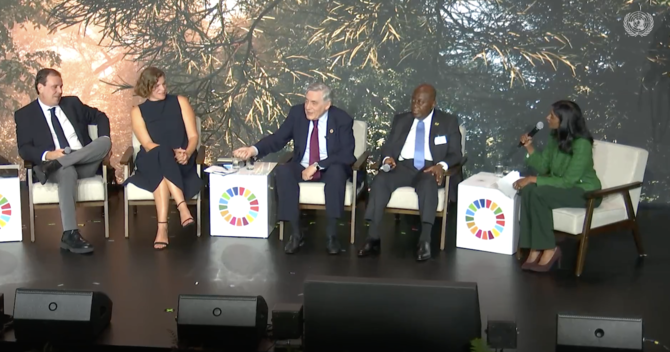
Former UK Prime Minister Gordon Brown speaks at the Sustainable Development Summit in New York on Monday. (UN Web TV)
Short Url
Updated 18 September 2023
Follow

Global coordinated action required to solve climate change, inequality: Ex-UK PM

  • Gordon Brown: ‘Unless we act now, we won’t achieve anything that we want to achieve by 2030’
  • Sustainable Development Summit marks halfway point in implementation of UN’s SDGs

LONDON: Global problems such as climate change, pandemics and inequality cannot be solved without coordinated international action, former UK Prime Minister Gordon Brown said on Monday during the Sustainable Development Summit in New York.

The event at the UN headquarters marks the halfway point in the implementation of the organization’s Sustainable Development Goals.

Brown, who is the UN special envoy for global education, said the world needs to agree on “burden sharing,” and countries who are more able should take more responsibility.

Ghana’s President Nana Akufo-Addo said a major obstacle to achieving the SDGs is the view that for one person to be wealthy, another has to be poor.

“That’s the major obstacle. We saw it, for instance, at the time of COVID, when those who have the capacity to produce a vaccine suddenly decided that it was better to act domestically for themselves than to act for the global community,” he added.

“But this, for me, is the issue that we need to confront. Is it possible that we can create a situation whereby we accept that it’s possible for all of us 8 billion people on this planet to be able to live on this planet and make use of its resources in such a way that we can all be comfortable?”

He said: “There’s really no advantage if we continue the way it has been going before, whereby for you to be rich, I have to be poor. That matter is a matter that all of us have to come to grips with.”

Brown said the key to achieving the SDGs is acting now. “We’ve got droughts, we’ve got floods, we’ve got storms, we’ve got illiteracy, we’ve got disease, we’ve got squalor. Unless we act now, then we won’t achieve anything that we want to achieve by 2030,” he added.

Stefan Schweinfest, director of the UN Statistics Division, announced a new partnership with Google’s Data Commons to make authoritative UN data more findable, accessible and usable for everyone.


The Director of the United Nations Statistics Division Stefan Schweinfest announces a new partnership with Google’s Data Commons on Monday. (UN Web TV)

“In response to Secretary-General Antonio Guterres’ call for data-driven transformation of the United Nations, we’re modernizing UN data over the next two years to bring data together from across the entire UN system into a new, user-friendly public interface with advanced search functionality,” Schweinfest said.

“Together, we’ve built the first stage of that: the UN Data Commons for the SDGs. This new interface allows for seamless exploration of SDG data sets, the global SDG report, and analytics facilitating informed data-driven decisions for SDG acceleration.”

Agnes Kalibata, president of the Alliance for a Green Revolution in Africa, drew attention to the huge flash flood that swept thousands to their deaths in Libya last week.


The President of the Alliance for a Green Revolution in Africa Agnes Kalibata speaks at the Sustainable Development Summit on Monday. (UN Web TV)

“We need a global policy to fix climate change. We also need countries to come through on adaptation,” she said.

“The biggest challenge of all times for the African continent that we need to find solutions to is something we have no ability to find a solution to — it’s called climate change.

“That’s causing droughts and droughts and droughts and floods. And you’re seeing that across the African continent.

“And I don’t know whether Africa alone can do anything about that until we all, as the world, decide to do something.”


Europe to launch international commission for Ukraine war damages

Updated 6 sec ago
Follow

Europe to launch international commission for Ukraine war damages

  • The two-year-old Register of Damage , which will become part of the commission, has received more than 80,000 claims submitted by individuals, organisations and public bodies in Ukraine under a wide range of categories

THE HAGUE: European leaders including Ukraine's Volodymyr Zelenskiy meet in The Hague on Tuesday to launch an International Claims Commission to compensate Kyiv for hundreds of billions of dollars in damage from Russian attacks and alleged war crimes.
The one-day conference, co-hosted by the Netherlands and the 46-nation Council of Europe, the continent's top rights group, was to be attended by dozens of senior figures including European Union foreign policy chief Kaja Kallas.
The meeting coincides with ongoing U.S.-backed peace diplomacy aimed at stopping the war, which began with Russia's full-scale invasion of Ukraine in February 2022.

HIGHLIGHTS

• Hague-based commission to assess Ukraine's claims over Russia's invasion

• Over 80,000 claims submitted to Register of Damage

• World Bank estimates $524 billion needed for Ukraine reconstruction

• European leaders expected to sign convention on Tuesday

• Ukrainian President Zelenskiy expected to attend one-day conference

Russian officials were not immediately reachable to comment on the plan, but have repeatedly rejected allegations that Russian forces committed war crimes during the conflict.

POSSIBLE AMNESTY IN PEACE DEAL
The possible inclusion of an amnesty for wartime atrocities in a peace deal, which was at one point proposed by the administration of President Donald Trump, could complicate Europe's plans to also compensate victims of abuses in Ukraine ranging from sexual violence and child deportations to destruction of religious sites.
The two-year-old Register of Damage , which will become part of the commission, has received more than 80,000 claims submitted by individuals, organisations and public bodies in Ukraine under a wide range of categories.
More than 50 states and the European Union have drafted a Council of Europe convention to create the commission, which will take force after it has been ratified by 25 signatories, as long as sufficient funds have been secured to finance the work.
Dozens of countries have already indicated support for the commission, likely to be based in The Hague. As many as 35 nations have indicated they will sign the convention at Tuesday's meeting, a source familiar with the discussions said.
The commission - the second part of an international compensation mechanism for Ukraine - will review, assess and decide on claims submitted to the Register of Damage for Ukraine, which was created by the Council of Europe in 2023, and determine compensation awards on a case-by-case basis.
Claims can be filed for damage, loss or injury caused by Russian acts committed in or against Ukraine on or after the February 24, 2022 invasion. The claims, which cover violations of international law, can be brought by affected individuals, companies or the Ukrainian state, a draft of the proposal said.

$524 BILLION FOR POST-WAR RECONSTRUCTION
The World Bank has estimated the cost of reconstruction in the coming decade at $524 billion (447 billion euros), or nearly three times Ukraine's economic output in 2024. But that figure is through December 2024 only and does not include damage caused this year, when Russian attacks escalated as part of a campaign targeting utilities, transport and civilian infrastructure.
Details on how any damages awarded by the commission would be paid still need to be worked out, but the source said Russian assets frozen by the EU were among the options being discussed.
The Council of Europe was founded in 1949 to promote democracy, human rights and the rule of law across the continent and is its oldest intergovernmental organisation.