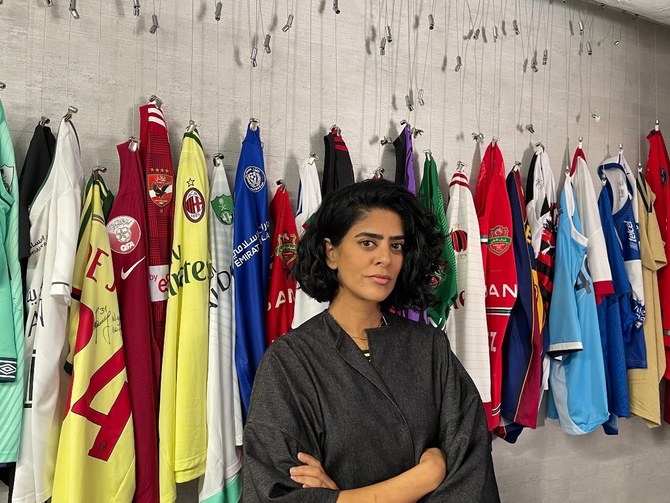

DUBAI: Surrounded by football memorabilia in her office on Jumeirah Beach Road, Budreya Faisal is plotting the rebirth of women’s football in the UAE.
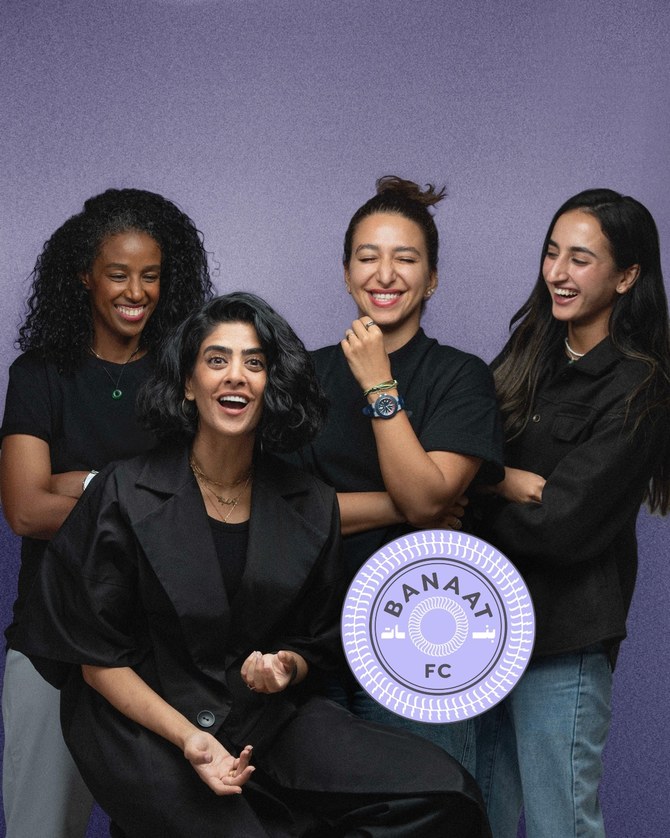
On Aug. 28, Emirati Women’s Day, she launched Banaat FC, a new Dubai-based club that is looking to push back the stagnation that has seeped into the women’s game over the last decade.
“Rise. Represent. Reclaim,” is the club’s motto.
But Banaat’s origin story has some plot twists.
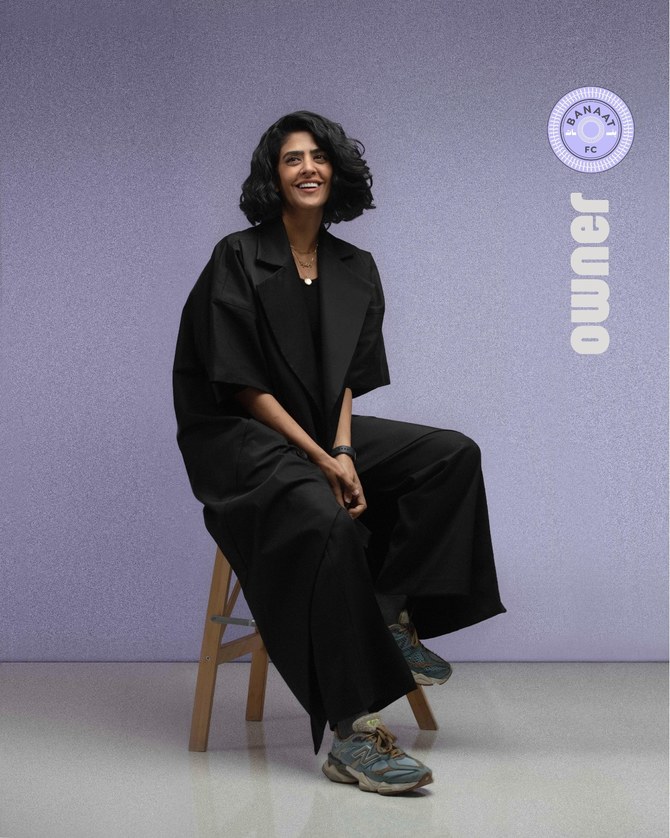
The big idea of the CEO and owner of sports marketing agency Ghost Concept had, initially, little to do with women’s football. Or indeed any “real" football team at all.
“I was on my way from Egypt, and I decided I was going to do something crazy, which was start a fake football club that only exists online,” Faisal told Arab News. “I’d actually recruit micro influencers from the community as our players and create fake background stories and experience, and then create fake transfers and rivalries, and use AI as well to support with imagery. Boost this club up to a point where it becomes so cool that I can get sponsors for it and set an actual benchmark for how clubs in the Arab world should be operating.”
It was meant to be her way of showing regional clubs that, in marketing terms, “it’s time for you to wake up” and realize your potential.
Quickly, however, her targets changed.
“I was so excited,” she said. “And then I felt guilty immediately after the insane excitement because that effort wasn’t going towards someone that needed it. I thought I’ll take a third division men’s club, and transform that club. Women’s (clubs) didn’t even cross my mind at that point.”
There was a light bulb moment when she came across an Instagram account dedicated to women’s football in the UAE.
“The day after I came to the office after being away for six weeks, I went online and I saw this account called UAW football, UAE Women's Football,” she said. “It’s a relatively new account. And you can tell that it was someone that made it not an organization, but it actually represented, it was active and it’s cool. It’s sharing what it can about women’s football here.”
Faisal also noticed that the majority of the teams in the last iteration of the UAE Women’s League were expatriate clubs.
“And that was the aha moment. First I was annoyed then I thought why am I annoyed? Instead of getting annoyed, do something.”
Faisal called her friend Maria Khan, the captain of Pakistan’s national team, for advice.
“She used to play here and support that women’s football development in the federation. And she just signed for a club in Saudi. So I called her and I asked her a few questions. She had always helped me and supported me with all the info I needed.”
So what does it take to actually start a club here?
“She said ‘you need a coach, you need a coach’s assistant, a physio and a venue, like facility or pitch to play on.’ I said OK, and then in terms of salaries, she was like, ‘oh, no, no, no salaries.’”
Faisal says that it blew her mind to discover that female players had to “pay to play.”
The UAE Football Association has encouraged clubs to establish women’s teams that could play in a prospective professional league, with the criteria of having at least five Emirati players.
Academies and teams would charge foreign players to join, with a select number of international players receiving salaries, while Emirati players could join for free — with fees subsidized by the UAE FA — but would not receive any payment.
There was a risk that this situation would leave Emirati players disincentivi
zed or sidelined.
“So yes, it’s a great initiative from the association to say we need a league,” said Faisal. “We need some kind of competition, so that’s a great start. And then what they’ve done to compensate that is they get the national team girls to train four times a week with the association, and they train twice a week for their club.”
It was then that Faisal decided to set up a club by Emiratis for Emiratis but she realized she needed the right people for the project.
There was only one person she felt she should start with, which was UAE national coach Houriya Taheri, who at the time was in Thailand with the under-20 squad.
“I said to her, I’m going tell you something crazy, but I’m going to do it. I don’t care if it’s a good idea, I’m gonna do something big,” Faisal said. “And she had this kind of smile on her face, it felt like she was smiling from the inside, almost like relief. And she told me this is going to change women’s football and the UAE. And it’s like they’ve been waiting for it.”
In her role as head of Ghost Concept, Faisal has worked on branding projects with the UAE’s Al-Nasr and Egyptian giants Al-Ahli, represented Emirati superstar Omar Abdulrahman and collaborated with FIFA on a documentary, “Aspire to the World,” before last year’s World Cup.
With Banaat, Faisal insisted that she wanted Emirati technical staff and Taheri knew just the right person for head coach.
“She said I have the coach for you, don’t even think about it. It’s going to be coach Noora.”
Noora Al-Mazrouie is a former goalkeeper and an Asian Football Confederation-certified coach, as well as being a mentor for the current UAE No. 1 Maha Al-Blooshi. She is currently the UAE national team’s goalkeeping coach.
Al-Mazrouie is considered the prototype professional female player in the women’s game.
“She had wanted to do everything she could to develop the game, and that’s what I want. And I want to be that opportunity for her. I want to be that support. She’s been waiting for someone to say I got you, let me celebrate you. So I wanted to do that for her.”
Faisal and Al-Mazrouie went about creating a squad, initially made up mostly of players from the UAE national team, with others joining through a series of trials that have taken place on Tuesday nights.
“I want every Emirati mother and father to look at our team and think my daughter can play there. This feels like a safe place. This feels like a healthy environment and a place where there are no bad influences.”
The team’s players will be expected to spread the positive message that Faisal is after.
“Every girl in Banaat FC must have a public Instagram and TikTok account. And an active one.”
“I don’t need this to be the strongest team. I don’t care if we’re last this year. I need to deliver a message I need to make a statement. I need to make (an) impact, and to create that impact sacrifices have to be made and that sacrifice is you’re going to have to be more active and more present and people are going (to) have to know you exist to support you. It’s not even a sacrifice.”
The UAE FA’s headquarters in Khawaneej is where Banaat have been holding their training sessions, and where the trials have taken place. Home matches will also be played there until a permanent venue is found.
“My ideal scenario is that Banaat develops and becomes something strong, where we get some kind of government support and we get a facility,” Faisal said.
Banaat will be the seventh team to join the top division, which kicks off on Oct. 14.
Faisal is confident that her present squad will gel quickly.
“Considering 14 of them are already training with the national team regularly, I’m not too worried,” she said. “That means 14 of them already know each other and play with each other. And that’s amazing that the chemistry on the pitch won’t be the biggest concern.”
When the launch of Banaat FC was announced in partnership with GQ Middle East, Faisal provided a link through which applicants could leave their details, and explain why they wanted to join the project.
It ended up being more than just recruitment for players.
“We’re getting such beautiful stories from people about their passion for the sport, and so many messaging saying they just want to support us, or ‘I used to play but I stopped because there was no proper league, I want to support you,’ ‘I want to give my time for free, tell me what I can do.’ It’s amazing, I feel like we’re going (to) have like a really strong community.”
Faisal says she is open to any individual or entity wanting to support the project, to give fans a unique match experience.
“I wrote community is our backbone. So for us, it’s us going out to them and then (them) coming in and supporting us.”