

Kakar to become first Pakistani caretaker PM to address UNGA

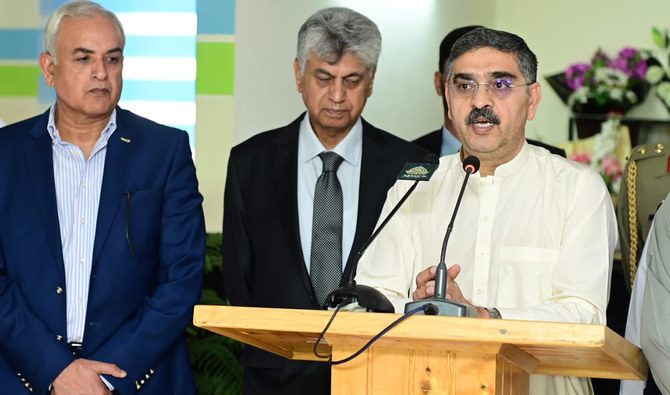
The file photo shows Pakistan's Caretaker Prime Minister Anwaar-ul-Haq Kakar (center) talking to the media after the inauguration of a hospital in Gilgit, Pakistan on September 13, 2023. (Photo courtesy: @GovtofPakistan/Twitter)
Short Url
Updated 19 September 2023
Follow

Kakar to become first Pakistani caretaker PM to address UNGA

  • This year’s annual session will run from September 19-26
  • PM Kakar is scheduled to address the session on September 22 

ISLAMABAD: Pakistani caretaker prime minister, Anwaar-ul-Haq Kakar, has set off on a five-day visit to the United States to attend the 78th session of United Nations General Assembly (UNGA) in New York, he said on Monday, and will become the first caretaker PM in the country’s history to address the main deliberative, policymaking, and representative organ of the UN.

Under Pakistan’s constitution, a neutral caretaker government oversees national elections, which must be held within 90 days of the dissolution of the parliament’s lower house — which in this instance means early November. But polls will be pushed to as far as March as the election regulator draws hundreds of new constituencies based on a fresh population count.

No Pakistani caretaker prime minister before Kakar has ever addressed UNGA. This year’s annual session will run from September 19-26. Kakar will address the session on September 22.

“Setting off for a pivotal 5-day journey to the USA,” the prime minister said on social media.

“Excited to represent Pakistan at the 78th #UNGA, discuss global climate challenges, engage with world leaders, and explore insights with international media and top think tanks.”


During his address, the prime minister will elaborate on measures being taken by the government to consolidate Pakistan’s economic recovery and efforts to mobilize domestic and external investments, Pakistani state media reported. Kakar will also meet world leaders on the sidelines of the UNGA meetings. 


Pakistan engages Saudi Arabia, China in bid to ease surging Middle East tensions 

Updated 10 March 2026
Follow

Pakistan engages Saudi Arabia, China in bid to ease surging Middle East tensions 

  • Pakistan’s foreign minister stresses need for de-escalation in conversations with Chinese, Saudi counterparts
  • Tensions in the Middle East continue to remain high as conflict between US, Israel and Iran intensifies

ISLAMABAD: Pakistan’s Deputy Prime Minister Ishaq Dar spoke to the foreign ministers of Saudi Arabia and China on Tuesday, stressing the importance of diplomatic engagement to de-escalate tensions in the Middle East as the Iran war intensifies. 

Pakistan has constantly engaged regional countries in efforts to broker a ceasefire in the Middle East, after the US and Isreal launched coordinated strikes against Iran on Feb. 28. 

Iran launched fresh attacks on Gulf countries on Tuesday morning, where it has targeted US military bases in recent weeks. In addition to firing missiles and drones at Israel and American bases in the region, Iran has also been targeting energy infrastructure which, combined with its stranglehold on the Strait of Hormuz, has sent oil prices soaring worldwide. 

Dar spoke to Saudi Foreign Minister Prince Faisal bin Farhan to discuss developments in the Middle East and ongoing deliberations at the UN Security Council, Pakistan’s foreign office said in a statement. 

“DPM/FM shared Pakistan’s perspective, underscoring the importance of continued coordination and diplomatic engagement to support de-escalation and promote peace and stability across the region and beyond,” the statement said. 

Dar, who also serves as Pakistan’s foreign minister, spoke to Chinese foreign minister Wang Yi over the telephone separately. The two discussed the evolving regional situation and broader global developments.

Dar underscored the need to ease tensions in the Middle East and the wider region during the conversation, the foreign office said. 

Yi appreciated Pakistan’s constructive efforts aimed at promoting de-escalation and stability in the region, it added. 

“The two leaders stressed the importance of de-escalation and emphasized the need to pursue dialogue and diplomacy in accordance with the principles of the UN Charter,” the foreign office’s statement said. 

The conflict in the Middle East has hit Pakistan hard as well, forcing Islamabad to hike petrol and diesel prices by Rs55 per liter last Friday. 

Pakistan’s government has also announced a set of austerity measures, which include closing schools and cutting down on government expenditures, as it evaluates petrol stocks and looks for alternative supply routes.