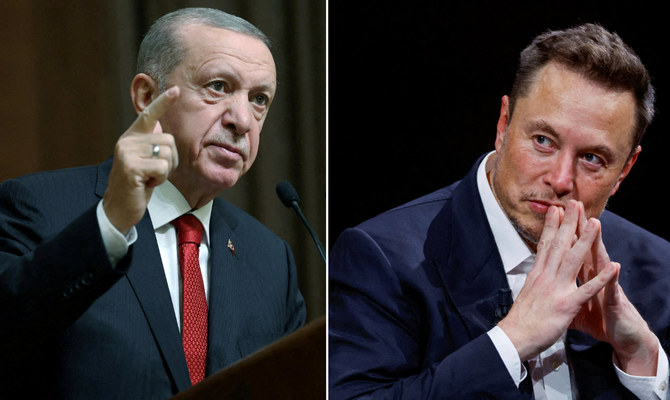
Turkish President Recep Tayyip Erdogan asked Tesla CEO Elon Musk to build a Tesla factory in Turkiye, Anadolu Agency posted on social media platform X on Sunday.
Erdogan asked Musk during a meeting at Turkish House, a skyscraper near the United Nations in New York, the Turkish state-owned news agency said.
Musk is also set to meet Israeli Prime Minister Benjamin Netanyahu in California on Monday. Musk posted on X that their talks would focus on artificial intelligence technology.
Erdogan is in the US to attend the 78th session of the United Nations General Assembly.
Tesla in August expressed an interest in building a factory in India that would produce a low-cost electric vehicle (EV). Tesla currently has six factories and is building a seventh in Mexico in northern Nuevo Leon state, part of the electric carmaker’s push to expand its global footprint.
Musk said in May that the automaker would probably pick a location for a new factory by the end of this year.
Tesla shares are up 123 percent so far this year and the automaker on Saturday said it had produced its 5 millionth car.
Tesla and the Turkish embassy in Washington did not immediately respond to requests for comment.


Turkish President Erdogan asks Musk to build Tesla factory in Turkiye
https://arab.news/rmg53
Turkish President Erdogan asks Musk to build Tesla factory in Turkiye


Saudi POS stays above $4bn as Ramadan spending lifts outlays on home goods
RIYADH: Saudi point-of-sale transactions remained above $4 billion in the week ending Feb. 14, with spending on furniture and home supplies rising ahead of Ramadan, central bank data showed.
Overall POS activity totaled SR15.34 billion ($4.09 billion), representing a 4.8 percent week-on-week decrease, while the number of transactions dipped 1.6 percent to 252 million, according to the Saudi Central Bank.
Spending on furniture and home supplies rose 5.9 percent to SR697.35 million, marking the strongest weekly increase among major retail categories.
Expenditure on electronics increased 2.9 percent, while spending on construction and building materials rose 1.1 percent.

Sectors that saw declines includes freight transport and courier services, which posted a drop of 5 percent to SR64.86 million.
Pharmacy and medical supplies spending fell 8.2 percent to SR223.81 million, but outlays on medical services rose 5.7 percent to SR539.68 million.
Food and beverage expenditure decreased 4.3 percent, but the total spend of SR2.57 billion meant it retained the largest share of POS activity.
Restaurants and cafes followed with SR1.73 billion, despite a 4.7 percent decline. Apparel and clothing outlays represented the third-largest share of POS spending during the monitored week, up 0.5 percent to SR1.38 billion.

The Kingdom’s major urban centers mirrored the mixed national changes. Riyadh, which accounted for the largest share of total POS spending, saw a 3.4 percent drop to SR5.32 billion. The number of transactions in the capital reached 80.7 million, down 0.8 percent week on week.
In Jeddah, transaction values decreased 4.4 percent to SR2.12 billion, while Dammam reported a 3.3 percent decrease to SR746.29 million.
POS data, tracked weekly by SAMA, provides an indicator of consumer spending trends and the ongoing growth of digital payments in Saudi Arabia.
The data also highlights the expanding reach of POS infrastructure, extending beyond major retail hubs to smaller cities and service sectors, supporting broader digital inclusion initiatives.
The growth of digital payment technologies aligns with Saudi Arabia’s Vision 2030 objectives, promoting electronic transactions and contributing to the Kingdom’s broader digital economy.


