

Hot air balloon flights boost Luxor tourism boom

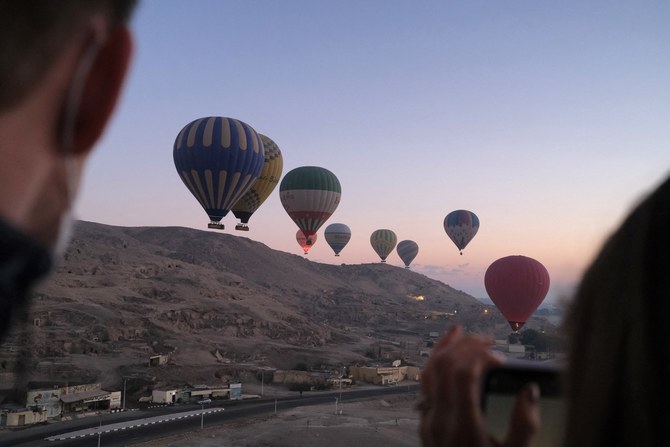
Balloons carrying tourists take off above the west bank of the Nile river in Egypt's southern city of Luxor early on January 18, 2022. (AFP)
Short Url
Updated 17 September 2023
Follow

Hot air balloon flights boost Luxor tourism boom

CAIRO: Hot air balloon flights over some of Egypt’s most famous attractions are fuelling a tourism boom in and around Luxor, according to officials.

On Sunday, 32 hot air balloons carrying 720 tourists of various nationalities flew above Luxor Governorate.

Tourists can enjoy the magic of green natural scenes, mountains, and ancient Pharaonic temples from above the governorate, located in southern Egypt.

Hot air balloon flights over Luxor are a popular attraction as tourists enjoy the panoramic view of ancient Egyptian temples, the river Nile, and green agricultural fields.

Ahmed Aboud, a representative of the Federation of Hot Air Balloon Companies in Luxor, said that the trips are one of the most important programs for tourists keen visit the monuments and archaeological destinations of the ancient city.

Aboud said that balloonists enjoy viewing Luxor’s temples, the Ramesseum Temple, the Colossi of Memnon, the Nile, and agricultural crops from above the western mainland.

A comprehensive examination of each balloon is carried out prior to each flight, said Aboud, with pofessional safety and personal security procedures for tourists top priorities.

He said that Luxor Governorate had taken full safety measures and it cooperates with all concerned parties, paying attention to maintaining the security of flight participants.

There is full compliance with the rules set by civil aviation authorities and the balloons land at the designated airport west of the city.

The remarkable adventure of riding a hot air balloon begins after dawn.

Tourists are brought from hotels and boats where they are staying, and small boats across the Nile are used to transfer tourists to the western mainland.

Buses then transport the tourists to the hot air balloon airport after breakfast is served. The flights are popular, attracting visits from international celebrities.

In the winter, the demand for trips increases, and tourists flock to enjoy the magic of warm winter weather in the morning over the sites.


1,965 Israeli violations recorded against Palestinians in February

Updated 3 sec ago
Follow

1,965 Israeli violations recorded against Palestinians in February

  • Head of Wall and Settlement Resistance Commission condemns attacks as a continuation of ‘terror’ against Palestinians
  • Violations included assaults, uprooting trees, burning fields and preventing olive pickers from accessing their lands

LONDON: Israeli forces and settlers carried out 1,965 attacks across Palestinian towns in the occupied West Bank in February, according to a report by the Palestinian Authority.

Muayyad Shaaban, head of the Wall and Settlement Resistance Commission, condemned the attacks as a continuation of the “terror” against the Palestinian people, their land and property.

The commission documented 1,454 attacks by Israeli forces and 511 by settlers, most of which were concentrated in the governorates of Hebron with 421 attacks, followed by Nablus with 340, Ramallah and Al-Bireh with 320, and East Jerusalem with 210 attacks.

Violations have included direct beatings of Palestinians, uprooting trees, burning fields, and preventing olive pickers from accessing their lands.

Israeli forces have seized land and demolished homes and agricultural facilities under the pretext of “security,” which has enabled settlers to expand their settlements, according to Wafa news agency.

Shaaban said: “What is taking place represents an organized methodology aimed at emptying the land of its owners and imposing an integrated racist colonial system.”

Israeli settlers have poisoned and uprooted a total of 1,314 trees, including 1,054 olive trees, in the areas of Ramallah, Bethlehem, Hebron, Nablus and Tulkarm. The olive groves have been a lifeline for Palestinians in the West Bank, with an estimated 80,000 to 100,000 families relying on the olive harvest for their livelihoods, according to the UN Human Rights Council.

In February, Israeli forces demolished 122 structures belonging to Palestinians, including 56 inhabited homes, nine uninhabited homes, 34 agricultural facilities and 18 sources of livelihood. More than one-third of these demolitions took place in Jerusalem, totaling 46 structures.