Pakistan’s PM expresses ‘alarm’ over border situation, asserts it won’t cause delay in elections

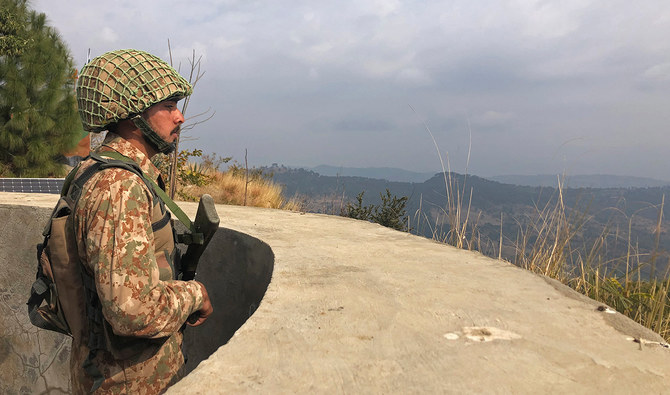
A Pakistan's army soldier stands guard on the Line of Control (LoC) at Abdullah Pur village in Bhimber district of Pakistani-controlled Kashmir on February 5, 2021. (AFP/File)
Short Url
Updated 17 September 2023
Follow

Pakistan’s PM expresses ‘alarm’ over border situation, asserts it won’t cause delay in elections

  • Anwaar-ul-Haq Kakar says his administration has been assisting the election commission on a daily basis
  • The PM says his government will have no objection if the top court rules in favor of early national polls

ISLAMABAD: Caretaker Prime Minister Anwaar-ul-Haq Kakar described Pakistan’s border situation as “alarming” in an interview on Saturday, though he ruled out the possibility of any delay in the next general elections due to the security situation on the country’s international frontiers.
Kakar made this assertion against the backdrop of rising political voices seeking the election commission to announce the date for the national polls, which have already been delayed due to the delimitation of national and provincial constituencies in the country.
President Arif Alvi had dissolved the National Assembly on the advice of former Prime Minister Shehbaz Sharif in August, just a few days before its tenure was set to expire.
According to the constitution, the next election should have been held within 90 days, ending at the beginning of November. However, the Election Commission of Pakistan (ECP) decided to redraw the constituencies based on a digital census conducted earlier this year in April. There is growing uncertainty surrounding the national polls since then which may now happen somewhere in February.
The prime minister told the Voice of America’s Urdu service there was no fear of delayed elections due to security situation on Pakistan’s borders.
“At the moment, I do not see any such possibility,” he told the interviewer. “It is true that there is an alarming situation on the eastern and western borders which has enhanced the security threat and our response mechanism. But we are confident that we will control the situation and complete the electoral process at the same time.”
Kakar disagreed when asked why his administration was doing almost everything other than focusing on the national polls.
“It is not right to say that we are not taking steps to facilitate elections,” he continued. “The caretaker administration has been fulfilling the Election Commission of Pakistan’s requirements and fully providing it assistance on a daily basis.”
However, he reiterated it was not the mandate of his interim government to announce the elections and was only required to provide financial, security and other assistance to the ECP.
He also maintained his government would not raise any objection if the Supreme Court ruled in favor of holding the general elections within the 90-day period.


Punjab expands Pakistan-India Wagah border arena with museum, partition-themed park

Updated 02 January 2026
Follow

Punjab expands Pakistan-India Wagah border arena with museum, partition-themed park

  • The border crossing, near eastern city of Lahore, is the primary land route between Pakistan and India and one of the most recognizable symbols of their often-tense relations
  • The site is best known for its daily flag-lowering ceremony, a choreographed military ritual performed by border forces from both countries that draws thousands of spectators

ISLAMABAD: Maryam Nawaz, chief minister of Pakistan’s Punjab province, on Thursday inaugurated the newly constructed arena at Wagah border cross between Pakistan and India, which includes a museum and a partition themed park.

The Wagah border crossing, located near the eastern city of Lahore, is the primary land route between Pakistan and India and one of the most recognizable symbols of the often-tense relationship between the two neighbors. It serves as a key point for prisoner exchanges and limited movement of travelers, while remaining tightly regulated due to security considerations.

The site is best known for its daily flag-lowering ceremony, a choreographed military ritual performed by border forces from both countries that draws thousands of spectators. Over the years, the ceremony has evolved into a popular tourist attraction, blending displays of nationalism with public spectacle and making it one of Pakistan’s most visited landmarks, which connects with India’s Attari.

Flanked by military officials, CM Nawaz visited the crossing and inaugurated the new arena, with its seating capacity increased from 7,500 to 25,000 spectators, the state-run Radio Pakistan broadcaster reported. The chief minister also visited the martyrs’ monument and offered her respects.

“In addition to the arena’s expansion, several new constructions have been added at the Joint Check Post Wagah. These new developments include a theme park depicting the partition of the Subcontinent, featuring models of a railway station, military equipment and a Martyrs’ Memorial,” the broadcaster reported.

“A Pakistan Museum has also been established within the arena, showcasing the country’s history and culture from the Freedom Movement to the present day.”

In August 1947, Britain divided the Indian Sub-continent, its former colony, into two countries — Hindu-majority India and Muslim-majority Pakistan.

Excitement over independence was quickly overshadowed by some of the worst bloodletting that left up to 1 million people dead as gangs of Hindus and Muslims slaughtered each other.

Creating two independent nations also tore apart millions of Hindu and Muslim families in one of the world’s largest peacetime migrations, which displaced at least 15 million people.

The fate of Kashmir, then a princely state, was left undecided. The Himalayan territory continues to remain a flashpoint in relations between the neighbors, who have fought multiple wars over it.