

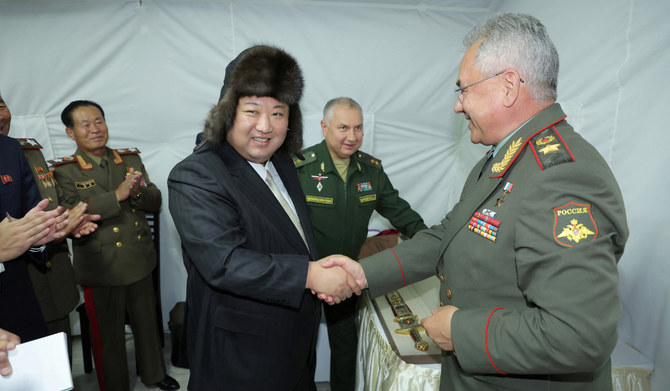


SEOUL, South Korea: North Korean leader Kim Jong Un held discussions with Russia’s defense minister on strengthening “strategic and tactical coordination” between the countries’ militaries, the North’s state media said Sunday, as Kim continued a visit to Russia’s Far East that has raised concerns about an arms alliance that would fuel Moscow’s war on Ukraine.
The talks with Defense Minister Sergei Shoigu came after Kim on Friday was shown some of Russia’s most advanced weapons systems deployed for its war on Ukraine, including nuclear-capable bombers and hypersonic missiles, and a key warship of its Pacific fleet, the Korean Central News Agency said.
Kim’s trip, highlighted by a summit with Russian President Vladimir Putin on Wednesday, has underscored how their interests are aligning in the face of separate, intensifying confrontations with the West. US and South Korean officials have said North Korea could provide badly needed munitions for Putin’s war on Ukraine in exchange for sophisticated Russian weapons technology that would advance Kim’s nuclear ambitions.
While his predominant focus is on military cooperation, Kim also appears to be using his trip to encourage broader exchanges between the countries as he tries to break out of diplomatic isolation.
The governor of Russia’s Primorye region, which includes Vladivostok, said he plans to meet with Kim on Sunday. Gov. Oleg Kozhemyako said on his messaging app channel they would discuss exchange programs for schoolchildren to attend summer camps in one another’s country and other ways to cooperate in sports, tourism and culture. Russian media said Kim may also visit food industry businesses in Primorye.
A day after visiting an aircraft plant in Komsomolsk-on-Amur that produces Russia’s most powerful fighter jets, Kim on Saturday traveled to an airport near the port city of Vladivostok, where Shoigu and other senior military officials gave him an up-close look at Russia’s strategic bombers and other warplanes.
All the Russian warplanes shown to Kim were among the types that have seen active use in the war in Ukraine, including the Tu-160, Tu-95 and Tu-22 bombers that have regularly launched cruise missiles.
During Kim’s visit, Shoigu and Lt. Gen. Sergei Kobylash, the commander of the Russian long-range bomber force, confirmed for the first time that the Tu-160 had recently received new cruise missiles with a range of more than 6,500 kilometers (over 4,040 miles).
Shoigu, who had met Kim during a rare visit to North Korea in July, also showed Kim another of Russia’s latest missiles, the hypersonic Kinzhal, carried by the MiG-31 fighter jet, that saw its first combat during the war in Ukraine.
Kim and Shoigu later traveled to Vladivostok, where they inspected the Admiral Shaposhnikov frigate. Russia’s navy commander, Adm. Nikolai Yevmenov, briefed Kim on the ship’s capabilities and weapons, which include long-range Kalibr cruise missiles that Russian warships have regularly fired at targets in Ukraine.
KCNA, which has reported Kim’s activities in Russia a day late while crafting the details to meet government propaganda purposes, said Kim was accompanied on Saturday’s visits by his top military officials, including his defense minister and the top commanders of his air force and navy.
Following a luncheon, Kim and Shoigu talked about the regional security environment and exchanged views on “practical issues arising in further strengthening the strategic and tactical coordination, cooperation and mutual exchange between the armed forces of the two countries,” KCNA said.
In their July meeting, Kim gave Shoigu a similar inspection of North Korean weapons systems before inviting him to a massive parade in the capital, Pyongyang, where he rolled out his most powerful intercontinental ballistic missiles designed to target the United States.
Kim’s visits to military and technology sites this week possibly hint at what he wants from Russia, perhaps in exchange for supplying munitions to refill Putin’s declining reserves as his invasion of Ukraine becomes a drawn-out war of attrition.
Kim’s meeting with Putin was held at Russia’s main spaceport, a location that pointed to his desire for Russian assistance in his efforts to acquire space-based reconnaissance assets and missile technologies.
Experts have said potential military cooperation between the countries could include efforts to modernize North Korea’s outdated air force, which relies on warplanes sent from the Soviet Union in the 1980s.
Kim in recent months has also refocused on strengthening the country’s navy, which analysts say could be driven by ambitions to obtain Russia’s sophisticated technologies for ballistic missile submarines and nuclear-propelled submarines as well as to initiate joint naval exercises between Russia and North Korea.
Later Saturday, Kim visited a local theater to watch Pyotr Tchaikovsky’s Sleeping Beauty ballet performance. KCNA said Kim received a rousing ovation by people at the theater and expressed “deep thanks to the performers and the theater for their impressive and elegant ballet of high artistic value.”
Russia’s RIA Novosti state news agency said Kim left after the first act.


