Pakistan to repatriate ‘illegal’ Afghan immigrants in bid to curb smuggling — PM Kakar

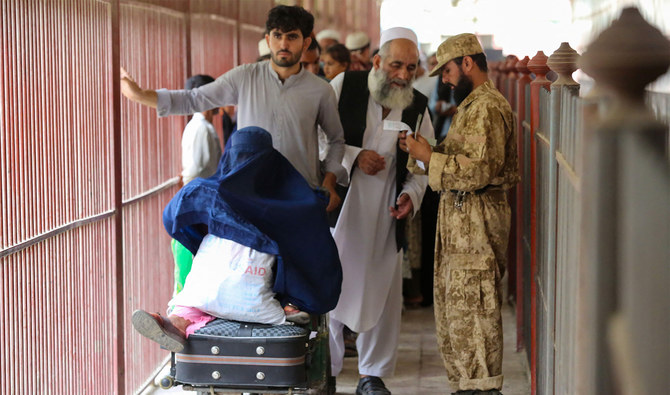
Afghans cross into Pakistan while a security personnel stands guard at the Pakistan-Afghanistan border in Torkham on September 15, 2023. (Photo courtesy: AFP/File)
Short Url
Updated 15 September 2023
Follow

Pakistan to repatriate ‘illegal’ Afghan immigrants in bid to curb smuggling — PM Kakar

  • The development comes as Pakistan continues to face an economic slowdown for the last one year 
  • The South Asian country is taking desperate measures to avoid losses of precious foreign exchange 

ISLAMABAD: Pakistan’s caretaker prime minister, Anwaar-ul-Haq Kakar, said on Friday his country would return all “illegal” Afghan immigrants to curb smuggling of goods and foreign currency, in an attempt to strengthen the dwindling South Asian economy. 

The development comes as Pakistan continues to face an economic slowdown for the last one year, with its foreign exchange reserves depleting, currency devaluing sharply and inflation rising to record highs. 

The country, which barely averted a default in June by securing a crucial $3 billion International Monetary Fund (IMF) bailout, is desperately trying to curb power theft, smuggling and black-marketing of commodities to save precious foreign exchange. 

On Friday, PM Kakar presided over a meeting in Islamabad to review progress on the government’s plan to crackdown on those involved in these illegal practices, particularly the smuggling of currency and goods. 

“To prevent it, a very effective policy has been agreed upon. It has three categories, one [is relating to] those refugees who are registered and are our obligation under the international conventions and we will fulfill them at any cost. Second are the aliens who have no basis to stay here. Neither they have come on a visa, nor they have any legal documents,” Kakar told reporters after the meeting. 

“The third category includes the ones who fall under the domain of identity theft who have gotten identity card by breaking into our system and other documents, which they were not legally entitled to. We have made a policy keeping these three categories in view and God willing, you will see it very soon that we will push back aliens because they have no right to stay on our soil.” 

Pakistan first opened its borders to Afghan refugees in the 1980s after the beginning of a US-sponsored and Pakistan-backed ‘Afghan jihad’ to counter the so-called expansionist designs of the former Soviet Union, becoming the largest refugee-hosting country in the world. 

According to the UNHCR, more than 4.4 million Afghan refugees have returned to their homeland since 2002 under a UNHCR-assisted voluntary repatriation program, but around 1.4 million still live in refugee camps, villages and urban centers across Pakistan. 

In the last few days, police in Pakistan’s southern port city of Karachi arrested hundreds of Afghan nationals for allegedly residing unlawfully in the country. But a senior diplomat from Afghanistan and a human rights activist said that many of those apprehended possessed valid documents. 

PM Kakar explained that today’s meeting was held to monitor what had happened in the past week with regard to synchronizing all actions against smuggling, hoarding and power theft, and how could they take forward this strategy. 

He said his government had “zero tolerance” for smuggled goods. 

“And an illegal industry of currency, our crackdown on that will be very consistent and this message should be conveyed repeatedly,” he said. “Whoever made investments in this illegal arena, I believe they will have to suffer huge losses.” 

Asked about any relief to power consumers, the prime minister said it was linked with prices in the international market and beyond his government’s control. 

“Things connected with the international market, that is a phenomenon which different states do not have any control over,” he said. “And we are also part of that global arrangement.” 

Pakistan recently hiked fuel and electricity prices that sparked massive protests in the South Asian country, where people have been troubled by double-digit inflation for months. The hikes came as part of the conditions agreed with the IMF for the $3 billion bailout deal. 


Sindh assembly passes resolution rejecting move to separate Karachi

Updated 6 sec ago
Follow

Sindh assembly passes resolution rejecting move to separate Karachi

  • Chief Minister Shah cites constitutional safeguards against altering provincial boundaries
  • Calls to separate Karachi intensified amid governance concerns after a mall fire last month

ISLAMABAD: The provincial assembly of Pakistan’s southern Sindh province on Saturday passed a resolution rejecting any move to separate Karachi, declaring its territorial integrity “non-negotiable” amid political calls to carve the city out as a separate administrative unit.

The resolution comes after fresh demands by the Muttahida Qaumi Movement (MQM) and other voices to grant Karachi provincial or federal status following governance challenges highlighted by the deadly Gul Plaza fire earlier this year that killed 80 people.

Karachi, Pakistan’s largest and most densely populated city, is the country’s main commercial hub and contributes a significant share to the national economy.

Chief Minister Syed Murad Ali Shah tabled the resolution in the assembly, condemning what he described as “divisive statements” about breaking up Sindh or detaching Karachi.

“The province that played a foundational role in the creation of Pakistan cannot allow the fragmentation of its own historic homeland,” Shah told lawmakers, adding that any attempt to divide Sindh or separate Karachi was contrary to the constitution and democratic norms.

Citing Article 239 of Pakistan’s 1973 Constitution, which requires the consent of not less than two-thirds of a provincial assembly to alter provincial boundaries, Shah said any such move could not proceed without the assembly’s approval.

“If any such move is attempted, it is this Assembly — by a two-thirds majority — that will decide,” he said.

The resolution reaffirmed that Karachi would “forever remain” an integral part of Sindh and directed the provincial government to forward the motion to the president, prime minister and parliamentary leadership for record.

Shah said the resolution was not aimed at anyone but referred to the shifting stance of MQM in the debate while warning that opposing the resolution would amount to supporting the division of Sindh.

The party has been a major political force in Karachi with a significant vote bank in the city and has frequently criticized Shah’s provincial administration over its governance of Pakistan’s largest metropolis.

Taha Ahmed Khan, a senior MQM leader, acknowledged that his party had “presented its demand openly on television channels with clear and logical arguments” to separate Karachi from Sindh.

“It is a purely constitutional debate,” he told Arab News by phone. “We are aware that the Pakistan Peoples Party, which rules the province, holds a two-thirds majority and that a new province cannot be created at this stage. But that does not mean new provinces can never be formed.”

Calls to alter Karachi’s status have periodically surfaced amid longstanding complaints over governance, infrastructure and administrative control in the megacity, though no formal proposal to redraw provincial boundaries has been introduced at the federal level.