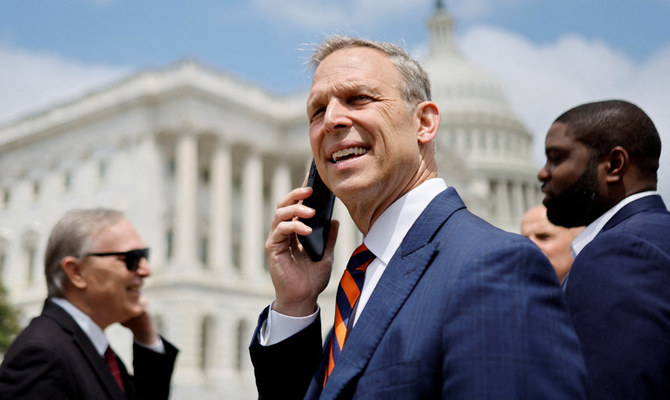
WASHINGTON: A US appeals court has ruled that some of the contents of Republican Representative Scott Perry’s cellphone should be shielded from the criminal probe into former President Donald Trump’s efforts to overturn his 2020 election loss, but found that some of his other communications may not be protected.
The ruling by a three-judge panel of the US Court of the Appeals for the District of Columbia Circuit — dated Sept. 5 and unsealed publicly on Wednesday — handed a partial victory to the Trump ally who helped spread false claims that the election was stolen through widespread voting fraud.
The judges found that Perry’s communications with other members of Congress discussing the certification of the 2020 election results “are quintessential legislative acts” that can be shielded from executive branch agencies. But they found that not all of Perry’s texts and other communications with people outside of Congress were necessarily protected, and ordered a lower court to go back and review each communication.
Perry, a retired US Army National Guard brigadier general who represents a district in Pennsylvania in the US House of Representatives, has sought to prevent the Justice Department from reviewing the contents of his cellphone since it was seized by the FBI last year.
“The D.C. Circuit’s decision is a full-throated vindication of Congress’ protection from intrusive and overreaching inquiry into the legislative deliberations of Members of Congress,” John Rowley, one of Perry’s attorneys, said in a statement.
US Special Counsel Jack Smith has brought four criminal charges against Trump, the front-runner in the race for the Republican nomination to face Democratic President Joe Biden in the 2024 election, related to efforts to overturn the election.
Trump has pleaded not guilty and called the charges politically motivated. He also has pleaded not guilty to criminal charges brought in three other cases, including in Georgia where he faces state charges related efforts to undo his 2020 election loss in that state.
A spokesperson for Smith declined to comment on the Perry ruling.
Perry’s conduct is under scrutiny in Smith’s investigation because of the prominent role he played ahead of the Jan. 6, 2021, attack on the US Capitol by Trump supporters who sought to block Congress from certifying Biden’s election victory.
The legal dispute focuses on whether the contents of Perry’s cellphone are shielded from disclosure under a provision of the US Constitution that gives members of Congress immunity from civil litigation or criminal prosecution for actions that arise in the course of their legislative duties.
Justice Department attorneys in February had urged the D.C. Circuit to uphold a ruling by Judge Beryl Howell, who had found that Perry’s communications were not within a “legitimate legislative sphere” and therefore could be reviewed by the FBI.
The panel included Judges Gregory Katsas and Neomi Rao, both appointed by Trump, and Judge Karen Henderson, appointed by Republican former President Ronald Reagan.

US court shields some of congressman’s phone records in Trump election probe
https://arab.news/vtms2
US court shields some of congressman’s phone records in Trump election probe
- The judges found that Perry’s communications with other members of Congress discussing the certification of the 2020 election results “are quintessential legislative acts” that can be shielded from executive branch agencies
India’s space industry gears up for human spaceflight tests, commercial expansion in 2026
- ISRO plans to complete 7 space missions by March, including Gaganyaan mission test
- In 2025, India’s space sector had over 300 startups operating in rocket launches, satellites, analysis
NEW DELHI: After sending its first astronaut to the International Space Station, autonomously docking two satellites, and launching the heaviest payload this year, India’s space industry is preparing for the first uncrewed test of its human spaceflight program in 2026.
In 2025, India’s space program spearheaded by the Indian Space Research Organisation marked several milestones, starting in January, when it became the fourth country to perform space docking — connecting two spacecraft in orbit, which is a capability crucial for future space stations and deep-space missions.
In June, Shubhanshu Shukla, an Indian Air Force pilot, flew to the ISS as part of the Axiom 4 mission. He became the second Indian national in space, after Rakesh Sharma in 1984.
A month later, ISRO, in collaboration with NASA, launched a joint observation satellite to provide high-resolution radar imagery of the Earth, and in December capped the year by deploying the BlueBird Block 2, the heaviest payload ever launched from Indian soil.
It “marked a decisive year for India’s space sector as policy reforms translated into tangible execution across launch, satellite manufacturing, Earth observation, space data, and satellite communications,” said Lt. Gen. AK Bhatt (retd.), director general of the Indian Space Association.
The year also saw new contracts, production lines, launch vehicles moving closer to operational readiness, and growth in India’s $9 billion space economy driven largely by the private industry and public–private partnerships, which Bhatt expected to expand in the coming year.
“The Indian space sector is poised for a transformative 2026, with ISRO’s rigorous seven-mission schedule by March,” he told Arab News.
ISRO last month announced plans to complete seven space missions by March 2026, including the first uncrewed test flight of India’s Gaganyaan human spaceflight program.
Another mission will be EOS‑N1, where ISRO and India’s Defence Research and Development Organisation will launch an Earth observation satellite for strategic and surveillance applications.
The private industry will also have its debut by HAL-L&T launching the first fully indigenously manufactured Polar Satellite Launch Vehicle early next year, which will carry OceanSat-3A, an Earth observation satellite for oceanography and environmental monitoring.
“Complementing this, private innovators like Skyroot Aerospace with its Vikram-I orbital launch in January-February, GalaxEye’s pioneering multi-sensor Drishti satellite in Q1 and Dhruva Space’s LEAP-2 on the HAL-L&T PSLV and Agnibaan rocket by Agnikul in Q3 will further confirm the vitality of our ecosystem,” Bhatt said.
Over the past few years, India has been establishing its position in the global space industry.
In August 2023, ISRO’s Chandrayaan-3 moon rover made history by landing on the lunar surface, making India the first country to land near the lunar south pole and the fourth to land on the moon — after the US, the Soviet Union, and China.
A month later, it launched Aditya-L1 in 2023 — the country’s first solar observation mission, and the world’s second after the US Parker Solar Probe in 2021.
India currently accounts for about 2 percent of the $450 billion global space economy, with its share expected to rise to nearly 8 percent by 2033, driven largely by private companies.
In 2025, the country’s space sector had more than 300 active startups operating in rocket launches, satellites, Earth observation, satellite communications, propulsion, electronics, space monitoring, and data analytics, according to Indian Space Association data.
“As launch capacity improves and satellite constellations scale up, the real value creation is now shifting closer to applications, analytics and decision-making. From agriculture and climate monitoring to infrastructure planning and national security, satellite data is steadily moving from being a niche input to a mainstream business and governance tool,” said Amit Kumar, co-founder and chief operating officer of Suhora Technologies, a space data company that turns satellite imagery and artificial intelligence‑driven analytics into actionable intelligence.
“As we move into 2026, the opportunity lies in translating India’s space capabilities into everyday insights that solve real-world problems at scale.”