

How Libya’s chaos left its people vulnerable to deadly flooding

1 / 3
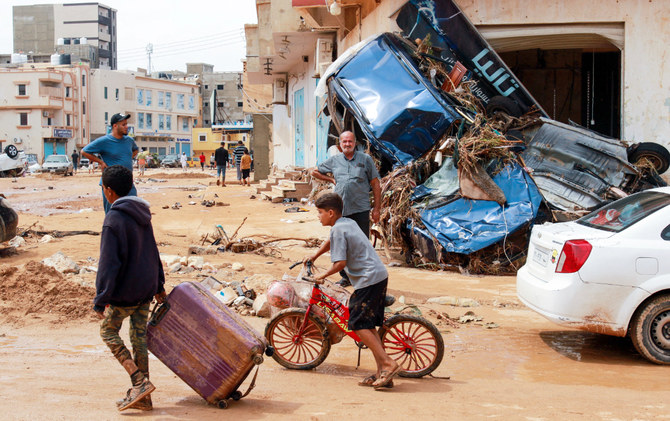
A boy pulls a suitcase past debris in a flash-flood damaged area in Derna, eastern Libya, on September 11, 2023. (AFP)
2 / 3
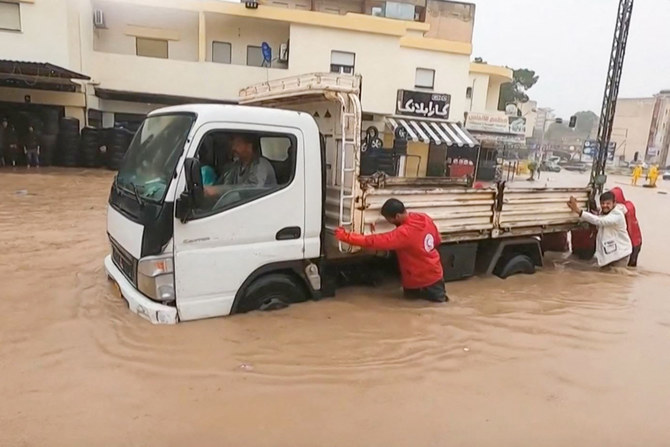
This grab from a video published on the Facebook account of the Libyan Red Crescent on September 11, 2023, shows members of their team assisting drivers whose cars are engulfed in floods in al-Bayda town in eastern Libya. (AFP)
3 / 3
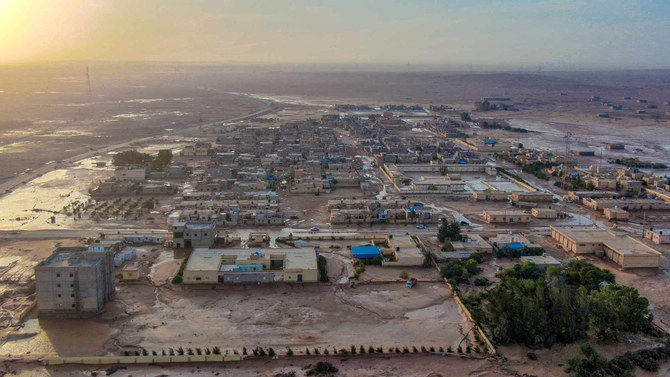
General view of flood water covering the area as a powerful storm and heavy rainfall hit Al-Mukhaili, Libya September 11, 2023, in this handout picture. (REUTERS)
Short Url
Updated 13 September 2023
Follow

How Libya’s chaos left its people vulnerable to deadly flooding

  • Videos of the aftermath show water gushing through the port city’s remaining tower blocks and overturned cars, and later, bodies lined up on sidewalks covered with blankets, collected for burial

LONDON: A storm that has killed thousands of people and left thousands more missing in Libya is the latest blow to a country that has been gutted by years of chaos and division.
The floods are the most fatal environmental disaster in the country’s modern history. Years of war and lack of a central government have left it with crumbling infrastructure that was vulnerable to the intense rains. Libya is currently the only country yet to develop a climate strategy, according to the United Nations.
The north African country has been divided between rival administrations and beset by militia conflict since NATO-backed Arab Spring uprising toppled autocratic ruler Muammar Qaddafi in 2011.
The city of Derna in the country’s east saw the most destruction, as large swaths of riverside buildings vanished, washed away after two dams burst.
Videos of the aftermath show water gushing through the port city’s remaining tower blocks and overturned cars, and later, bodies lined up on sidewalks covered with blankets, collected for burial. Residents say the only indication of danger was the loud sound of the dams cracking, with no warning system or evacuation plan.
Here’s a look at why the storm was so destructive and what obstacles stand in the way of getting aid to those who need it most:
TWO GOVERNMENTS, TWO PRIME MINISTERS
Since 2014. Libya has been split between two rival governments, each backed by international patrons and numerous armed militias on the ground.
In Tripoli, Prime Minister Abdul Hamid Dbeibah heads Libya’s internationally recognized government. In Benghazi, the rival prime minister, Ossama Hamad, heads the eastern administration, which is backed by powerful military commander Khalifa Hiftar.
Both governments and the eastern commander have separately pledged to help the rescue efforts in the flood-affected areas, but they have no record of successful cooperation.
Rival parliaments have for years failed to unify despite international pressure, including planned elections in 2021 that were never held.
As recent as 2020, the two sides were in an all-out war. Haftar’s forces besieged Tripoli in a year-long failed military campaign to try to capture the capital, killing thousands. Then in 2022, former eastern leader Fathi Basagah tried to seat his government in Tripoli before clashes between rival militias forced him to withdraw.
The support of regional and world powers has further entrenched the divisions. Haftar’s forces are backed by Egypt, Russia, Jordan and the United Arab Emirates, while the west Libya administration is backed by Turkiye, Qatar and Italy.
The UAE, Egypt and Turkiye are all helping rescue efforts on the ground. But as of Tuesday, rescue operations were struggling to reach Derna.
Claudia Gazzini, a senior Libya analyst at International Crisis Group, says the problem is partially logistical with many of the roads entering the port city having been severed by the storm. But political strife also plays a role.
“International efforts to send rescue teams have to go through the Tripoli-based government,” said Gazzini. That means permissions to allow aid inside the most affected areas have to be approved by rival authorities.
She was skeptical the Benghazi government could manage the problem alone, she said.
GROWING UNREST AND DISCONTENT
The flooding follows a long line of problems born from the country’s lawlessness.
Last month, protests broke out across Libya after news broke of a secret meeting between the Libyan and Israeli foreign ministers. The demonstrations turned into a movement calling for Debibah to resign.
Earlier in August, sporadic fighting broke out between two rival militia forces in the capital, killing at least 45 people, a reminder of the influence rogue armed groups wield across Libya.
Libya has become a major transit point for Middle Eastern and African migrants fleeing conflict and poverty to seek a better life in Europe. Militias and human traffickers have benefited from the instability in Libya, smuggling migrants across borders from six nations, including Egypt, Algeria and Sudan.
Meanwhile, Libya’s rich oil reserves have done little to help its population. The production of crude oil, Libya’s most valued export, has at times slowed to a trickle due to blockades and security threats to companies. Allocation of oil revenues has become a key point of disagreement.
TALE OF A NEGLECTED CITY
Much of Derna was constructed when Libya was under Italian occupation in the first half of the 20th century. It became famous for its scenic white beachfront houses and palm gardens.
But in the aftermath of Qaddafi’s ouster in 2011, it disintegrated into a hub for extremist groups, was bombarded by Egyptian airstrikes and later besieged by forces loyal to Hiftar. The city was taken by Hiftar’s forces in 2019.
Like other cities in the east of the country, it has not seen much rebuilding or investment since the revolution. Most of its modern infrastructure was constructed during the Qaddafi era, including the toppled Wadi Derna dam, built by a Yugoslav company in the mid 1970s.
According to Jalel Harchaoui, an associate fellow specializing in Libya at the London-based Royal United Services Institute for Defense and Security Studies, Hiftar views the city and its population with suspicion, and has been reluctant to allow it too much independence. Last year, for instance, a massive reconstruction plan for the city was led by outsiders from Benghazi and elsewhere, not natives of Derna.
“Tragically, this mistrust might prove calamitous during the upcoming post-disaster period,” Harchaoui said.


Aoun reassures Lebanon that risk of war is ‘fading’ in year-end message

Lebanese President Joseph Aoun. (File/AFP)
Updated 46 min 55 sec ago
Follow

Aoun reassures Lebanon that risk of war is ‘fading’ in year-end message

  • Israeli military spokesperson said it targeted 380 armed operatives, 950 military sites in Lebanon in past year
  • Beirut’s southern suburb residents pledge to avoid celebratory gunfire on New Year’s Eve

BEIRUT: Lebanese President Joseph Aoun on Wednesday sought to reassure citizens in his year-end address, saying “the overall atmosphere remains positive and the risk of war is fading,” amid widespread concern over a possible Israeli escalation against Hezbollah.

Fear of renewed attacks followed Israeli criticism of a Lebanese Army weapons-confiscation operation that is set to enter its second phase at the start of the 2026. The plan include the expansion from areas north of the Litani River to the Awali River, after the first phase was completed south of the Litani.

President Aoun cautioned that this does not mean “completely eliminating the risk of war,” stressing that “work is underway with various friendly and brotherly countries to completely neutralize the threat of war.”

Addressing Internal Security officials, Aoun said that the “situation is among the best,” noting that this assessment has been echoed by foreign visitors to Lebanon, despite the strain caused by large numbers of Syrian and Palestinian refugees.

He added that security forces were fully carrying out their duties and solving crimes with notable speed, pointing to the successful visit of Pope Leo XIV earlier this year as further evidence of progress.

On Monday, Egyptian Ambassador to Lebanon Alaa Moussa stressed during a Beirut press conference that implementing “international agreements and resolutions, foremost among them the Nov. 27, 2014 agreement and Resolution 1701, constitutes the fundamental approach to sparing Lebanon further security tensions,” speaking of “dire consequences that could result from continued escalation.”

The Egyptian diplomat indicated that “there are no hidden warnings or threats directed at Lebanon, but rather a clear commitment to the agreements signed by the concerned parties, which must be fully implemented by everyone.”

The ambassador stated that his country, under the directives of President Abdel Fattah El-Sisi, is “exerting intensive efforts to reduce tensions in southern Lebanon and the region in general, through active diplomatic contacts led by the Minister of Foreign Affairs Badr Abdelatty with relevant regional and international parties.”

Israeli military spokesman Avichai Adraee published on Wednesday a summary of Israeli attacks on Hezbollah in Lebanon in 2025.

“The Army targeted approximately 380 armed operatives, including Ali Tabatabai (chief of staff), Hassan Kamal (responsible for anti-tank missiles on the southern front), Abbas Hassan Karky (logistics officer in the southern command), and Khodr Saeed Hashem (commander of the naval force in the Radwan Unit),” he said.

“It also attacked approximately 950 military targets, including 210 launch sites and weapons depots, 140 military buildings, and about 60 tunnel entrances,” Adraee added.

In the statement, he accused Hezbollah of committing about 1,920 ceasefire violations and said the military would continue its raids and targeting operations in the new year.

UNIFIL Com. Gen. Diodato Abagnara said in his end-of-the-year message that “UNIFIL will continue to support Lebanon and Israel in implementing their obligations under Resolution 1701, building on the stability achieved in 2025 and strengthening efforts toward a lasting peace.”

As part of the weapons restriction plan, on Tuesday, the Fatah movement — the Palestinian National Security Forces in Lebanon — handed over a new batch of heavy and medium weapons from the Ain Al-Hilweh Palestinian refugee camp to the Lebanese Army in four trucks, away from the media.

This is the second batch of weapons to be handed over from the camp, which is the largest Palestinian refugee camp in Lebanon. It represents the fifth phase of the Palestinian weapons handover process in the camps, four of which were completed between Aug. 21 and Sept. 13, 2025, encompassing nine camps, including Ain Al-Hilweh.

The handover follows and implements an agreement reached between Aoun and Palestinian President Mahmoud Abbas after the latter’s visit to Lebanon in May.

Abbas had announced “the Palestinian Authority’s support for the Lebanese state’s plan to extend its authority over all Lebanese territory, including the Palestinian camps.”

Hamas continues to refuse to hand over its weapons to the Lebanese Army, while Hezbollah maintains its weapons north of the Litani River.

The Lebanese Army implemented “exceptional security measures in various Lebanese regions on New Year’s Eve, with the aim of maintaining security.”

It called on citizens to “cooperate with the security measures taken to maintain public safety and prevent incidents,” warning of the consequences of firing weapons, which will be prosecuted as it poses a threat to public safety.

In another measure, authorities announced that gun licenses and traffic permits will be suspended until Jan. 2, 2026.

In Beirut’s southern suburbs, residents signed a pledge as part of an Internal Security Forces campaign against celebratory gunfire on New Year’s Eve, committing not to fire weapons in public and to report violations with photos or videos.