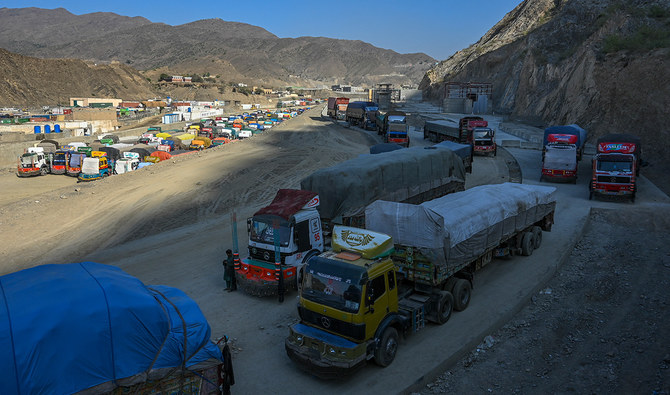

TORKHAM: Hundreds of trucks and travelers were stranded Tuesday on the Afghanistan-Pakistan border, a week into the closure of the nations’ busiest crossing after a gunfight erupted across the frontier.
Islamabad and Kabul have been in diplomatic deadlock since border guards opened fire at the Torkham crossing, halfway between the two capitals, in a dispute over an under-construction Afghan outpost.
Each blamed the other for firing the first salvo last Wednesday, souring already poor relations between Islamabad and Afghanistan’s Taliban rulers.
The Pakistan side of the border — usually bustling with pedestrian and truck traffic — was abandoned on Monday, with markets and offices shut and crowds of travelers sheltering in nearby mosques.
Pakistan is in the grip of an economic downturn, while Afghanistan is still reeling from the mass withdrawal of foreign aid in response to the Taliban’s return to government two years ago.
Jamal Nasir, deputy commissioner of Khyber district, said 1,300 vehicles, including trucks and trailers, were sitting idle waiting for the international trade hub to reopen.
“Fruit and vegetable trucks have been turned back because their cargo was either rotten or feared to rot,” he told AFP.
Ghani Gul, a 55-year-old Afghan, was still stranded in Pakistan six days after attempting to return home after receiving medical treatment in Peshawar.
“I am stuck here, and I have no money left,” he said. “Why should I suffer from the border closure? Both countries should do what they want, but at least leave the border open for common people.”
On the Afghan side, officials and residents staged a small protest on Monday, marching toward the closed border gates.
“Pakistan should not involve traders in politics,” said truck driver Siddiqullah, who goes by one name. “How are traders and the poor at fault?“
Pakistan was one of only three nations to grant formal recognition to the previous Taliban government of 1996-2001.
This time Pakistan, like all others, has withheld recognition. Diplomatic ties have also frayed over frequent flare-ups along their border, including sporadic gunfights and crossing closures.
Islamabad also complains Kabul is failing to secure its frontier — a colonial-era demarcation that every Afghan government has disputed — allowing militants to cross and strike on Pakistan’s soil.
There was an increase in attacks of almost 80 percent in the first half of 2023 compared to last year, according to the Pakistan Institute for Conflict and Security Studies.
The United Nations Security Council has said the Pakistan Taliban, the largest threat to Islamabad, is considered by Kabul to be part of their state and given “safe haven and material and logistical assistance.”
Afghan authorities have repeatedly denied the allegations.
The Pakistan foreign ministry said on Monday “Unprovoked firing by Afghan border security forces invariably emboldens the terrorist elements.”
“Pakistan has continued to exercise restraint and prioritize dialogue in the face of persistent, unwarranted provocations by Afghan troops deployed along the Pakistan-Afghanistan border,” said spokeswoman Mumtaz Zahra Baloch.
The Taliban government’s foreign ministry said at the weekend Pakistan’s alleged attack on its border guards was “contrary to good neighborliness.”
“The closure of the gate cannot be justified under any circumstances,” a statement said.