

US says does not support any one candidate in Pakistan, calls for fair elections

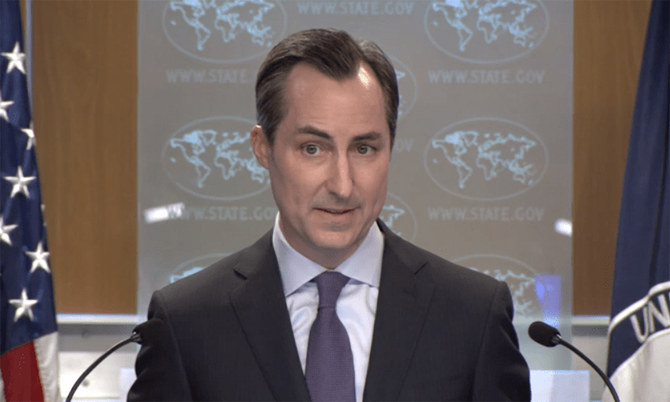
In this file photo, Matthew Miller, the State Department’s spokesperson, addresses a press briefing on June 16, 2023. (Photo courtesy: US State Dept)
Short Url
Updated 12 September 2023
Follow

US says does not support any one candidate in Pakistan, calls for fair elections

  • Elections in Pakistan are widely expected to be delayed to February and beyond due to delimitation of constituencies
  • US State Department spokesperson says Washington will continue to support reforms that improve Pakistan’s economy

ISLAMABAD: US State Department Spokesperson Matthew Miller on Monday clarified Washington’s stance that it does not support any one political entity in Pakistan, urging Islamabad to hold free and fair elections as the country heads toward elections. 

Miller’s remarks follow US Ambassador to Pakistan Donald Blome’s August 24 meeting with Chief Election Commissioner Sikander Sultan Raja in which the American envoy reiterated Washington’s support for free and fair polls in the country. Pakistan is heading toward general elections but polls, which were supposed to be held in November, are widely expected to be delayed to February and beyond since the Election Commission of Pakistan (ECP) first plans to redraw federal and provincial constituencies on the basis of the latest digital census. The ECP has said it would complete the exercise by December 14. 

Pakistan’s election regulator has assured all stakeholders that elections would be held on time and has held consultations with major political parties on redrawing constituencies. The ECP has assured political parties it would hold polls immediately after the exercise is concluded. Most parties have backed the ECP’s decision to redraw constituencies except for former prime minister Imran Khan’s Pakistan Tehreek-e-Insaf (PTI) party, which has described the election regulator’s delimitation timetable as “malicious and a clear deviation from the constitution.” Pakistan’s constitution requires national polls to be held within 90 days after the dissolution of the National Assembly.

“The United States does not take any position with respect to the outcome of an election in Pakistan,” Miller responded to a question about Blome’s meeting with Raja last month, during a US State Department briefing. “We do not support any one political party or any candidate in Pakistan.  But we of course urge free and fair elections in Pakistan, as we do throughout the world.”

Independent analysts have raised concerns about the credibility of the upcoming elections, with Khan behind bars on graft allegations that he says are politically motivated. Khan has accused Pakistan’s powerful military and the previous government of former premier Shehbaz Sharif of attempting to sideline him from politics due to his growing popularity among the masses. Both have categorically rejected the allegations. 

Concerns about whether elections in Pakistan would be free, fair and transparent dominate the political landscape at a time when the South Asian country is reeling from an economic crisis that has seen its national currency weaken considerably against the US dollar while its reserves plummet. Steep power bills amid staggering inflation triggered protests across the country last week and in August, as Islamabad looks to implement tough conditionalities imposed by the International Monetary Fund (IMF) on Pakistan in return for a $3 billion bailout package that it approved in June. 

In response to a question, Miller said Washington would continue to support reforms that improve Pakistan’s economy. 

“I’ve spoken to this on a number of occasions about our support for reforms that would allow the improvement of the economy in Pakistan, and will continue to do so,” the US official said. 


Curfew extended in Gilgit-Baltistan, probe ordered after deadly Khamenei protests

Updated 03 March 2026
Follow

Curfew extended in Gilgit-Baltistan, probe ordered after deadly Khamenei protests

  • At least 15 people were killed in clashes with law enforcement agencies over the weekend in Gilgit-Baltistan
  • Government also announces a de-weaponization campaign, crackdown on hate speech and cybercrime in region

ISLAMABAD: The government in Pakistan’s Gilgit-Baltistan (GB) region on Tuesday extended a curfew in Gilgit district and ordered a judicial probe into violent protests over the killing of Iranian Supreme Leader Ali Khamenei in US-Israeli strikes last week, an official said.

At least 15 people were killed in clashes with law enforcement agencies over the weekend in GB, where protesters torched and vandalized several buildings, including United Nations regional offices, an army-run school, software technology park and a local charity building.

The violence prompted regional authorities to impose curfew in Gilgit and Skardu districts on March 2-4 as officials urged people to stay indoors and cooperate with law enforcers, amid widespread anger in Pakistan, particularly among members of the Shiite minority, over Khamenei’s killing.

On Tuesday, the GB government convened to review the situation and announced the extension of curfew in Gilgit among a number of security measures as well as ordered the establishment of a judicial commission to investigate the weekend violence in the region.

“The government has made it clear that the law will strictly take its course against elements involved in vandalism at government institutions, private properties and incidents of vandalism in Gilgit and Skardu and no kind of mischief will be tolerated,” Shabbir Mir, a GB government spokesperson, said in a statement.

“In view of the security situation, curfew will remain in force in Gilgit, while the decision to extend the curfew in Skardu will be taken keeping the ground realities and the changing situation in view.”

The statement did not specify how long the curfew will remain in place in Gilgit.

Besides the formation of the judicial commission to investigate the violent clashes, the government also decided to launch a large-scale de-weaponization campaign in the entire Gilgit district, for which relevant institutions have been directed to immediately complete all necessary arrangements, according to Mir.

In addition, a crackdown has been ordered on hate speech, spread of fake news and cybercrime.

“The aim of these decisions is to ensure the rule of law, protect the lives and property of citizens and crack down on miscreants,” he said. “Approval has also been given to immediately survey the affected infrastructure and start their restoration work on priority basis.”

Demonstrators in Pakistan’s southern port city of Karachi also stormed the US Consulate on Sunday, smashing windows and attempting to burn the building. Police responded with batons, tear gas, and gunfire, leaving 10 people dead and more than 50 injured.

Pakistani authorities have since beefed up security at US diplomatic missions across the country, including around the US consulate building in Peshawar, to avoid any further violence.