


Pakistani ex-cricketer sentenced to 12 years for threatening Dutch far-right leader

1 / 2
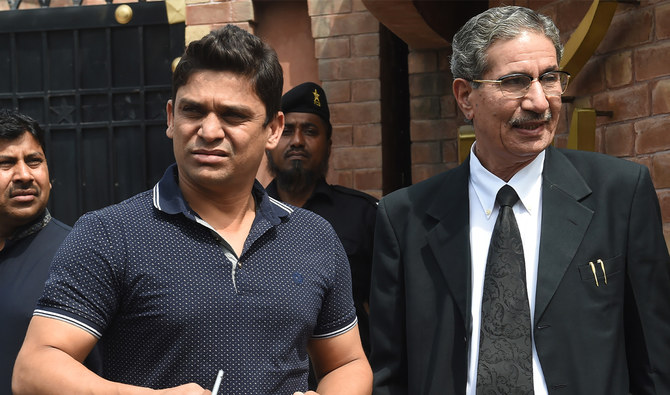
Forner Pakistani cricketer Khalid Latif (L) leaves with his lawyer after appearing before a tribunal in Lahore, Pakistan on March 31, 2017. (Photo courtesy: AFP/File)
2 / 2
Firebrand anti-Islam lawmaker Geert Wilders listened as presiding judge Verbeek, right, delivered the court's verdict against a former Pakistan cricketer accused of incitement to kill, at the high security court building near Schiphol airport, on September 11, 2023 (Photo courtesy: REUTERS_
Short Url
Updated 11 September 2023
Follow

Pakistani ex-cricketer sentenced to 12 years for threatening Dutch far-right leader

  • Khalid Latif, 37, tried in absentia for urging people to murder Dutch far-right leader 
  • Latif received a five-year ban from cricket in 2017 over a spot-fixing scandal 

AMSTERDAM: A Dutch court sentenced a former Pakistani cricketer to 12 years in prison on Monday after he was tried in absentia for urging people to murder Dutch far-right leader Geert Wilders.

The court ruled that the statement by 37-year-old Khalid Latif — who lives in Pakistan and has not attended any stage of the trial or been detained in the Netherlands — should be regarded as incitement to murder, sedition and threat.

Prosecutors said Latif posted a video in 2018, offering a reward for the murder of Wilders. That video came after Wilders said he planned to hold a contest for cartoons depicting caricatures of the Prophet Muhammad (peace be upon him). The competition was later canceled.

Images of the Prophet Muhammad (peace be upon him) are forbidden in Islam as a form of idolatry. Caricatures are regarded by most Muslims as highly offensive.

Reuters was not immediately able to reach Latif — who received a five-year ban from cricket in 2017 over a spot-fixing scandal — for comment. Latif, 37, captained the Pakistan team in the 2010 Asian Games.


Pakistan reviews austerity measures amid Middle East crisis, urges strict nationwide implementation

Updated 5 sec ago
Follow

Pakistan reviews austerity measures amid Middle East crisis, urges strict nationwide implementation

  • Deputy Prime Minister Ishaq Dar chairs review meeting of austerity steps
  • Officials briefed on salary cuts, school closures, four‑day week, petrol conservation

ISLAMABAD: Pakistan’s government on Wednesday assessed progress on a sweeping set of austerity measures introduced to mitigate the country’s economic strain from sharply rising global oil prices and supply disruptions linked to the ongoing war in the Middle East.

Prime Minister Shehbaz Sharif this week announced a series of austerity steps, including a four‑day work week for government offices, requiring 50  percent of staff to work from home, cutting fuel allowances for official vehicles by half, grounding up to 60  percent of the government fleet and closing all schools for two weeks to conserve fuel amid the global oil crisis.

The measures were unveiled in response to global oil market volatility triggered by the conflict involving the United States, Israel and Iran, which has disrupted supply routes such as the Strait of Hormuz and pushed crude prices sharply higher, straining Pakistan’s heavily import‑dependent energy sector.

“The meeting stressed the importance of strict and transparent adherence to the austerity measures, promoting fiscal responsibility and prudent use of public resources,” Deputy Prime Minister and Foreign Minister Senator Mohammad Ishaq Dar said in a statement.

He was chairing a meeting of the Committee for Monitoring and Implementation of Conservation and Additional Austerity Measures, constituted under the directions of the PM, bringing together federal and provincial officials to review execution of the broad cost‑cutting plan. 

Dar emphasized the government’s commitment to enforcing the PM’s austerity steps nationwide. The committee’s review also covered reductions in departmental expenditure, deductions from salaries of senior officials earning over Rs. 300,000 ($1,120), and coordination with provincial administrations to ensure uniform implementation of the plan.

Participants at the meeting reiterated that all ministries and divisions must continue strict monitoring and reporting, with transparent oversight mechanisms, as Pakistan navigates the economic pressures from the prolonged Middle East crisis and its fallout on global energy and trade markets.