

Won’t accept building of ‘unlawful structures,’ Pakistan tells Kabul amid border closure

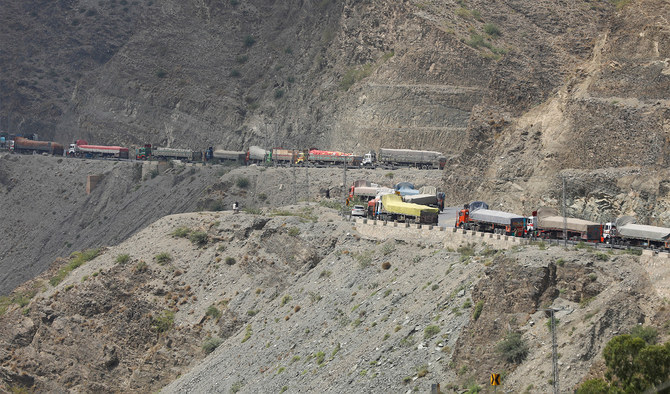
Trucks loaded with supplies to leave for Afghanistan are seen stranded at the Michni checkpost, after the main Pakistan-Afghan border crossing closed after clashes, in Torkham, Pakistan on September 7, 2023. (REUTERS)
Short Url
Updated 11 September 2023
Follow

Won’t accept building of ‘unlawful structures,’ Pakistan tells Kabul amid border closure

  • Pakistan closed Torkham border crossing on Sept. 6 after clashes broke out between Afghan, Pakistani border forces
  • Islamabad urges Kabul to respect its territorial sovereignty, ensure Afghan soil is not used for attacks against Pakistan

ISLAMABAD: Pakistan responded to Afghanistan’s criticism over the closure of the main Torkham border crossing on Monday, saying it will not tolerate the construction of any structures by the Afghan government within its territory and called on Kabul to respect its territorial sovereignty, the foreign ministry said in a statement. 

On September 6, Pakistan closed the busy Torkham border pass which connects Pakistan with landlocked Afghanistan and sees heavy movement of people and goods on a daily basis after clashes between the border forces of the two countries. Pakistani officials said clashes erupted after Afghanistan started illegal construction on Pakistan’s side of the border while Kabul responded by saying its border forces were repairing an old security post. 

Afghanistan said the border clash and closure of the gate were actions “against good neighborliness” and called on Pakistan to reopen the border as trade between the two countries was suffering and a large number of passengers were stranded on both sides of the border. The main border crossing between the two countries remained shut for the sixth day on Monday. 

“Pakistan cannot accept the construction of any structures by IAG inside its territory since these violate its sovereignty,” Pakistan’s foreign office spokesperson, Mumtaz Zahra Baloch, said in a statement. “On the 6th of September, instead of a peaceful resolution, Afghan troops resorted to indiscriminate firing, targeting Pakistan military posts, damaging the infrastructure at the Torkham Border Terminal, and putting the lives of both Pakistani and Afghan civilians at risk, when they were stopped from erecting such unlawful structures.”

“Such unprovoked and indiscriminate firing on Pakistani border posts cannot be justified under any circumstances,” Baloch said, adding that such incidences embolden militants. “These elements are enjoying sanctuaries inside Afghanistan as confirmed by the UN Security Council’s Analytical Support and Sanctions Monitoring Team in its latest report.”

The foreign office spokesperson said Pakistan had always facilitated the Afghan transit trade and would continue to do so. However, she warned Islamabad would not let the agreement be misused. Baloch said Islamabad was ready to resolve bilateral issues and concerns via constructive dialogue so both countries can “reap the dividends of economic connectivity and resultant prosperity.”

“We expect the Afghan interim authorities to be mindful of Pakistan’s concerns, respect the territorial integrity of Pakistan and ensure that the Afghan territory is not used as a launching pad for terrorist attacks against Pakistan,” Baloch added. 

Disputes linked to the 2,600 km (1,615 mile) border between Pakistan and Afghanistan have been a bone of contention between the neighbors for decades. Tensions between the two countries have escalated since November 2022 after the Pakistani Taliban or the Tehreek-e-Taliban Pakistan (TTP) stepped up attacks inside Pakistan when a fragile truce between the two sides broke down. 

Islamabad has repeatedly said militants use Afghanistan’s soil to launch attacks in Pakistan, an accusation the Taliban government has rejected several times. The Afghan government has said Pakistan’s security concerns is its internal problem and has ruled out sheltering TTP militants. 

On September 6, Pakistan’s army said 12 militants and four soldiers had been killed during a gunbattle with security forces in the country’s northwestern Chitral district. The military said militants had crossed over from Afghanistan into the border area and attacked two military posts. It urged Kabul to act against militants and ensure its country is not used as a launching pad for militancy against Pakistan. 


No casualties as blast derails Jaffar Express train in Pakistan’s south

Updated 26 January 2026
Follow

No casualties as blast derails Jaffar Express train in Pakistan’s south

  • Passengers were stranded and railway staffers were clearing the track after blast, official says
  • In March 2025, separatist militants hijacked the same train with hundreds of passengers aboard

QUETTA: A blast hit Jaffar Express and derailed four carriages of the passenger train in Pakistan’s southern Sindh province on Monday, officials said, with no casualties reported.

The blast occurred at the Abad railway station when the Peshawar-bound train was on its way to Sindh’s Sukkur city from Quetta, according to Pakistan Railways’ Quetta Division controller Muhammad Kashif.

No group immediately claimed responsibility for the bomb attack, but passenger trains have often been targeted by Baloch separatist outfits in the restive Balochistan province that borders Sindh.

“Four bogies of the train were derailed due to the intensity of the explosion,” Kashif told Arab News. “No casualty was reported in the latest attack on passenger train.”

The Jaffar Express stands derailed near Abad Railway Station in Jacobabad following a blast on January 26, 2026. (AN Photo/Saadullah Akhtar)

Another railway employee, who was aboard the train and requested anonymity, said the train was heading toward Sukkur from Jacobabad when they heard the powerful explosion, which derailed power van among four bogies.

“A small piece of the railway track has been destroyed,” he said, adding that passengers were now standing outside the train and railway staffers were busy clearing the track.

In March last year, fighters belonging to the Balochistan Liberation Army (BLA) separatist group had stormed Jaffar Express with hundreds of passengers on board and took them hostage. The military had rescued them after an hours-long operation that left 33 militants, 23 soldiers, three railway staff and five passengers dead.

The passenger train, which runs between Balochistan’s provincial capital of Quetta and Peshawar in the country’s northwest, had been targeted in at least four bomb attacks last year since the March hijacking, according to an Arab News tally.

The Jaffar Express stands derailed near Abad Railway Station in Jacobabad following a blast on January 26, 2026. (AN Photo/Saadullah Akhtar)

Pakistan Railways says it has beefed up security arrangements for passenger trains in the province and increased the number of paramilitary troops on Jaffar Express since the hijacking in March, but militants have continued to target them in the restive region.

Balochistan, Pakistan’s southwestern province that borders Iran and Afghanistan, is the site of a decades-long insurgency waged by Baloch separatist groups who often attack security forces and foreigners, and kidnap government officials.

The separatists accuse the central government of stealing the region’s resources to fund development elsewhere in the country. The Pakistani government denies the allegations and says it is working for the uplift of local communities in Balochistan.