

Lula says Putin would not be arrested in 2024 Brazil G20 meeting

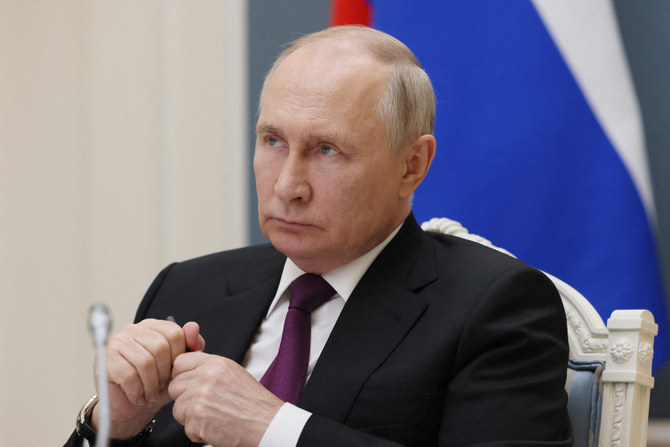
Russia's President Vladimir Putin chairs a meeting on socio-economic development of the Smolensk Region via video link in Moscow on September 9, 2023. (Sputnik handout photo via AFP)
Short Url
Updated 10 September 2023
Follow

Lula says Putin would not be arrested in 2024 Brazil G20 meeting

  • The ICC issued an arrest warrant last March against or the war crime of illegally deporting hundreds of children from Ukraine
  • Brazil will host next year's annual meeting of the G20, composed of the world's top 20 national economies, of which Russia is a member

Brazilian President Luiz Inacio Lula da Silva said on Saturday that Russian leader Vladimir Putin would not be arrested in Brazil if he attends the Group of 20 meeting in Rio de Janeiro next year.
Interviewed on the sidelines of the G20 meeting in Delhi by news show Firstpost, Lula said Putin would be invited to next year’s event, adding that he himself planned to attend a BRICS bloc of developing nations meeting due in Russia before the Rio meeting.
“I believe that Putin can go easily to Brazil,” Lula said. “What I can say to you is that if I’m president of Brazil, and he comes to Brazil, there’s no way he will be arrested.”
The International Criminal Court issued an arrest warrant against Putin in March, accusing him of the war crime of illegally deporting hundreds of children from Ukraine. Russia has denied its forces have engaged in war crimes, or forcibly taken Ukrainian children.
Putin has repeatedly skipped international gatherings, and was not present at the G20 get-together in Delhi, sending Foreign Minister Sergei Lavrov.
Brazil is a signatory to the Rome Statute which led to the founding of the ICC. Lula’s office did not immediately respond to a request for comment.
On Saturday, the G20 nations adopted a consensus declaration that avoided condemning Russia for the war in Ukraine but called on all states not to use force to grab territory. 


’Content to die’: Afghanistan’s hunger crisis worsened by winter, aid cuts

Updated 5 sec ago
Follow

’Content to die’: Afghanistan’s hunger crisis worsened by winter, aid cuts

  • As winter spreads across Afghanistan’s arid landscape, work opportunities have dried up, while the wave of returning Afghans has swelled the population by a tenth, said Aylieff of WFP
  • “Last year was the biggest malnutrition surge ever recorded in Afghanistan and sadly the prediction is that it’s going to get worse“

KABUL: In the dull glow of a single bulb lighting their tent on the outskirts of Kabul, Samiullah and his wife Bibi Rehana sit down to dry bread and tea, their only meal of the day, accompanied by their five children and three-month-old grandchild.
“We have reached a point where we are content with death,” said 55-year-old Samiullah, whose family, including two older sons aged 18 and 20 and their wives, is among the millions deported by neighboring Iran and Pakistan in the past year.
“Day by day, things are getting worse,” he added, after their return to a war-torn nation where the United Nations’ World Food Programme estimates 17 million battle acute hunger after massive cuts in international aid.
“Whatever happens to us has happened, but at least our children’s lives should be better.”
He was one of the returned Afghans speaking before protests in Iran sparked a massive crackdown by the clerical establishment, killing more than 2,000 in ensuing violence.
Samiullah said his family went virtually overnight from its modest home in Iran to their makeshift tent, partially propped up by rocks and rubble, after a raid by Iranian authorities led to their arrests and then deportation.
They salvaged a few belongings but were not able to carry out all their savings, which would have carried them through the winter, Samiullah added.
Reuters was unable to reach authorities in Iran for ⁠comment.
“Migrants who are newly returning to the country receive assistance as much as possible,” said Afghan administration spokesman Zabiullah Mujahid, in areas from transport to housing, health care and food.
It was impossible to eradicate poverty quickly in a country that suffered 40 years of conflict and the loss of all its revenue and resources, he added in a statement, despite an extensive rebuilding effort.
“Economic programs take time and do not have an immediate impact on people’s lives.”
The WFP says Iran and Pakistan have expelled more than 2.5 million Afghans in massive repatriation programs.
Tehran ramped up deportations last year amid a flurry of accusations that they were spying for Israel. Authorities blamed the expulsions on concerns about security and resources.
Islamabad accelerated deportations amid accusations that the Taliban was harboring militants responsible for cross-border attacks ⁠on Pakistani soil, allegations Afghanistan has denied.

NO INCOME, NO AID
As winter spreads across Afghanistan’s arid landscape, work opportunities have dried up, while the wave of returning Afghans has swelled the population by a tenth, said John Aylieff, the WFP’s country director.
“Many of these Afghans were working in Iran and Pakistan and they were sending back remittances,” he told Reuters, adding that 3 million more people now face acute hunger. “Those remittances were a lifeline for Afghanistan.”
Cuts to global programs since US President Donald Trump returned to the White House have sapped the resources of organizations such as the WFP, while other donor countries have also scaled back, putting millions at risk worldwide.
“Last year was the biggest malnutrition surge ever recorded in Afghanistan and sadly the prediction is that it’s going to get worse,” added Aylieff, estimating that 200,000 more children would suffer acute malnourishment in 2026.
At the WFP’s aid distribution site in Bamiyan, about 180 km (111 miles) from Kabul, the capital, are stacks of rice bags and jugs of palm oil, while wheelbarrows trundle in more food, but it is still too little for the long queues of people.
“I am forced to manage the winter with these ⁠supplies; sometimes we eat, sometimes we don’t,” said Zahra Ahmadi, 50, a widowed mother of eight daughters, as she received aid for the first time.

’LIFE NEVER REMAINS THE SAME’
At the Qasaba Clinic in the capital, mothers soothed their children during the wait for medicine and supplements.
“Compared to the time when there were no migrants, the number of our patients has now doubled,” said Dr. Rabia Rahimi Yadgari.
The clinic treats about 30 cases of malnutrition each day but the supplements are not sufficient to sustain the families, who previously relied on WFP aid and hospital support, she said.
Laila, 30, said her son, Abdul Rahman, showed signs of recovery after taking the supplements.
“But after some time, he loses the weight again,” she said.
After the Taliban takeover, she said, “My husband lost his (government) job, and gradually our economic situation collapsed. Life never remains the same.”
The United States led a hasty withdrawal of international forces from Afghanistan in July 2021, after 20 years of war against the Taliban, opening the doors for the Islamists to take control of Kabul.
As dusk gathers and the temperature falls, Samiullah brings in firewood and Bibi Rehama lights a stove for warmth.
“At night, when it gets very cold, my children say, ‘Father, I’m cold, I’m freezing.’ I hold them in my arms and say, ‘It’s OK.’ What choice do we have?” Samiullah said.
“(When) I worked in Iran, at least I could provide a full meal. Here, there is neither work nor livelihood.”