
MALE, Maldives: The Maldives presidential election Saturday was headed toward a second round between the top two candidates after none of the eight contestants secured more than 50 percent of the vote for an outright win, local media reported.
Main opposition candidate Mohamed Muiz secured a surprise lead with more than 46 percent of votes, while the incumbent President Ibrahim Mohamed Solih secured 39 percent in an election that turned into a virtual referendum over which regional power — India or China — will have the biggest influence in the Indian Ocean archipelago state.
The elections commission was scheduled to announce its official results Sunday morning. A second round, if confirmed, will take place later this month.
Saturday’s vote was to choose the country’s fifth freely elected president since Maldives became a multiparty democracy in 2008. Eight candidates are vying for the post with Solih, perceived as pro-India, facing off against his main rival Muiz, who is seen as pro-China.
Solih is seeking a second term and is battling allegations by Muiz that he had allowed India an unchecked presence in the country.
Muiz promised that if he wins the presidency, he will remove Indian troops stationed in the Maldives and balance the country’s trade relations, which he said is heavily in India’s favor.
The People’s National Congress, Muiz’s party, is viewed as heavily pro-China. Its leader, Abdullah Yameen, was president from 2013-2018, during which he made the Maldives a part of China’s Belt and Road initiative. The initiative envisages building ports, railways and roads to expand trade — and China’s influence — across Asia, Africa and Europe.
Mohamed Shareef, a senior official for Muiz’s party, told The Associated Press that the removal of Indian military personnel was a “non-negotiable” position for the party. He said the number of Indian troops and their activities are hidden from Maldivians and that they have near-exclusive use of certain ports and airports in the country.
Both India and China are vying for influence in the tiny state made up of some 1,200 coral islands in the Indian Ocean, located by the main shipping route between East and the West.
Solih was considered the front-runner in the field of eight candidates since his strongest rival, Yameen, was blocked from running by the Supreme Court because he is in prison for corruption and money laundering convictions.
Muiz seems to have taken advantage of a split in Solih’s Maldivian Democratic Party that led Mohamed Nasheed, a charismatic former president, to break away and field his own candidate. Nasheed’s candidate, Ilyas Labeeb, has secured 7 percent of the vote.
Sahida Saeed, a university student who was voting in the Maldives Embassy in neighboring Sri Lanka, said she wanted a leader who can take care of current issues. “Due to the population increase, the employment rates are at risk (of decreasing),” she said.
“Indian influences are a threat to us since military bases are coming to Maldives. And I don’t believe that any other country’s military forces should come to our country and try to take over,” said Isaq Nuhan, a school teacher also voting in Colombo.
Nasheed is backing Labeeb who, though not highly critical of India, has accused Solih of not being transparent in his dealings with New Delhi, said Azim Zahir, a political science and international relations lecturer at the University of Western Australia.
The “India Out” campaign — spearheaded by Muiz’s party — has been ubiquitous on social media in the runup to the election and almost all candidates except Solih adopted the “India vs. the rest” rhetoric, said Zahir.
Solih was widely credited with having brought stability to the country and adeptly handling the COVID pandemic, which was expected to help him gain support.
Solih also had no corruption allegations against him, unlike Muiz, who had served as a housing minister.
There is also a possibility that the mostly Sunni Muslim nation could become more socially conservative because both sides are backed by religious hard-liners. The groups are not known to espouse violence but they want more control over women and are against music and art and religious freedom, Zahir said.
Maldives is believed to have sent the highest number of fighters per capita when the Daesh group was at its height. A local group with the IS ideology set off a bomb targeting Nasheed in 2021, seriously wounding him.
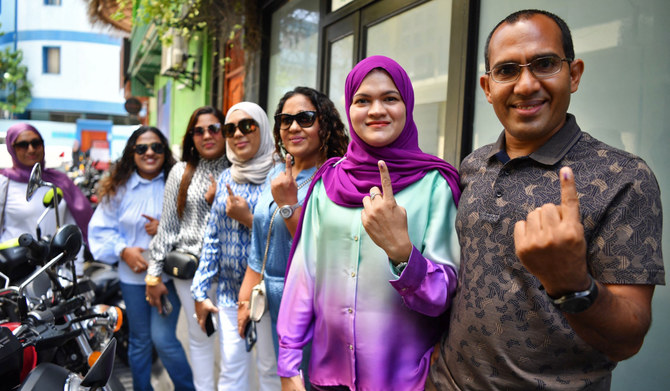
More than 282,000 people were eligible to vote in the election.