

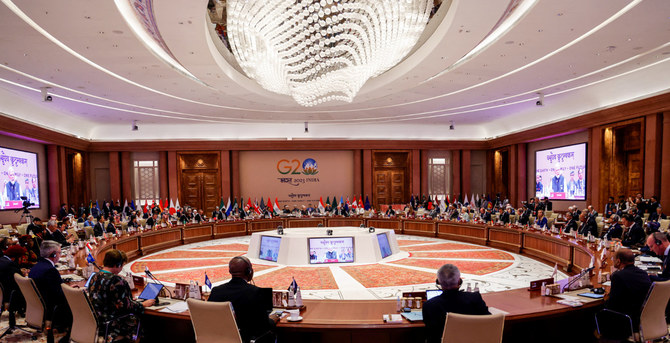

NEW DELHI: The Group of 20 biggest economies reached consensus on a leaders’ declaration, India’s prime minister announced on Saturday, the first day of the bloc’s annual summit taking place in New Delhi.
Leaders of the G20 member states, alongside invited countries and international organizations, have gathered in the Indian capital to discuss pressing challenges facing the global economy at a time when the group is deeply divided over Russia’s war in Ukraine.
Western nations have been pushing for a stronger collective stance condemning Moscow’s actions, while others have called for a greater focus on broader economic issues.
The announcement of the leaders’ declaration, which was expected at the end of the two-day summit, came after delegates from the world’s most powerful countries reportedly reached a compromise on the language used in reference to the war.
“On the back of the hard work of all the teams, we have reached a consensus on the G20 Leaders Summit Declaration,” Narendra Modi told the G20 leaders in attendance. “I announce the adoption of this declaration.”
The 37-page declaration addressed the war in Ukraine immediately after the preamble, and reiterated that the G20 was “not the platform to resolve geopolitical and security issues.”
“We acknowledge that these issues can have significant consequences for the global economy,” the statement read.
“We highlighted the human suffering and negative added impacts of the war in Ukraine with regard to global food and energy security, supply chains, macro-financial stability, inflation and growth, which has complicated the policy environment for countries … There were different views and assessments of the situation.”
The language differed from the one used during the G20 summit in Bali last year, where the declaration said “most members strongly condemned the war.” Draft communiques with such reference to Ukraine this year have reportedly been rejected by Russia and China.
This year’s leaders’ declaration also called for an end to military attacks on infrastructure that could affect food and energy security, while calling “on all states to uphold the principles of international law including territorial integrity and sovereignty, international humanitarian law, and the multilateral system that safeguards peace and stability.”
It added: “We will unite in our endeavor to address the adverse impact of the war on the global economy and welcome all relevant and constructive initiatives that support a comprehensive, just, and durable peace in Ukraine … Today’s era must not be of war.”
The document’s early adoption was viewed as another important breakthrough, not only for the G20, but also for India, which holds this year’s presidency.
“Despite the fact that there was intense speculation about the inability to reach consensus on the Delhi declaration, India has managed to come out with a joint and consensus-based document,” Harsh V. Pant, vice president of the Observer Research in New Delhi, told Arab News.
“It signifies India’s leadership in bringing different contending parties together and in framing the language of the document in a manner that appeals to both sides or all sides when it comes to this issue.”
Consensus was achieved in part thanks to its language, which tied together international law and the territorial integrity of states with the developmental challenges brought about by the Ukraine war in various parts of the world, he said.
“That also allowed the contending parties to continue with the document because, if they did not agree to the document, they would have been seen as spoilers, because India was framing it through the lens of the Global South.”
Under India’s presidency, Modi has been building momentum to give a greater voice and focus to the Global South, a term that broadly comprises low-income nations in Africa, Latin America, the Caribbean, and developing nations in Asia and Oceania.
In a strong step in that direction, the G20 on Saturday welcomed the African Union to join, making it only the second regional bloc to become a permanent member after the EU. The AU’s newly minted membership was also seen as a major achievement for India.
“From the very beginning, India was saying that we need to make multilateral institutions more diverse, more inclusive, and without Africa’s representation as part of the G20, it looked incomplete,” Pant said.
“Bringing the African Union on par with the EU and placing them together on this platform will be remembered as India’s big accomplishment.”
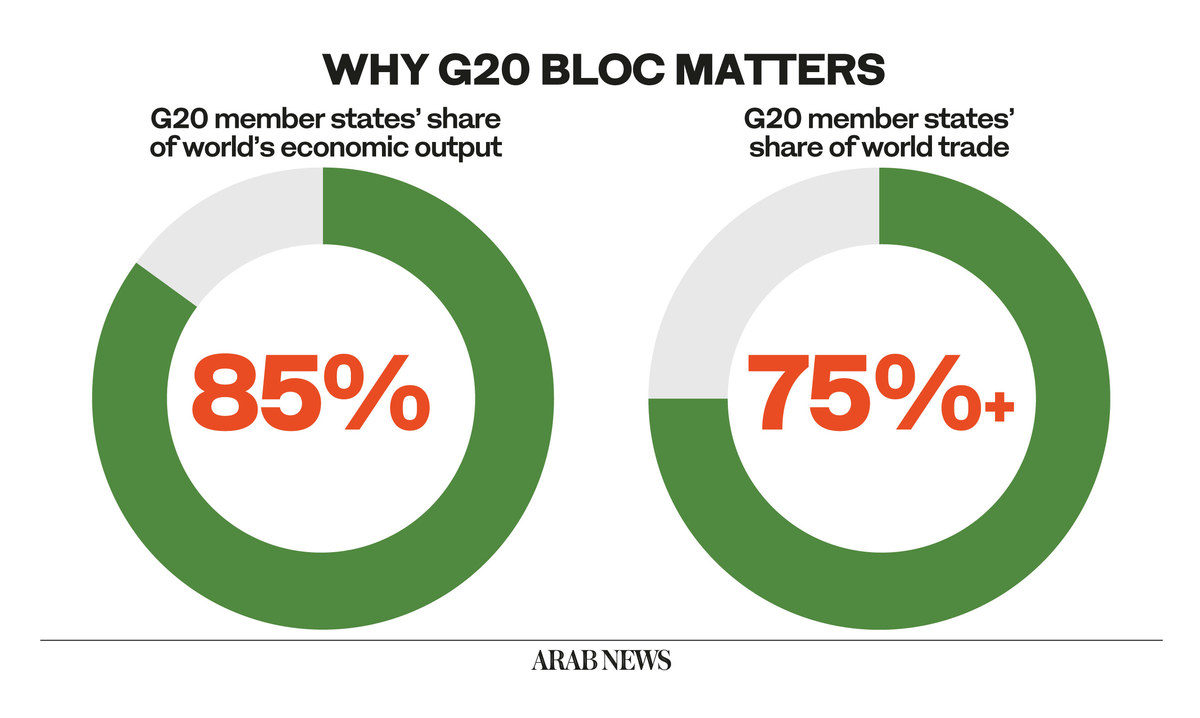
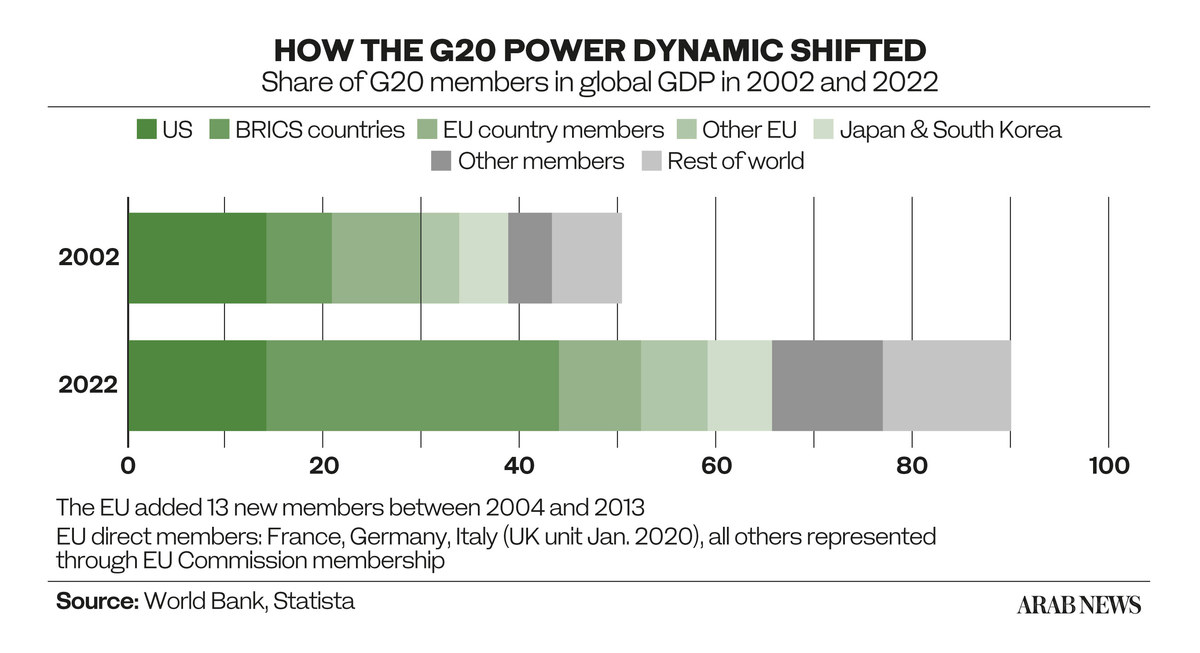
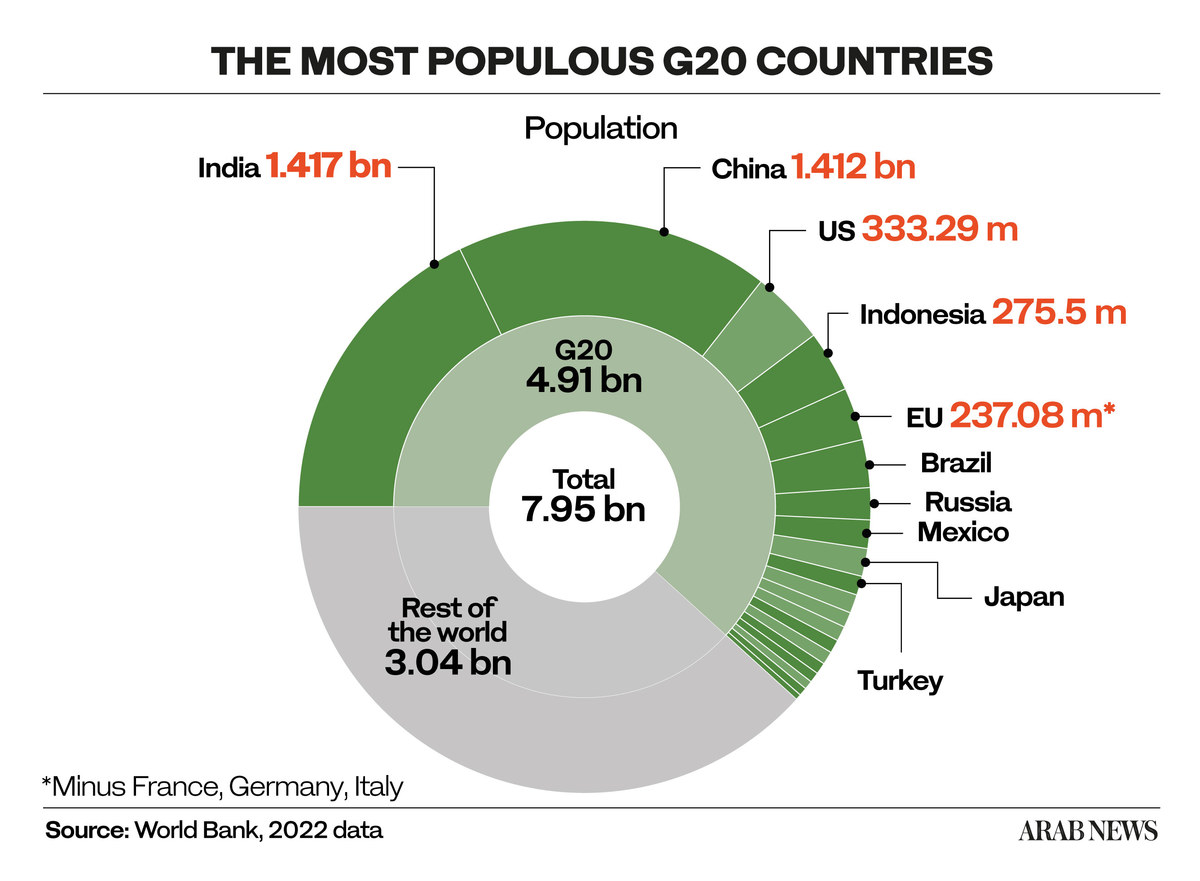
The AU, a body made up of some 55 member states, has long called for African representation among the G20, which previously comprised 19 countries and the EU, representing about 85 percent of global GDP and two-thirds of the world population.
Moussa Faki Mahamat, head of the African Union Commission, took to social media to celebrate the bloc’s entry into the G20.
“I welcome the African Union’s entry into the G20 as a full member,” Mahamat wrote on X, the social media platform formerly known as Twitter.
“This membership, for which we have long been advocating, will provide a propitious framework for amplifying advocacy in favor of the continent and its effective contribution to meeting global challenges.”

The G20 welcomed the African Union to join, making it only the second regional bloc to become a permanent member after the EU. (Supplied)
Bringing the AU into the G20 was in line with India’s “move to act as the voice of the Global South,” Rezaul H Laskar, a senior Indian journalist and strategic affairs expert, told Arab News.
“I think it’s a very significant decision because the AU is, after all, a bloc with 55 countries. There are a lot of countries over there which need to have a greater say in the global governance architecture.”
Laskar said that it was “a very significant decision and it was good to see the African Union president (Azali Assoumani, president of Comoros) being invited to take his place even at the start of the discussions.”
India made big waves on the first day of the summit despite the absence of at least a fifth of G20 heads of state and government. The leaders of Russia, China and Mexico opted not to attend, while Spain’s President Pedro Sanchez was not able to to make it after contracting COVID-19.
Marking the opening of India’s first G20 summit, Modi called on members to overcome a crisis of trust in the world.
“After COVID-19, a huge crisis of lack of trust has come in the world. Conflict has deepened this trust deficit,” he said.
“Today, as the president of the G20, India invites the entire world to come together and, first and foremost, transform this global trust deficit into global trust and confidence. This is a time for all of us to walk together.”


