

Pakistan launches new visa regime for businesses to attract foreign investment

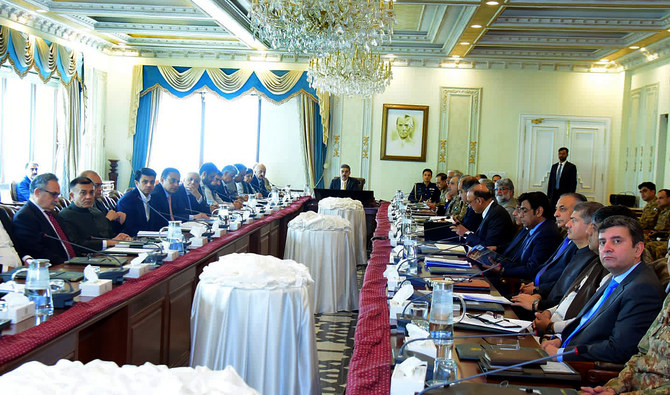
Pakistan Caretaker Prime Minister Anwaar-ul-Haq Kakar chairs the meeting of a Special Investment Facilitation Council in Islamabad on September 9, 2023. (Photo courtesy: Prime Minister's Office)
Short Url
Updated 09 September 2023
Follow

Pakistan launches new visa regime for businesses to attract foreign investment

  • Under the new policy, foreign investors will be able to get long-term visas without lengthy documentation
  • Foreign Minister Jilani says Pakistan wants to increase ease of doing business to secure more investment

ISLAMABAD: Caretaker Prime Minister Anwaar-ul-Haq Kakar unveiled a business-friendly visa regime on Saturday as part of his administration’s initiatives to bolster the national economy following a meeting of the country’s Special Investment Facilitation Council (SIFC).

The council, which is grounded in civil-military collaboration, aims to streamline economic decision-making processes and promote foreign investment, with a special emphasis on enticing financial support from Middle Eastern countries.

A June 17 notification from the office of former Prime Minister Shehbaz Sharif outlined the SIFC’s mission to attract investments across sectors, including energy, information technology, minerals, defense, and agriculture.

“Today, from the platform of SIFC, very important decisions were taken regarding the new visa regime related to an open Pakistan, under which businesspeople who are abroad, if they want to come to Pakistan, will be able to get visas easily from all [diplomatic] missions of the country on the basis of a document from their country or international business organizations,” the prime minister said in a short video statement.

“Along with this, all the entities and businesspeople associated with [local] chambers [of commerce] will also be able to issue [sponsorship] document to any person outside of Pakistan and, based on that, it will be easier to issue visas,” he continued.

Kakar said the new visa policy was not just limited to individuals but would also benefit small and big businesses.

He maintained that Pakistan was entering a new era of business and economy which would take it toward greater prosperity.

His message was followed by a news conference of key members of his interim administration in which foreign minister Jalil Abbas Jilani said the country was pursuing “proactive diplomacy” and had increased its trade with nearly all of its international partners.

He maintained the SIFC was set up to provide a “one-window operation” to all investors and was going to play a vital role in increasing the ease of doing business in the country.

“Pakistan’s diplomatic missions are trying to create greater awareness about the SIFC,” he said. “We have shared all the support material with them [to promote it].”

Jilani informed the new policy would help Pakistan issue “long-term visas” to people interested in doing business in the country.

The fifth meeting of the council’s apex committee was also attended by army chief General Asim Munir, who pledged unwavering support of his institution to the government’s efforts for the economic revival of Pakistan.


Pakistan stocks rebound on easing regional tensions, gain over 1,500 points

Updated 8 sec ago
Follow

Pakistan stocks rebound on easing regional tensions, gain over 1,500 points

  • The development came after Iran said it was keeping communication channels with Washington open amid cost-of-living protests
  • It followed a threat by President Donald Trump last week to intervene militarily if Tehran continued cracking down on protesters

ISLAMABAD/KARACHI: The Pakistan Stock Exchange (PSX) edged higher on Tuesday as the benchmark index gained more than 1,500 points, with analysts citing easing regional tensions following signals of potential talks between Iran and the United States (US).

The benchmark KSE-100 index gained 1,567.36 points, or 0.86 percent, to close at 183,951.50 points, compared to the previous close of 182,384.14 points when the market had shed more than 2,000 points, according to PSX data.

Iran has been witnessing public unrest over worsening economic conditions. Around 2,000 people, including security personnel, have been killed in violent protests, Reuters reported, citing an Iranian official.

Tehran said on Monday that it was keeping communication channels with Washington open as US President Donald Trump imposed 25 percent tariffs on countries trading with the Islamic republic.

“Stocks showed sharp recovery at PSX after Iran and US signal talks over unrest in Iran,” Ahsan Mehanti, chief executive officer at Arif Habib Commodities, told Arab News.

“Surging global crude oil prices and speculations ahead of corporate results in the earnings season played a catalyst role in bullish close.”

Najeeb Ahmed Khan Warsi, digital and retail business officer at Al-Habib Capital Market, said the index had seen a three-day bearish streak.

“Geopolitics and global volatility driving downturn, profit-taking and economic concerns weigh in,” he added.

Meanwhile, Pakistani market research firm Topline Securities said the benchmark index ended the session on a “positive note” on Tuesday.

“Trading interest remained subdued, as total market volumes reached 1,033 million shares, while the value of shares traded stood at Rs62.9 billion,” it said in a daily market review on X.

United Bank Limited (UBL), National Bank of Pakistan (NBP), Muslim Commercial Bank Limited (MCB), Lucky Cement Limited (LUCK) and Meezan Bank Limited (MEBL) jointly contributed 936 points to the index, according to the research firm.

Fauji Fertilizer Company Limited (FFC), Sazgar Engineering Works Limited (SAZEW) and Haleon Pakistan Limited (HALEON) collectively shaved 158 points off the index.

“Bank of Punjab (BOP) led the volume rankings, emerging as the most actively traded stock with 73 million shares,” Topline Securities added.