

US repositioning forces in Niger after military junta tells French troops to leave

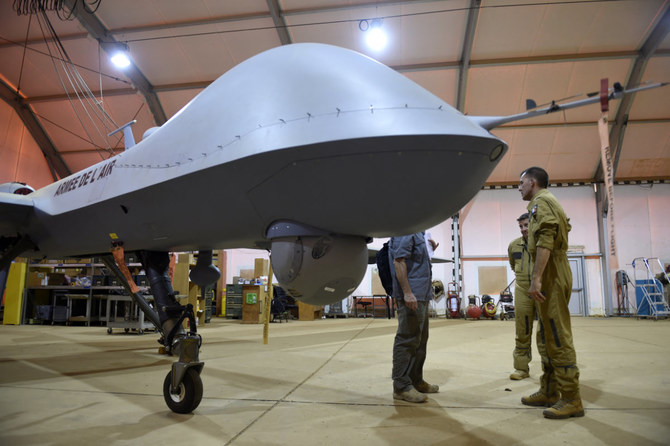
Colonel Eric Bometon (R), commander of the "Detachement Air" (DetAir) of the Operation Barkhane, an anti-terrorist operation in the Sahel, and Commander Paul (2nd R) present an US-made drone Reaper bought by the French army on June 9, 2015 in the French army base in Niamey, Niger. (AFP / File Photo)
Short Url
Updated 08 September 2023
Follow

US repositioning forces in Niger after military junta tells French troops to leave

  • Washington's 1,100 military personnel in Niamey have largely remained on bases after the Niger military takeover
  • Niger has been a key base for both American and French anti-jihadist operations

WASHINGTON: The United States is moving some of its troops from a base in Niger’s capital Niamey — where rebel officers seized power in a July coup — to another in the Agadez area, the Pentagon said Thursday.

Washington has some 1,100 military personnel in the country, but the Defense Department says they have largely remained on bases while curtailing activities such as joint training after the military takeover in Niger.
The United States “is repositioning some of our personnel and some of our assets from Air Base 101 in Niamey to Air Base 201 in Agadez,” Deputy Pentagon Press Secretary Sabrina Singh told journalists.
“There’s no immediate threat to US personnel or violence on the ground,” she said, describing the move as a “precautionary measure.”
A “small group” of personnel will remain at Air Base 101 following the move, which is currently ongoing, Singh said.
She also said “some non-essential personnel and contractors” had previously departed the country.
Niger has been a key base for both American and French anti-jihadist operations, and the repositioning of US troops comes after a French defense ministry source said Paris was holding holds talks with Niger on withdrawing “elements” of its presence there.

There have been days of rallies calling for Niger’s former colonial ruler to remove its forces, and military-appointed Prime Minister Ali Mahaman Lamine Zeine said earlier this week that “contacts” were under way about a “very swift” departure for Paris’ troops.
But Singh said there is “no tie” between the US move and “what the French military is doing right now.”
Niger’s President Mohamed Bazoum was toppled on July 26 by some members of his guard and was detained along with his family.
The West African bloc ECOWAS has taken a hard line on Niger following a cascade of coups in the region, threatening to use force to restore civilian rule.
Troops took power in Mali and Burkina Faso, where like Niger, losses among the armed forces are surging in the face of a long-running jihadist insurgency.
A putsch also took place in Guinea in 2021 after the country’s octogenarian president, Alpha Conde, ran for a third term in office, a move that opponents said breached constitutional limits.
Echoing past US comments, Singh expressed hope for a negotiated solution to the situation in Niger.
“We are hopeful that diplomatic talks will continue and that the situation in Niger will be resolved diplomatically,” she said.


UN experts concerned by treatment of Palestine Action-linked hunger strikers

Updated 8 sec ago
Follow

UN experts concerned by treatment of Palestine Action-linked hunger strikers

  • Eight prisoners awaiting trial for alleged offences connected to the group have taken part in the protest

LONDON: UN human rights experts have raised concerns about the treatment of prisoners linked to Palestine Action who have been on hunger strike while on remand, warning it may breach the UK’s international human rights obligations.

Eight prisoners awaiting trial for alleged offences connected to the group have taken part in the protest, reported The Guardian on Friday.

Among them are Qesser Zuhrah and Amu Gib, who were on hunger strike at HMP Bronzefield from Nov. 2 to Dec. 23, and Heba Muraisi, held at HMP New Hall. Others include Teuta Hoxha, Kamran Ahmed and Lewie Chiaramello, who has refused food on alternate days due to diabetes.

Zuhrah and Gib temporarily resumed eating this week because of deteriorating health but said they plan to resume the hunger strike next year, according to Prisoners for Palestine.

In a statement issued on Friday, UN special rapporteurs, including Gina Romero and Francesca Albanese, said the handling of the prisoners was alarming.

“Hunger strike is often a measure of last resort by people who believe that their rights to protest and effective remedy have been exhausted. The state’s duty of care toward hunger strikers is heightened, not diminished,” they said.

Three of the prisoners were in hospital at the same time on Sunday, with Ahmed admitted on three occasions since the hunger strike began.

The experts said: “Authorities must ensure timely access to emergency and hospital care when clinically indicated, refrain from actions that may amount to pressure or retaliation, and respect medical ethics.”

Prisoners for Palestine has alleged that prison staff initially denied ambulance access for Zuhrah during a medical emergency last week, with hospital treatment only provided after protesters gathered outside the prison.

“These reports raise serious questions about compliance with international human rights law and standards, including obligations to protect life and prevent cruel, inhuman or degrading treatment,” the experts said, adding: “Preventable deaths in custody are never acceptable. The state bears full responsibility for the lives and wellbeing of those it detains. Urgent action is required now.”

Families and supporters have called for a meeting with Justice Secretary David Lammy, while lawyers claim the Ministry of Justice has failed to follow its own policy on handling hunger strikes.

Government officials are understood to be concerned about the prisoners’ condition but cautious about setting a wider precedent.