

Pakistan invites US to join projects under Special Investment Facilitation Council

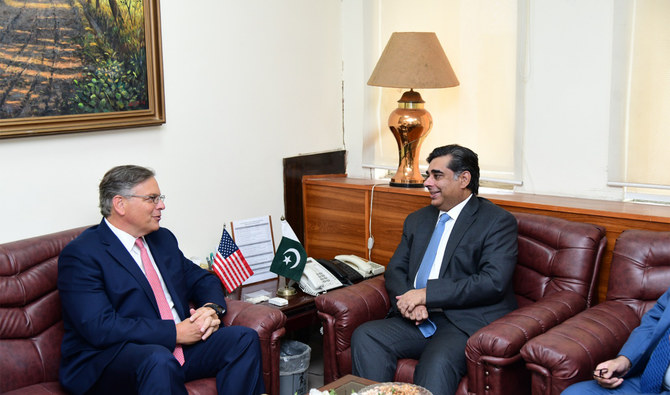
Pakistani caretaker minister for commerce, Dr. Gohar Ejaz (right), meets US Ambassador Donald Blome in Islamabad, Pakistan on September 7, 2023. (Photo courtesy: Government of Pakistan Ministry of Commerce Industries and Production)
Short Url
Updated 07 September 2023
Follow

Pakistan invites US to join projects under Special Investment Facilitation Council

  • SIFC, a civil-military hybrid body, was formed in June to attract investments from GCC and other foreign nations
  • US envoy, commerce minister discuss trade in textiles, value-added food products, mangos, dates, soybean, beef

ISLAMABAD: Pakistani caretaker minister for commerce, Dr. Gohar Ejaz, met US Ambassador Donald Blome on Thursday and invited Washington to explore opportunities under a Special Investment Facilitation Council (SIFC) formed in June to attract foreign investment.

SIFC is a hybrid civil-military forum aimed to fast-track decision making and promote investment from foreign nations, particularly Gulf countries. 

“Ejaz informed [US envoy] that the Government of Pakistan has formed a Special Investment Facilitation Council aimed at attracting investments in various sectors such as Mines and Minerals, Agriculture, Information Technology, and Energy and he invited that more US companies could explore the options to invest in these sectors,” the ministry of commerce said in a statement.

“The Minister elaborated on the government’s efforts for economic revival plan with the Ambassador underscoring the importance of economic growth of Pakistan’s future and appreciated the US government for their continued support.”

Among key highlights of the meeting was a discussion on potential opportunities for boosting trade in various sectors, including textiles, value-added food products, fresh mangos, dates, soybean and beef.

A notification dated June 17 from then Prime Minister Shehbaz Sharif’s Office said SIFC would seek investments in the energy, IT, minerals, mining, defense, and agriculture sectors from GCC countries. 

The body, which has the army chief and other military leaders in key roles, aims to take a “unified approach” to steer the country out of economic crisis.

Pakistan has reportedly approved 20 projects to pitch for multibillion-dollar investments from Gulf and other states under the SIFC umbrella.

The identified projects include the Saudi Aramco Refinery, TAPI Gas Pipeline, Thar Coal Rail Connectivity, hydropower projects of 245 MW in Gilgit-Baltistan, handing over of 85,000 acres of land to a single investor, the establishment of cloud infrastructure, and telecom infrastructure deployment.

On Monday, caretaker Prime Minister Anwaar-ul-Haq Kakar confirmed Pakistan would get $25 billion each from Saudi Arabia and the UAE for investments in IT, mining, minerals and agriculture. Riyadh and Abu Dhabi have not yet commented on the PM’s statement. 


Pakistan says defense pact with Saudi Arabia elevated brotherly ties to ‘new heights’

Updated 25 February 2026
Follow

Pakistan says defense pact with Saudi Arabia elevated brotherly ties to ‘new heights’

  • Pakistan, Saudi Arabia signed strategic defense pact last year pledging aggression against one will be treated as attack on both
  • Deputy PM Ishaq Dar says enduring bonds with Islamic and Arab nations form vital pillar of Pakistan’s foreign policy 

ISLAMABAD: Deputy Prime Minister Ishaq Dar said on Wednesday that Pakistan’s defense pact with Saudi Arabia elevated its brotherly ties with the Kingdom to “new heights,” stressing that close ties with Arab and Islamic nations form a key pillar of Islamabad’s foreign policy. 

Pakistan and Saudi Arabia signed a Strategic Mutual Defense Agreement on Sept. 17 last year, pledging that aggression against one country would be treated as an attack on both, enhancing joint deterrence and formalizing decades of military and security cooperation.

Both nations agreed in October 2025 to launch an economic cooperation framework to strengthen trade and investment ties. 

“In the Middle East, our landmark Strategic Mutual Defense Agreement with Saudi Arabia has elevated our brotherly ties to new heights,” Dar said while speaking at the Pakistan Governance Forum 2026 event in Islamabad. 

The Pakistani deputy prime minister was speaking on the topic “Navigating International Relations Amidst Changing Geo-Politics.”

Dar noted that Pakistan has reinforced partnerships with other Middle Eastern nations such as the UAE, Qatar, Jordan, Oman, Egypt and Bahrain. He said these partnerships have yielded “concrete agreements” in investment, agriculture, infrastructure, and energy sectors. 

“Our enduring bonds with Islamic and Arab nations form a vital pillar of our foreign policy, and we will continue to expand our partnerships across Asia, Latin America, and Africa,” he said. 

Dar pointed out that the presidents of Kazakhstan, Uzbekistan and Kyrgyzstan have undertaken visits to Pakistan in recent months, reflecting Central Asian nations’ desire to boost cooperation with Islamabad.

On South Asia, the Pakistani deputy PM said Pakistan has successfully transformed its fraternal ties with Bangladesh into “a substantive partnership.”

“Similarly, the trilateral mechanism involving China, Pakistan, and Bangladesh has been launched with a view to expanding and deepening regional cooperation and synergy,” the Pakistani minister said. 

He said Islamabad has strengthened its “all-weather” partnership with China via the second phase of the multi-billion-dollar China-Pakistan Economic Corridor agreement and “unwavering support” from both sides for each other’s core interests. 

Dar said Pakistan had also reinvigorated its partnership with the US, advancing cooperation in trade, technology, investment, and regional stability. 

“This calibrated approach has enhanced our ability to navigate complexity with skill and confidence, ensuring that our national interests are served without compromising our core foreign policy principles,” he said.