Nigerian appeals court dismisses challenges against President Bola Tinubu’s election win

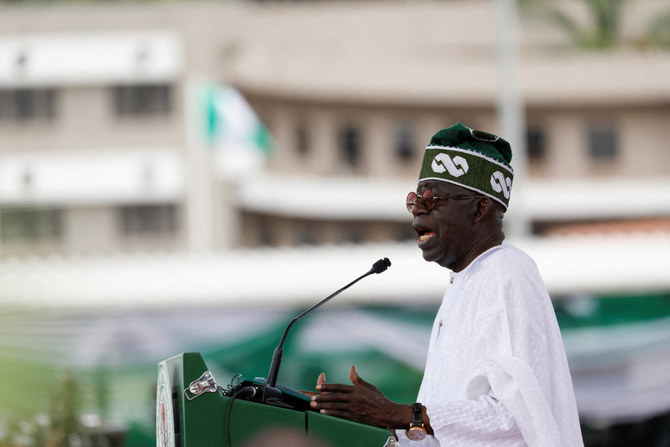
Nigeria's President Bola Tinubu speaks after his swearing-in ceremony in Abuja on May 29, 2023. (REUTERS/File Photo)
Short Url
Updated 07 September 2023
Follow

Nigerian appeals court dismisses challenges against President Bola Tinubu’s election win

  • 3 opposing parties challenged the election results claiming Tinubu was not qualified to run for president because he was a citizen of Guinea
  • Court also ruled that petitioners failed to prove claim that Tinubu was once indicted on drug charges in the US, thereby disqualifying him from running for president

ABUJA, Nigeria: An appeals court in Nigeria on Wednesday rejected petitions filed by the opposition challenging the legitimacy of President Bola Tinubu’s victory in the February election after ruling that the political parties were not able to prove their cases alleging voting irregularities and questioning Tinubu’s qualifications.

Three opposing parties challenged the election results which they said was illegally announced and argued that Tinubu was not qualified to run for president because he was a citizen of Guinea and allegedly did not have the required academic credentials.
The opposition, which had hinted at possible protests if the court upheld Tinubu’s election, rejected the court’s ruling but did not immediately say if they will appeal it. The verdict can be appealed at Nigeria’s Supreme Court within 60 days.
In the Court of Appeal in the Nigerian capital, Abuja, a five-member justice panel, dismissed most of the grounds of the petitions filed by the Peoples Democratic Party’s Atiku Abubakar, a former vice president who came second in the election, the third-place finisher Peter Obi with Labour Party as well as the Allied Peoples Movement.
The panel ruled that Obi was not able to prove his claims that the Nigerian election commission did not follow due process in announcing the results of the vote nor that the voting was marred by irregularities and that he — not Tinubu — won the election with a majority of votes. The court also ruled that he failed to prove his claim that Tinubu was once indicted on drug charges in the United States, thereby disqualifying him from running for president.
“It is clearly evident that the petitioners have failed to discharge the burden of proof placed on them by law,” said Haruna Tsammani, head of the panel. “They have not been able to leave any cogent, credible and acceptable evidence.”
It also rejected a petition by the Allied Peoples Movement which sought to nullify Tinubu’s victory on the ground that his running mate — Vice President Kashim Shettima— was not legally nominated to contest. It said Shettima met the minimum constitutional provisions allowing him to run.
Abubakar’s claims that Tinubu is a citizen of Guinea and was therefore not qualified to contest in the election was also rejected by the court which ruled that the Peoples Democratic Party candidate could not prove his argument.
Tinubu, who is currently attending the G20 summit in India, has denied all the allegations made by the petitioners.
Amid tight security in Abuja, various support groups chanted songs near the court premises to show solidarity with their political parties and to urge the judiciary to “do the right thing.”
A protester, James Mike, said they stood by the court to let the judiciary know “the last hope of the common man depends on” them.
The tribunal is empowered to either uphold Tinubu’s election win, declare someone else the winner, annul the vote, or to order a new election. It would have been a first in Nigeria’s history if the judges upheld the petitions and annulled the presidential election.
A presidential election can be annulled only on the basis of evidence that the Independent National Electoral Commission did not follow the law and acted in ways that might have affected an election’s outcome.
Since Nigeria returned to democracy in 1999, all presidential elections but one have been contested in court. None were overturned.
Police in Abuja issued a statement Tuesday warning citizens “to be cautious in their actions and statements,” saying security forces would not “condone activities capable of inciting violence or causing a descent into anarchy.”
The 71-year-old Tinubu won the election with less than 50 percent of the vote, also a first in Nigeria’s history. The election was largely described by observers as an improvement from the 2019 election, although critics also said the delays in uploading — and announcing — election results could have given room for ballot tampering, critics say.
Since taking office in May, Tinubu introduced measures that he said would reform the country’s ailing economy but which have further squeezed millions of poor and hungry Nigerians during his first 100 days in office. Most of the Nigerian leader’s reforms, though well-intentioned, have been poorly implemented, critics have said.
On Tuesday, Nigeria Labor Congress workers launched a two-day “warning strike” to protest the growing cost of living due to the removal of gas subsidies, threatening to “shut down” Africa’s largest economy if their demands for improved welfare are not met. It was their second strike in over a month.
The Nigerian government urged citizens to be patient with Tinubu. Mohammed Idris, Nigeria’s minister of information, said though steps taken by the government “to save the country from hitting the rocks brought momentary discomfort to Nigerians,” the president has “never failed in his appeal to Nigerians to see the current inconveniences as a price we must all pay to save our country from disappearing.”


Old Delhi iftars revive Mughal heritage, one course at a time

Updated 58 min 2 sec ago
Follow

Old Delhi iftars revive Mughal heritage, one course at a time

  • Dastarkhwan-e-Jahaanuma iftars have been held in Old Delhi since 2017
  • Muslim and non-Muslim participants arrive from across India and abroad

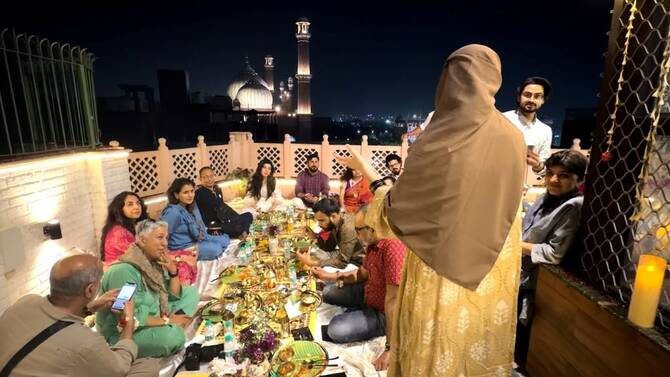
NEW DELHI: On a rooftop in Delhi’s historic walled city, guests from across India sit on cushions around a low table overlooking Jama Masjid, waiting for its sunset call to prayer — the signal to start a special iftar that will take them back four centuries, to the Mughal era, if only for a while.

Mughals ruled the Indian subcontinent between the 16th and 19th centuries. Originally from Central Asia, they carried traditions borrowed from Arabs, Persians and Ottomans, which they merged with the various local Indian styles — a fusion that marked the global revival of Islamic architecture and culture.

Jama Masjid is one of the most iconic examples of the Mughal style — a scenic background to the curated iftars that bring 40 to 50 people from across India to share a meal, knowledge and experience.

“People getting together from different walks of life, different parts of the country, different religions, different cultures coming together — it was absolutely and completely amazing,” said Arvind Sirohi, who took part in the event with his wife.

“Lovely storytelling, amazing food, and end of the day, right next to Jama Masjid in Old Delhi. The ambience, the environment, the atmosphere came together so beautifully.”

The community-led iftar experience is called Dastarkhwan-e-Jahaanuma — from Urdu words meaning a “spread of food” and “showing the world.”

For Veena Sirohi, it did exactly what the name promised by bringing together people from different communities, different parts of India, and abroad.

“I think that’s a great way of synthesizing different cultures, bringing people together, bringing the human aspect of what we all are ... we are actually all one,” she told Arab News.

“And we had some wonderful comperes who told us about … the history of Ramadan, what goes behind it, how the food is curated, and how each and every item has a specific place in the menu.”

Served in gilded bowls and plates from traditional Indian crockery, with rose petals dotting the dastarkhwan cloth, the dishes were some of the festive Ramadan delicacies, offering a taste of Mughal culinary heritage.

Among them was mutanjan, or fragrant rice cooked with ghee, sugar, saffron, cardamom, and studded with nuts, which for many Indian Muslims is traditionally the first dish to break the fast.

It was followed by shabde, a rich, slow-cooked aromatic meat stew or the Delhi biryani — a fragrant, mildly spiced saffron rice and meat dish, where marinated chicken or mutton is layered with basmati rice and cooked slowly.

The hearty feast closed with nihari, a hearty stew simmered overnight with spices and bone marrow, which emerged in the 18th century and was originally eaten by Mughal royals for breakfast.

“These are the traditional dishes which are not usually available in the market, but are specially prepared by the bawarchees (cooks) of Old Delhi. Some of the dishes are occasional dishes,” said Abu Sufiyan Khan, the founder of Tales of City, the cultural experience company that has been curating Dastarkhwan-e-Jahaanuma since 2017.

The special iftars are hosted once a week throughout the fasting month, usually on weekends. There are variations in dishes served as they come from different kitchens, as Tales of City collaborates with various local artisans and cooks.

“We are curating this with different experts and every time the menu changes,” Khan said.

“We bring all these dishes onto a single dastarkhwan, and we share this meal with the people coming from all over India to break bread together in the holy month of Ramadan, know each other, learn about each other’s culture, and create a dialogue space where we can have more meaningful conversations and an opportunity to get to know each other.”

Those who take part, like Ayandrali Dutta, a food critic, appreciate everything about the experience, especially as it takes place in Old Delhi, where the vibe is always “jovial, lively, in all positive ways” during Ramadan.

“You get to meet interesting people, you get to hear interesting stories ... It’s a great initiative to show what Ramadan is, what kind of food is eaten, talk about the cultures between Lucknow and Delhi and other parts of the country. And it just brings a lot of happiness,” she said.

“I loved it. My heart is happy, my belly is full. Nothing else I can ask for.”