



RIYADH: The fintech sector is thriving in the Kingdom, which could be gauged through the fact that the share of digital payments reached 62 percent close enough to Saudi Arabia’s target of 70 percent by the end of 2025, said a top official of the central bank.
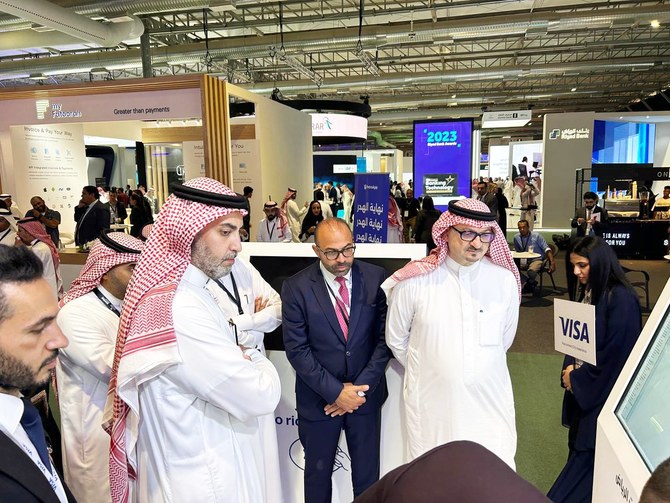
Speaking at the opening of a two-day Seamless Saudi Arabia 2023 in Riyadh, Khalid Walid Al-Dhaher, vice governor for supervision and technology at the Saudi Central Bank, highlighted the growth of the Saudi financial sector since the launch of Vision 2030.
“We have witnessed a significant increase in the number of financial technology companies, reaching 183 companies by the end of the second quarter of 2023. This achievement represents 80 percent of the target set for the year 2025, which is 230 companies,” he said.
SAMA’s aim is to enable financial institutions to promote the expansion of the private sector, create possibilities for new categories of stakeholders, and accelerate the digitization of payments.
Al-Dhaher said the growth of fintech will support “institutions and enable small and emerging businesses to introduce innovative and modern financial products such as e-wallets and digital financing platforms.”
The official said the Regulatory Sandbox Strategy is open to both international and domestic firms interested in testing fintech solutions in a real environment.
There are now 45 fintech companies operating in the regulatory sandbox, he said. “It also aims to achieve a cumulative value of bold financial investment reaching SR12.2 billion ($3.2 billion). The goal is for the fintech sector to contribute SR13.3 billion to the gross domestic product by 2030,” Al-Dhaher said.
Saudi Arabia’s digital economy is witnessing significant expansion, as the Kingdom recorded more than 8 billion transactions with a value of SR1.6 trillion in 2022, up from around SR6 billion transactions in 2021, according to a statement by the managing director of Saudi Payments, also known as Mada.
Speaking during a panel discussion, Abdulaziz Al-Afaleg highlighted how the financial ecosystem has grown in the Kingdom.
He said Mada will launch a new digital platform soon, which will be combined with data services and provide valuable inputs to the markets regarding the data flowing through the payment systems.
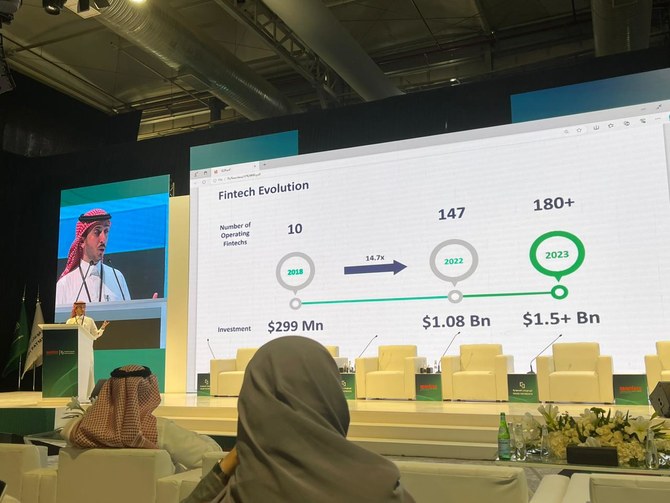
In another panel discussion, Nezar Alhaidar, managing director of Fintech Saudi underlined how Vision 2030 is serving as a catalyst for the growth and evolution of various industries including fintech.
“Back then in 2018, we had almost $300 million invested in the ecosystem. Today, we have over 180 fintech (firms) operating in Saudi Arabia and the invested amount is close to SR1.5 billion,” Alhaidar said.
The event witnessed the participation of experts from different financial sectors such as banking technology, payments and fintech, and retail, e-commerce, and marketing, hosting over 500 exhibitors to showcase innovative solutions and startups from across the region.
On the payment front, Saudi Arabia is seamlessly leading in terms of NFC payments, as the Kingdom has experienced a remarkable surge in mobile payment usage accounting for about 45 percent of transactions, Nassir Ghrous, vice president of Thales, Banking and Payment Services, told Arab News in an interview on the sidelines of the event.
“The fintech segment is key to drive and steer innovation in the payment industry. I think this is something that is fully aligned with Vision 2030, and that has been promoted by the Kingdom very successfully. So, what we do with the fintech is to allow them to get the space and to help modernization,” he said.
According to Checkout.com, e-commerce in the Kingdom has entered a steady phase of high growth, presenting expanded opportunities for both emerging entrepreneurs and well-established financial institutions.
“Ninety-one percent of consumers in the Kingdom now prefer to shop online and 14 percent of them shop every day,” Checkout.com’s Remo Giovanni Abbondandolo, general manager for Middle East and North Africa, told Arab News.
“When the trend started to boom in the region, specifically in Saudi Arabia we saw homegrown companies such as Tamara growing and taking the lead. That is why we wanted to support these payment methods,” Abbondandolo said.
As a knowledge partner at the conference, the General Authority for Small and Medium Enterprises, also known as Monsha’at, is actively participating in Seamless.


