Ukraine’s Zelensky moves to replace wartime defense minister

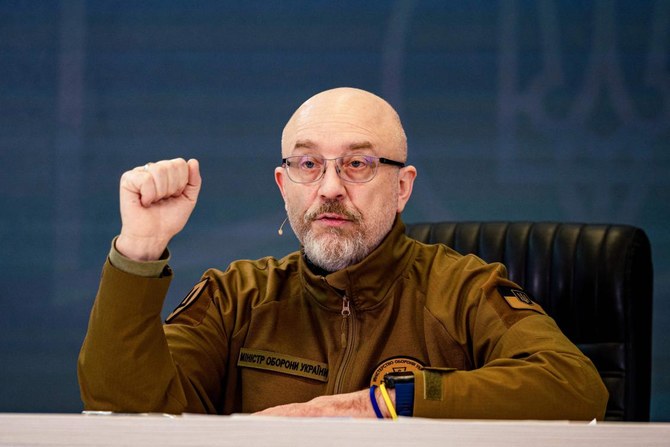
Ukrainian Defence Minister Oleksii Reznikov speaks during a press conference in Kyiv. (File/AFP)
Short Url
Updated 03 September 2023
Follow

Ukraine’s Zelensky moves to replace wartime defense minister

  • The announcement sets the stage for the biggest shakeup of Ukraine’s defense establishment during the war launched by Russia in February 2022

KYIV: Ukraine President Volodymyr Zelensky said Sunday that defense minister Oleksii Reznikov will be replaced this week with Rustem Umerov, a Crimean Tatar lawmaker.
Zelensky made the announcement on his official Telegram account.
“I have decided to replace the Minister of Defense of Ukraine. Oleksii Reznikov has gone through more than 550 days of full-scale war. I believe that the Ministry needs new approaches and other formats of interaction with both the military and society at large. Now Rustem Umerov should lead the Ministry,” he said.
Umerov, 41, a politician with the opposition Holos party, has served as head of the State Property Fund of Ukraine since September 2022. He was involved in the exchange of prisoners of war, political prisoners, children and civilians, as well as the evacuation of civilians from occupied territories. Umierov was also part of the Ukrainian delegation in negotiations with Russia over the UN-backed grain deal.
The announcement came after two people were hospitalized following a 3½-hour Russian drone barrage on a port in Ukraine’s Odesa region on Sunday, officials said.
The attack on the Reni seaport comes a day before Russian President Vladimir Putin is due to meet with his Turkish counterpart Recep Tayyip Erdogan to discuss the resumption of food shipments from Ukraine under a Black Sea grain agreement that Moscow broke off from in July.
Russian forces fired 25 Iranian-made Shahed drones along the Danube River in the early hours of Sunday, 22 of which were shot down by air defenses, the Ukrainian air force said on Telegram.
Ukrainian President Volodymyr Zelensky ‘s chief of staff, Andriy Yermak, described the assault as part of a Russian drive “to provoke a food crisis and hunger in the world.”
Russia’s Defense Ministry said in a statement that the attack was aimed at fuel storage facilities used to supply military equipment.
Putin and Erdogan’s long-awaited meeting is due to take place in Sochi on Russia’s southwest coast on Monday.
Turkish officials have confirmed that the pair will discuss renewing the Black Sea grain initiative, which the Kremlin pulled out of six weeks ago.
The deal — brokered by the United Nations and Turkiye in July 2022 — had allowed nearly 33 million metric tons (36 million tons) of grain and other commodities to leave three Ukrainian ports safely despite Russia’s war.
However, Russia broke away from the agreement after claiming that a parallel deal promising to remove obstacles to Russian exports of food and fertilizer hadn’t been honored.
Moscow complained that restrictions on shipping and insurance hampered its agricultural trade, even though it has shipped record amounts of wheat since last year.
The Sochi summit follows talks between the Russian and Turkish foreign ministers on Thursday, during which Russia handed over a list of actions that the West would have to take in order for Ukraine’s Black Sea exports to resume.
Erdogan has indicated sympathy with Putin’s position. In July, he said Putin had “certain expectations from Western countries” over the Black Sea deal and that it was “crucial for these countries to take action in this regard.”
Elsewhere in Ukraine, three people were killed in two separate attacks by Russian shelling in the Donetsk area Sunday. An 85-year-old man was named among the victims after being crushed by the rubble of his own home, Ukraine’s Prosecutors’ Office reported.
A 36-year-old man was also killed in another Russian attack on Ukraine’s Kherson region.
Ukrainian prosecutors announced Sunday that they had opened a war crimes investigation into the death of a police officer killed by Russian shelling on the town of Seredyna-Buda on Saturday afternoon.
Two other police officers and one civilian were wounded during the attack, which hit Ukraine’s north-eastern Sumy region.


Mystery of CIA’s lost nuclear device haunts Himalayan villagers 60 years on

Updated 4 sec ago
Follow

Mystery of CIA’s lost nuclear device haunts Himalayan villagers 60 years on

  • Plutonium-fueled spy system was meant to monitor China’s nuclear activity after 1964 atomic tests
  • Porter who took part in Nanda Devi mission warned family of ‘danger buried in snow’

NEW DELHI: Porters who helped American intelligence officers carry a nuclear spy system up the precarious slopes of Nanda Devi, India’s second-highest peak, returned home with stories that sent shockwaves through nearby villages, leaving many in fear that still holds six decades later.

A CIA team, working with India’s Intelligence Bureau, planned to install the device in the remote part of the Himalayas to monitor China, but a blizzard forced them to abandon the system before reaching the summit.

When they returned, the device was gone.

The spy system contained a large quantity of highly radioactive plutonium-238 — roughly a third of the amount used in the atomic bomb dropped by the US on the Japanese city of Nagasaki in the closing stages of the Second World War.

“The workers and porters who went with the CIA team in 1965 would tell the story of the nuclear device, and the villagers have been living in fear ever since,” said Narendra Rana from the Lata village near Nanda Devi’s peak.

His father, Dhan Singh Rana, was one of the porters who carried the device during the CIA’s mission in 1965.

“He told me there was a danger buried in the snow,” Rana said. “The villagers fear that as long as the device is buried in the snow, they are safe, but if it bursts, it will contaminate the air and water, and no one will be safe after that.”

During the Sino-Indian tensions in the 1960s, India cooperated with the US in surveillance after China conducted its first nuclear tests in 1964. The Nanda Devi mission was part of this cooperation and was classified for years. It only came under public scrutiny in 1978, when the story was broken by Outsider magazine.

The article caused an uproar in India, with lawmakers demanding the location of the nuclear device be revealed and calling for political accountability. The same year, then Prime Minister Morarji Desai set up a committee to assess whether nuclear material in the area near Nanda Devi could pollute the Ganges River, which originates there.

The Ganges is one of the world’s most crucial freshwater sources, with about 655 million people in India, Nepal, and Bangladesh depending on it for their essential needs.

The committee, chaired by prominent scientists, submitted its report a few months later, dismissing any cause for concerns, and establishing that even in the worst-case scenario of the device’s rupture, the river’s water would not be contaminated.

But for the villagers, the fear that the shell containing radioactive plutonium could break apart never goes away, and peace may only come once it is found.

Many believe the device, trapped within the glacier’s shifting ice, may have moved downhill over time.

Rana’s father told him that the device felt hot when it was carried, and he believed it might have melted its way into the glacier, remaining buried deep inside.

An imposing mass of rock and ice, Nanda Devi at 7,816 m is the second-highest mountain in India after Kangchenjunga. 

When a glacier near the mountain burst in 2021, claiming over 200 lives, scientists explained that the disaster was due to global warming, but in nearby villages the incident was initially blamed on a nuclear explosion.

“They feared the device had burst. Those rescuing people were afraid they might die from radiation,” Rana said. “If any noise is heard, if any smoke appears in the sky, we start fearing a leak from the nuclear device.”

The latent fear surfaces whenever natural disasters strike or media coverage puts the missing device back in the spotlight. Most recently, a New York Times article on the CIA mission’s 60th anniversary reignited the unease.

“The apprehensions are genuine. After 1965, Americans came twice to search for the device. The villagers accompanied them, but it could not be found, which remains a concern for the local community,” said Atul Soti, an environmentalist in Joshimath, Uttarakhand, about 50 km from Nanda Devi.

“People are worried. They have repeatedly sought answers from the government, but no clear response has been provided so far. Periodically, the villagers voice their concerns, and they need a definitive government statement on this issue.”

Despite repeated queries whenever media attention arises, Indian officials have not released detailed updates since the Desai-appointed committee submitted its findings.

“The government should issue a white paper to address people’s concerns. The white paper will make it clear about the status of the device, and whether leakage from the device could pollute the Ganges River,” Soti told Arab News.

“The government should be clear. If the government is not reacting, then it further reinforces the fear.”