

Inflation stalls high in Pakistan despite IMF bailout

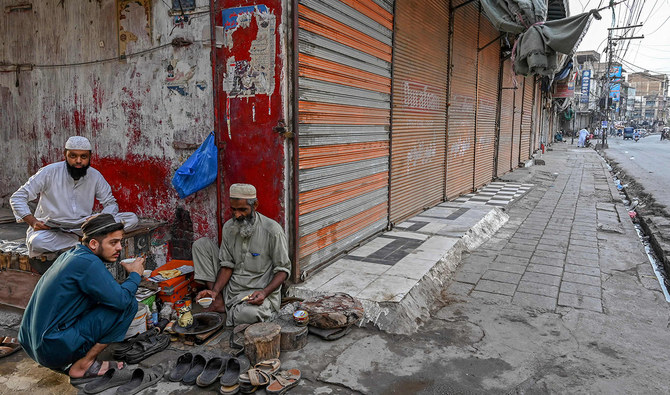
A cobbler drinks tea with friends aside closed shops along a roadside in Peshawar on September 2, 2023, during a nationwide strike by traders against the surge in electricity and fuel prices. (Photo courtesy: AFP)
Short Url
Updated 02 September 2023
Follow

Inflation stalls high in Pakistan despite IMF bailout

  • Pakistan was on the brink of default this summer, before the IMF agreed to a lifeline deal on condition that government cut subsidies 
  • Since then, the rupee has crossed a historic threshold of 300, while petrol prices and electricity costs have spiked, sowing discontent 

ISLAMABAD: Pakistan’s headline inflation persisted at 27.4 percent year-on-year in August, official data showed, as a tumbling rupee and soaring bills blamed on an IMF bailout package hampered government efforts to rein in prices. 

Pakistan was on the brink of default this summer, before the International Monetary Fund agreed to a lifeline deal on condition that the government cut subsidies that had cushioned living costs. 

Since then, the rupee has crossed a historic threshold of 300 to the dollar, whilst Islamabad has hiked petrol prices and electricity costs have spiked, sowing widespread discontent. 

Prices rose 1.7 percent month-on-month in August, according to government statistics released Friday, and the year-on-year figure of 27.4 percent was only one point shy of July’s, signalling little relief. 

In August, motor fuel cost eight percent more than July, whilst water bills in urban areas rose more than 11 percent and the price of tomatoes was up as much as 82 percent. 

Pakistan’s retailers said they will keep shops shuttered Saturday in protest over the soaring costs which have become a lightning rod for public anger ahead of forthcoming general elections. 


Pakistan nears $1.5 billion deal to supply weapons, jets to Sudan

Updated 09 January 2026
Follow

Pakistan nears $1.5 billion deal to supply weapons, jets to Sudan

  • Deal may include drones, air defense systems and Karakoram-8 aircraft, with possible JF-17 fighters
  • The sale is expected to bolster Sudan’s army in the ongoing civil war with the Rapid Support Forces

ISLAMABAD: Pakistan is in the final phases of striking a $1.5-billion deal to supply weapons and jets to Sudan, a former top air force official and three sources said, promising a major boost for Sudan’s army, battling the paramilitary Rapid Support Forces.

Their conflict has stoked the world’s worst humanitarian crisis for more than 2-1/2 years, drawing in myriad foreign interests, and threatening to fragment the strategic Red Sea country, a major gold producer.

The deal with Pakistan encompasses 10 Karakoram-8 light attack aircraft, more than 200 drones for scouting and kamikaze attacks, and advanced air defense systems, said two of the three sources with knowledge of the matter, who all sought anonymity.

It was a “done deal,” said Aamir Masood, a retired Pakistani air marshal who continues to be briefed on air force matters.

Besides the Karakoram-8 jets, it includes Super Mushshak training aircraft, and perhaps ‌some coveted JF-17 ‌fighters developed jointly with China and produced in Pakistan, he added, without giving figures ‌or ⁠a delivery ‌schedule.

Pakistan’s military and its defense ministry did not immediately respond to requests for comment.

A spokesman for Sudan’s army did not immediately respond to a message requesting comment.

Assistance from Pakistan, especially drones and jets, could help Sudan’s army regain the air supremacy it had toward the start of its war with the RSF, which has increasingly used drones to gain territory, eroding the army’s position.

PAKISTAN’S DEFENSE AMBITIONS

The deal is another feather in the cap for Pakistan’s growing defense sector, which has drawn growing interest and investment, particularly since its jets were deployed in a conflict with India last year.

Last month, Islamabad struck a weapons deal worth more than $4 billion with the Libyan National Army, officials said, for one of the South Asian nation’s largest arms sales, which includes JF-17 fighter jets and training aircraft.

Pakistan has also held talks with Bangladesh on a defense deal that could includes the Super Mushshak training jets and JF-17s, as ties improve ties with Dhaka.

The government sees Pakistan’s burgeoning industry as a catalyst to secure long-term economic stability.

Pakistan is now in a $7-billion IMF program, following a short-term ‌deal to avert a sovereign default in 2023. It won IMF support after Saudi Arabia and other Gulf allies provided financial and deposit rollovers.