

Pope praises Mongolia’s tradition of religious freedom from times of Genghis Khan at start of visit

1 / 6
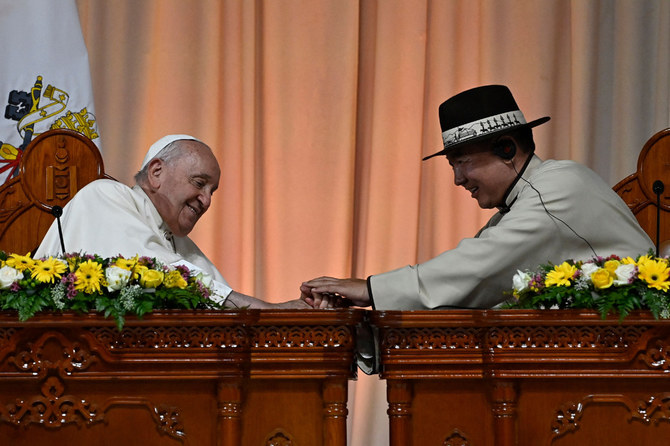
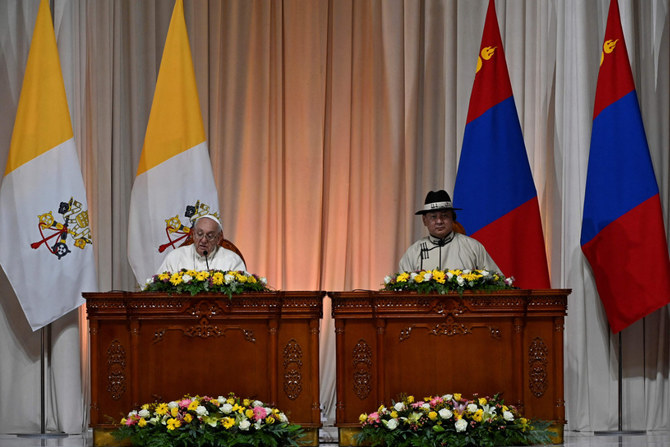
Mongolia's President Ukhnaagiin Khurelsukh (R) and Pope Francis attend a meeting with Mongolian authorities, members of the civil society and the diplomatic corps at the Mongol hall of the State Palace in Ulaanbaatar on September 2, 2023. (Pedro Pardo/AFP)
2 / 6
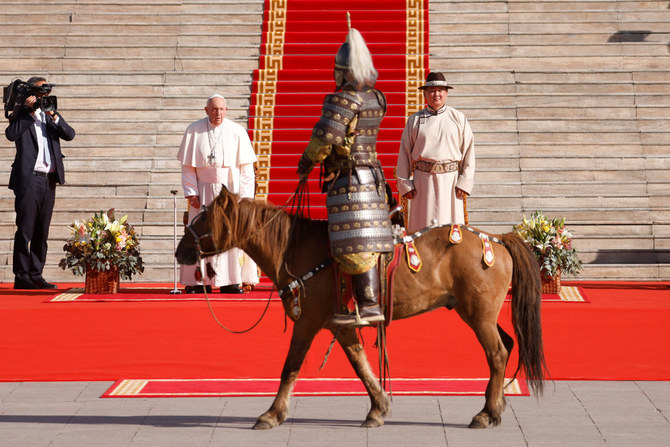
Pope Francis attends a welcome ceremony with President Ukhnaagiin Khurelsukh at Sukhbaatar Square, during his Apostolic Journey in Ulaanbaatar, Mongolia September 2, 2023. (REUTERS/Carlos Garcia Rawlins)
3 / 6
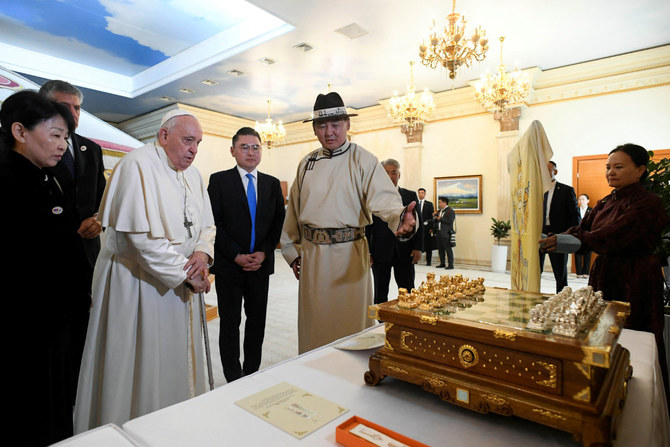
Mongolian President Ukhnaagiin Khurelsukh speaks to Pope Francis during a courtesy visit at the State Palace in Sukhbaatar Square in Ulaanbaatar on September 2, 2023. (Vatican Media/Handout via REUTERS)
4 / 6
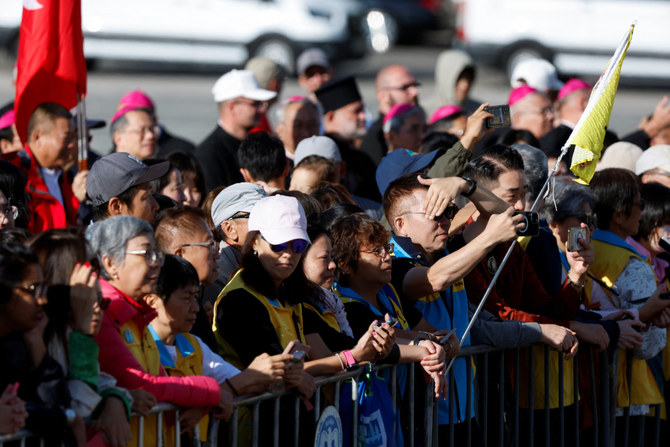
People gather ahead of Pope Francis's welcome ceremony with President Ukhnaagiin Khurelsukh at Sukhbaatar Square in Ulaanbaatar on September 2, 2023. (REUTERS/Carlos Garcia Rawlins)
5 / 6
Pope Francis attends a welcome ceremony with President Ukhnaagiin Khurelsukh at Sukhbaatar Square, during his Apostolic Journey in Ulaanbaatar, Mongolia September 2, 2023. (REUTERS/Carlos Garcia Rawlins)
6 / 6
Mongolia's President Ukhnaagiin Khurelsukh (R) and Pope Francis attend a meeting with Mongolian authorities, members of the civil society and the diplomatic corps at the Mongol hall of the State Palace in Ulaanbaatar on September 2, 2023. (Pedro Pardo/AFP)
Short Url
Updated 02 September 2023
Follow

Pope praises Mongolia’s tradition of religious freedom from times of Genghis Khan at start of visit

  • Warns about the threat represented by today’s consumerist spirit and said religions can help guard against it
  • Also cites the need to combat corruption; Mongolia has declared 2023 to be an “anti-corruption year”

ULAANBAATAR, Mongolia: Pope Francis on Saturday praised Mongolia’s tradition of religious freedom dating to the times of its founder, Genghis Khan, as he opened the first-ever papal visit to the Asian nation with a plea for peace and an end to the “insidious threat of corruption.”
Francis met with President Ukhnaagiin Khurelsukh inside a traditional Mongolian ger, or round yurt, set up inside the state palace, and wrote a message in the guest book that he was visiting Mongolia, “a country young and ancient, modern and rich of tradition,” as a pilgrim of peace.
“May the great clear sky, which embraces the Mongolian land, illuminate new paths of fraternity,” he wrote.
Francis is visiting Mongolia to minister to its young Catholic community of 1,450 and make a diplomatic foray into a region where the Holy See has long had troubled relations, with Russia to the north and China to the south.
While Christianity has been present in the region for hundreds of years, the Catholic Church has only had a sanctioned presence in Mongolia since 1992, after the country abandoned its Soviet-allied communist government and enshrined religious freedom in its constitution.

In his remarks, Francis praised Mongolia’s tradition of religious liberty, noting that such tolerance existed even during the period of the Mongol Empire’s vast expansion over much of the world. At its height, the empire stretched as far west as Hungary and remains the largest contiguous land empire in world history.
“The fact that the empire could embrace such distant and varied lands over the centuries bears witness to the remarkable ability of your ancestors to acknowledge the outstanding qualities of the peoples present in its immense territory and to put those qualities at the service of a common development,” Francis said. “This model should be valued and re-proposed in our own day.”
Francis, however, noted the need to combat corruption, an apparent reference to a scandal over Mongolia’s trade with China over the alleged theft of 385,000 tons of coal. In December, hundreds of people braved freezing cold temperatures in the capital to protest the scandal.
Francis warned about the threat represented by today’s consumerist spirit and said religions can help guard against an “individualistic mindset that cares little for others and for sound, established traditions.”


People gather ahead of Pope Francis's welcome ceremony with President Ukhnaagiin Khurelsukh at Sukhbaatar Square in Ulaanbaatar on September 2, 2023. (REUTERS/Carlos Garcia Rawlins)

“At the same time, they also represent a safeguard against the insidious threat of corruption, which effectively represents a serious menace to the development of any human community; corruption is the fruit of a utilitarian and unscrupulous mentality that has impoverished whole countries,” he said. “It is a sign of a vision that fails to look up to the sky and flees the vast horizons of fraternity, becoming instead self-enclosed and concerned with its own interests alone.”
The Mongolian government has declared 2023 to be an “anti-corruption year” and says it is carrying out a five-part plan based on Transparency International, the global anti-graft watchdog that ranked Mongolia 116th last year in its corruption perceptions index.
Later Saturday, Francis was to meet with the priests and missionaries who tend to the country’s tiny Catholic community at the capital’s St. Peter and Paul Cathedral.


After accepting US deportees, South Sudan wanted sanctions relief for top official, documents show

Updated 1 sec ago
Follow

After accepting US deportees, South Sudan wanted sanctions relief for top official, documents show

JUBA: After agreeing to accept deportees from the United States last year, South Sudan sent a list of requests to Washington that included American support for the prosecution of an opposition leader and sanctions relief for a senior official accused of diverting over a billion dollars in public funds.
The requests, contained in a pair of diplomatic communications made public by the State Department this month, offer a glimpse into the kind of benefits that some governments may have sought as they negotiated with the US over the matter of receiving deportees.
In the documents, the US expresses “appreciation” to South Sudan for accepting the deportees and details the names, nationalities and crimes for which each individual was convicted.
In July, South Sudan became the first African country to receive third-country deportees from the US Rwanda, Eswatini, Ghana and Equatorial Guinea have since received deportees.
The eight deportees to South Sudan included nationals of Mexico, Cuba, Vietnam, Laos, Myanmar and South Sudan itself.
Contentious deportations
They arrived in the South Sudanese capital of Juba after spending weeks on a US military base in Djibouti, where they were held after a US court temporarily blocked their deportation. Six of the eight men remain at a residential facility in Juba under the supervision of security personnel.
South Sudanese national Dian Peter Domach was later freed, according to the Ministry of Foreign Affairs, while Jesus Munoz-Gutierrez, a Mexican, was repatriated in September.
South Sudanese officials have not publicly said what long-term plan is in place for those still in custody. The third-country deportations were highly contentious, criticized by rights groups and others who expressed concern South Sudan would become a dumping ground.
Details of the deal between the US and South Sudan remain murky. It is still unclear what, if anything, South Sudan may have actually received or been promised. The documents only offer a glimpse into what the South Sudanese government hoped to get in return.
In other cases, Human Rights Watch said it saw documents showing the US agreed to pay Rwanda’s government around $7.5 million to take up to 250 deportees. The US will give Eswatini $5.1 million to take up to 160 deportees, according to the group.
For South Sudan, in one communication dated May 12 and marked confidential, South Sudan’s Ministry of Foreign Affairs raised eight “matters of concern which the Government of South Sudan believes merit consideration.” These ranged from the easing of visa restrictions for South Sudanese nationals to the construction of a rehabilitation center and “support in addressing the problem of armed civilians.”
Request to lift sanctions
But an eye-catching ask was for the lifting of US sanctions against former Vice President Benjamin Bol Mel as well as Washington’s support for the prosecution of opposition leader Riek Machar, the now-suspended first vice president of South Sudan who faces treason, murder and other criminal charges in a controversial case.
The allegations against Machar stem from a violent incident in March, when an armed militia with historical ties to him attacked a garrison of government troops. Machar’s supporters and some activists describe the charges as politically motivated.
Bol Mel is accused of diverting more than a billion dollars earmarked for infrastructure projects into companies he owns or controls, according to a UN report. He wielded vast influence in the government and was touted by some as Kiir’s likely successor in the presidency until he was dismissed and placed under house arrest in November.
Bol Mel was also viewed as a key figure behind the prosecution of Machar, one of the historical leaders of South Sudan’s ultimately successful quest for independence from Sudan in 2011.
Machar was Kiir’s deputy when they fell out in 2013, provoking the start of civil war as government troops loyal to Kiir fought forces loyal to Machar.
A 2018 peace agreement brought Machar back into government as the most senior of five vice presidents. His prosecution has been widely criticized as a violation of that agreement, and has coincided with a spike in violence that the UN says killed more than 1,800 people between January and September 2025.
The UN has also warned that a resurgence of fighting has brought the country “back to the edge of a relapse into civil war.” Machar is under house arrest in Juba while his criminal trial proceeds slowly.
In its communications with the US, South Sudan also asked for sanctions to be lifted over South Sudanese oil companies “to encourage direct foreign investments,” and for the US to consider investing in other sectors including fossil fuels, minerals and agriculture.
When asked if the US government had provided or promised South Sudan anything in return for accepting the deportees, a State Department official said, “In keeping with standard diplomatic practice, we do not disclose the details of private discussions.”
A spokesman for South Sudan’s Ministry of Foreign Affairs, Thomas Kenneth Elisapana, declined to comment.
US aid cuts
Despite accepting the US request to admit deportees, relations between the two governments have been strained in recent months.
In December, the US threatened to reduce aid contributions to the country, accusing the government of imposing fees on aid groups and obstructing their operations.
The US has historically been one of the largest donors to South Sudan, providing roughly $9.5 billion in aid since 2011. Over the years, South Sudan’s government has struggled to deliver many of the basic services of a state, and years of conflict have left the country heavily reliant on foreign aid.