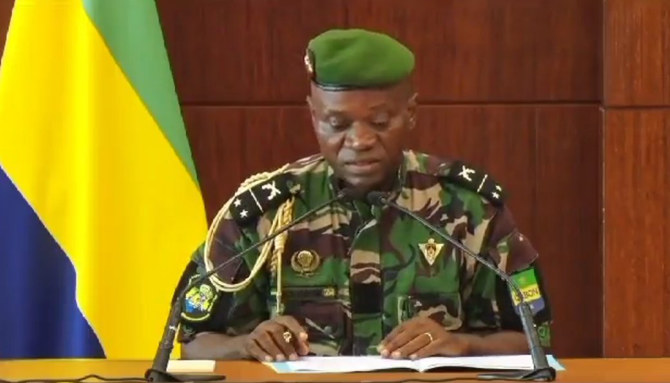


LIBREVILLE: The leader of a coup that this week overthrew Gabon’s President Ali Bongo said on Friday that he wanted to avoid rushing into elections that “repeat past mistakes,” as pressure mounted on the junta to hand back power to a civilian government.
Military officers led by General Brice Oligui Nguema seized power on Wednesday, minutes after an announcement that Bongo had secured a third term in an election.
The officers placed Bongo under house arrest and installed Nguema as head of state, ending the Bongo family’s 56-year hold on power.
The coup — West and Central Africa’s eighth in three years — drew cheering crowds onto the streets of the capital Libreville, but condemnation from abroad and at home.
Nguema said in a televised address on Friday evening that the junta would proceed “quickly but surely” but that it would avoid elections that “repeat the same mistakes” by keeping the same people in power.
“Going as quickly as possible does not mean organizing ad hoc elections, where we will end up with the same errors,” he said.
Central African regional bloc ECCAS has urged partners led by the United Nations and the African Union to support a rapid return to constitutional order, it said in a statement after an extraordinary meeting on Thursday. It said it would reconvene on Monday.

This video grab shows coup supporters cheering police officers in Libreville, Gabon, on Aug. 30, 2023. Gabon's opposition leader accused the family of the recently ousted president of engineering his removal from power in order to retain their control in the oil-rich Central African nation. (AP Photo/File)
Gabon’s main opposition group, Alternance 2023, which says it is the rightful winner of Saturday’s election, urged the international community on Friday to encourage the junta to hand power back to civilians.
“We were happy that Ali Bongo was overthrown but ... we hope that the international community will stand up in favor of the Republic and the democratic order in Gabon by asking the military to give back the power to the civilians,” Alexandra Pangha, spokesperson for Alternance 2023 leader Albert Ondo Ossa, told the BBC.
She said that the junta’s plan to inaugurate Nguema as head of state on Monday was “absurd.”
Crackdown on Bongo entourage
Bongo was elected in 2009, taking over from his late father who came to power in 1967. Opponents say the family did little to share Gabon’s oil and mining wealth.
For years the Bongo family occupied a luxurious palace overlooking the Atlantic Ocean. They own expensive cars and properties in France and the United States, often paid for in cash, according to a 2020 investigation by the Organized Crime and Corruption Reporting Project (OCCRP), a global network of investigative journalists.
Meanwhile, almost a third of the country’s 2.3 million people live in poverty.
Military leaders ordered the arrest of one of Bongo’s sons, Noureddin Bongo Valentin, and several members of Bongo’s cabinet early on Wednesday on accusations ranging from alleged embezzlement to narcotics trafficking.
State broadcaster Gabon 24 said on Thursday that duffel bags stuffed with cash wrapped in plastic had been confiscated from the homes of various officials. Its footage included a raid on the house of former cabinet director Ian Ghislain Ngoulou.
Standing next to Bongo Valentin, he told the channel that the money was part of Bongo’s election fund. It was unclear when the images were shot.
Lawyers for Bongo’s wife said on Friday that Bongo Valentin was incarcerated in an undisclosed location, and the family were concerned about his safety.

A campaign billboard of ousted Gabon President Ali Bongo Ondimba is seen along a street in Libreville on September 1, 2023. (AFP)
The streets of Libreville were calm on Friday under a heavy security force presence. Talk focused on the junta’s response.
“You need politicians to manage a transition, and above all a state,” said retired Libreville resident Timothe Moutsinga.
“We expect a lot from this government and this transition, a transfer of power to civilians.”
The takeover in Gabon follows coups in Guinea, Chad and Niger, plus two each in Mali and Burkina Faso since 2020. The takeovers have erased democratic gains in a region where insecurity and widespread poverty have weakened elected governments, worrying international powers with strategic interests at stake.
The White House said on Friday that it was pursuing “viable diplomatic solutions” to the situations in both Gabon and Niger, where a coup ousted President Mohamed Bazoum on July 26.
Alternance 2023 has said it wants a full vote count from Saturday’s election, which it said would show Ondo Ossa had won. Gabon’s election commission said after the election that Bongo had been re-elected with 64 percent of the vote, while Ondo Ossa secured almost 31 percent. Ballot counting was done without independent observers amid an Internet blackout.
Pangha said the opposition hoped to get an invitation from the junta to discuss the Central African country’s transition plan but said it had not received anything yet.
The African Union’s Peace and Security Council on Thursday called for fair and transparent elections. It said it will impose sanctions on the coup leaders if they do not restore constitutional order.
France, Gabon’s former colonial ruler, and other Western powers have condemned the takeover.