Iraq reports huge illegal drugs seizure, two arrests

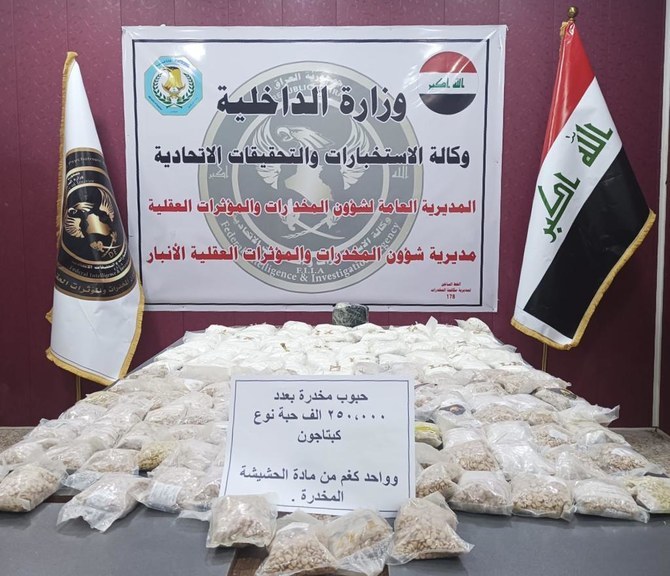
Iraqi security forces said Thursday they had seized 15 tonnes of illegal drugs, contraband pharmaceuticals and precursor chemicals and made two arrests. (X/@socialmoigoviq/File)
Short Url
Updated 31 August 2023
Follow

Iraq reports huge illegal drugs seizure, two arrests

  • They said the chemical components confiscated in Baghdad are used to manufacture crystal meth and captagon
  • The drug squad made the seizure in an upscale neighborhood of the capital, the interior ministry said

BAGHDAD: Iraqi security forces said Thursday they had seized 15 tons of illegal drugs, contraband pharmaceuticals and precursor chemicals and made two arrests.
They said the chemical components confiscated in Baghdad are used to manufacture crystal meth and captagon — two drugs whose consumption has surged in Iraq in recent years.
The drug squad made the seizure in an upscale neighborhood of the capital, the interior ministry said in a statement.
“Two suspects were arrested and brought to justice,” said Col. Bilal Sobhi, spokesman for the unit that is attached to the ministry.
The squad confiscated “15 tons of narcotics, chemical components used in the manufacture of drugs, and contraband medicines not registered with the health ministry,” he said.
Sobhi said the chemical components seized are used to make captagon, a synthetic amphetamine-type drug, and crystal meth or methamphetamine.
Iraqi authorities regularly announce the seizure of captagon pills, usually from neighboring Syria, the top supplier for the illicit market in Saudi Arabia and other wealthy Gulf countries.
War-scarred Iraq, originally mainly a drug transit country, has faced an explosion in narcotics use in recent years, mainly of captagon and crystal meth.
In early August, Iraqi justice officials announced the arrest of a trafficker in possession of 35 kilograms of opium and more than half a million captagon tablets.


UNESCO fears for fate of historical sites during Iran war

Updated 5 sec ago
Follow

UNESCO fears for fate of historical sites during Iran war

  • “UNESCO is deeply concerned by the first impact that the hostilities are already having on many world heritage sites,” Assomo said
  • Tehran’s Golestan palace, damaged in US–Israeli strikes, is testimony to the grandeur of Iran’s civilization in the 19th century

PARIS: UNESCO said it is deeply concerned about the fate of world heritage sites in Iran and across the region, after Tehran’s Golestan palace, often compared to Versailles, and a historic mosque and palace in Isfahan were damaged in the war.
The United Nations’ cultural agency on Wednesday urged all parties to protect the region’s outstanding cultural sites, saying four of Iran’s 29 world heritage sites had been damaged since the start of the US and Israeli war with Iran.
“UNESCO is deeply concerned by the first impact that the hostilities are already having on many world heritage sites,” Lazare Eloundou Assomo, director of the World ⁠Heritage Center, told Reuters, ⁠adding he was also concerned for sites in Israel, Lebanon and across the Middle East.
Tehran’s Golestan palace, damaged in US–Israeli strikes, is testimony to the grandeur of Iran’s civilization in the 19th century, he said.
The palace was chosen as the Persian royal residence and seat of power by the Qajar family and shows the introduction ⁠of European styles in Persian arts, according to the UNESCO website. The last Shah of Iran, Mohammad Reza Pahlavi, held a coronation ceremony there in 1969.
“We sometimes even compare it with the Versailles Palace in France, for instance, and it has suffered, unfortunately, some damage. We don’t know the extent for the moment. But clearly, with the images that we have been able to receive, we can confirm ... it has been affected,” Eloundou Assomo said.
Photos of the interior of the palace have shown piles of smashed glass and shards of ⁠wood on ⁠the floor, and shattered woodwork.
Isfahan was one of Central Asia’s most important cities and a key point on the Silk Road trading route. Its Masjed-e Jame (Jameh Mosque) is more than 1,000 years old and shows the development of Islamic art through 12 centuries.
Buildings close to the buffer zone of the prehistoric sites of the Khorramabad Valley have also been damaged, UNESCO said.
UNESCO has shared coordinates of key cultural sites to all parties, Eloundou Assomo said, and was monitoring damage.
“We are calling for the protection of all sites of cultural significance ... everything that tells the history of all the civilizations of the 18 countries in the region,” he said.