

Northwest Pakistani province on high alert as over 100 dengue cases reported in a week

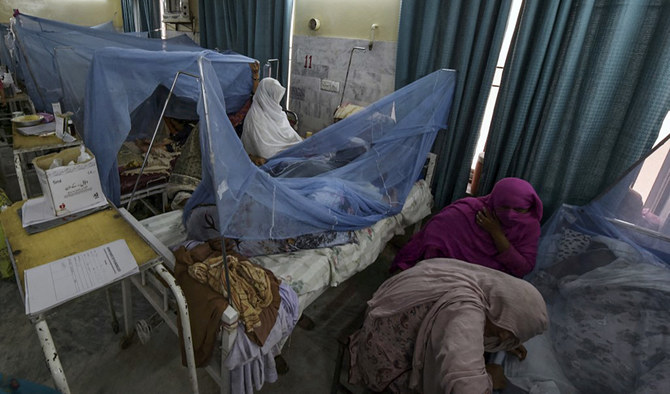
Relatives accompany patients suffering from dengue fever on beds under netting at a hospital in Peshawar, Pakistan on September 12, 2019. (AFP/File)
Short Url
Updated 30 August 2023
Follow

Northwest Pakistani province on high alert as over 100 dengue cases reported in a week

  • Health adviser says authorities taking measures to control dengue larvae spread in all districts
  • Dengue is endemic in Pakistan, with year-round transmission and peak infections in late August

ISLAMABAD: More than 100 people contracted the dengue virus in Pakistan's Khyber Pakhtunkhwa province over the last week, health authorities confirmed on Wednesday, prompting authorities to implement preventive measures in all districts of the northwestern region.

Dengue is an illness spread through the bite of an infected mosquito and can lead to death in its most severe form. People affected by dengue go through intense flu-like symptoms including high fever, intense headache, muscle and joint pain, and nausea and vomiting, typically persisting for approximately a week.

Health experts say the illness spreads because of poor hygiene conditions, and heavy monsoon rain provides ideal conditions for dengue-carrying mosquitoes to thrive in stagnant waters.

Data from the Khyber Pakhtunkhwa Health Department on Wednesday showed Peshawar, the provincial capital, had registered the highest count with 22 dengue cases in the past week while Mardan documented 13 cases, Swabi nine, Lower Chitral seven, Bajaur six, Kohat four, and Nowshera three. In addition, Dera Ismail Khan, Khyber, Abbottabad, and Lower Dir had two cases each, while Battagram, Hangu, Torghar, Manshera, Lakki Marwat, and Bannu had one case each.

“Several teams have been formed to prevent the spread of dengue in the province and the situation is being monitored in all the districts,” Dr. Riaz Anwar, adviser to the KP chief minister on health, said in a statement from the health department.

He said health authorities were implementing measures to curb the spread of dengue larvae across all districts and “comprehensive facilities” for patient treatment, including medical personnel and medications, were being made available in households.

“Indoor residual spraying (IRS) for dengue has also been started in the affected areas,” the official added.

According to the World Health Organization, Pakistan is considered an endemic region for dengue, with ongoing transmission throughout the year accompanied by seasonal surges. The mosquito population reaches its peak during the initial rainy season, typically around early June. However, the highest incidence of infections in both mosquitoes and humans occurs several months later, usually in late August.

On June 26, KP’s health department reported that at least 40 cases were reported within a week across the province.

The first case of dengue was registered in Pakistan in 1994. There is currently no cure or vaccine for the virus.


Pakistan, Egypt reaffirm support for dialogue, diplomacy to resolve regional issues

Updated 04 January 2026
Follow

Pakistan, Egypt reaffirm support for dialogue, diplomacy to resolve regional issues

  • The development comes amid tensions over Yemen following the Southern Transitional Council advance into Hadramaut, Al-Mahra
  • Saudi Arabia has invited factions in south Yemen to hold a dialogue in Riyadh to 'discuss just solutions to the southern cause'

ISLAMABAD: Pakistan and Egypt have reaffirmed their support for dialogue and diplomacy as the preferred means to resolve regional issues, the Pakistani foreign office said on Sunday, amid tensions over Yemen.

The development comes days after Saudi Arabia-led Coalition to Support Legitimacy in Yemen said it conducted a “limited” airstrike targeting two shipments of smuggled weapons and other military hardware coming from the Emirati port of Fujairah into Mukalla in southern Yemen.

Coalition Forces spokesman Major General Turki Al-Maliki said the weapons and combat vehicles were meant to support the Southern Transitional Council (STC) forces, backed by the United Arab Emirates (UAE), in Yemen's Hadramaut and Al-Mahra "with the aim of fueling the conflict." The UAE has since announced withdrawal of its remaining troops from Yemen, rejecting any actions that could threaten the Kingdom or undermine regional stability.

Pakistan's Foreign Minister Ishaq Dar on Sunday spoke with his Egyptian counterpart Badr Ahmed Mohamed Abdelatty over the phone and discussed the current regional situation with him, according to a Pakistani foreign office statement.

"Both leaders reviewed current regional situation and appreciated efforts of all parties in resolving issues through dialogue and diplomacy," the statement said.

Separately, Saudi Arabia’s foreign ministry has invited factions in south Yemen to hold a dialogue in Riyadh to “discuss just solutions to the southern cause.” The STC on Saturday welcomed Saudi Arabia’s invitation to take part in the inclusive dialogue among southern Yemeni factions.

Disregarding previous agreements with the Arab Coalition, the STC group had launched a sweeping military campaign early in December, seizing the governorates of Hadramaut along the Saudi border and the eastern governorate of Al-Mahra in Yemen’s border with Oman. It also took control of the strategic PetroMasila oilfields, which account for a massive portion of Yemen’s remaining oil wealth.

Pakistan this week expressed solidarity with Saudi Arabia and reaffirmed Islamabad’s commitment to the Kingdom’s security.

“Pakistan expresses complete solidarity with the Kingdom of Saudi Arabia and reaffirms its commitment to security of the Kingdom,” Pakistani foreign office spokesperson Tahir Andrabi told reporters at a weekly news briefing.

“Pakistan maintains its firm support for the resolution of Yemen issue through dialogue and diplomacy and hopes that Yemen’s people and regional powers work together toward inclusive and enduring settlement of the issue, safeguarding regional stability.”

Pakistan and Saudi Arabia signed a landmark defense pact in September last year, according to which aggression against one country will be treated as an attack against both. The pact signaled a push by both governments to formalize long-standing military ties into a binding security commitment.