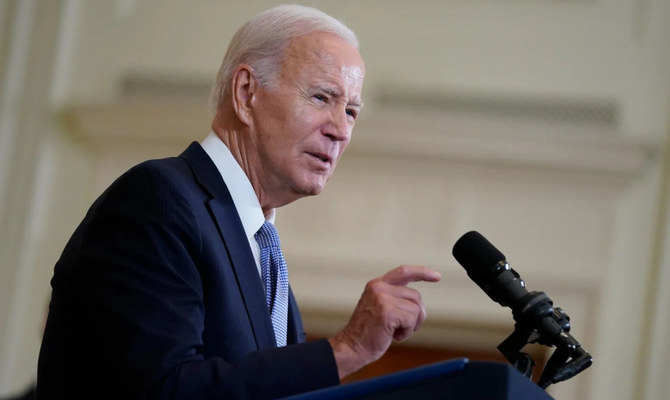
WASHINGTON: President Joe Biden touted the potential cost savings of Medicare’s first-ever price negotiations for widely used prescription drugs on Tuesday as he struggles to convince Americans that he’s improved their lives as he runs for reelection.
The drugs include the blood thinner Eliquis, diabetes treatment Jardiance and eight other medications. The negotiation process was authorized under the Inflation Reduction Act, which Biden signed last year, capping decades of debate over whether the federal government should be allowed to haggle with pharmaceutical companies.
Any lower prices won’t take effect for three years, and the path forward could be further complicated by litigation from drugmakers and heavy criticism from Republicans.
But the effort is a centerpiece of Biden’s reelection pitch as the Democrat tries to show Americans he’s deserving of a second term because of the work he’s doing to lower costs while the country is struggling with inflation. The drug negotiations, like many of Biden’s biggest policy moves, will take time to play out, and his challenge is to persuade the public to be patient.
“For all of you out there, I get it, and millions of Americans get it,” Biden said at the White House. “I promise you. I’m going to have your back and I’ll never stop fighting for you on this issue.”
He noted that he got “no help from the other team” — meaning Republicans — when it came to lowering prescription costs.
The drugs on the list announced Tuesday accounted for $3.4 billion in out-of-pocket costs for Medicare patients last year.
The Medicare program paid more than $50 billion for the drugs between June 1, 2022, and May 31, according to the Centers for Medicare and Medicaid Services, or CMS.
That includes more than $16 billion on Eliquis, a total that does not count discounts or rebates that are already negotiated for the drug. The drug from Pfizer and Bristol-Myers Squibb treats blood clots in the legs and lungs and reduces the risk of stroke in people with an irregular heartbeat called atrial fibrillation.
The diabetes treatments Jardiance from Eli Lilly and Co. and Boehringer Ingelheim and Januvia from Merck made the list. It also included Amgen’s autoimmune disease treatment Enbrel and Entresto from Novartis, which is used to treat heart failure.
Other drugs on the list include AstraZeneca’s diabetes and heart failure treatment Farxiga and three drugs from Johnson & Johnson: the blood thinner Xarelto, the blood cancer treatment Imbruvica and it’s biggest seller, Stelara, an IV treatment for psoriasis and other inflammatory disorders.
The list also includes several versions of Novo Nordisk’s Fiasp, a fast-acting insulin taken around meals.
The announcement Tuesday is another significant step toward taming drug pricing under the Inflation Reduction Act, which was signed by Biden last year. The law also calls for a $2,000 annual cap on how much people with Medicare have to pay out of pocket for drugs starting in 2025.
In addition, the law already caps out-of-pocket costs for insulin at $35 a month for Medicare patients.
“We are here today with the firm belief that in the United States of America, no senior should have to choose between whether they fill their prescription or fill their fridge with food,” Vice President Kamala Harris said.
For drugs on the list released Tuesday, the government aims to negotiate the lowest maximum fair price. That could help some patients who have coverage but still face big bills like coinsurance payments when they get a prescription.
About 9 percent of Medicare beneficiaries age 65 and older said in 2021 that they did not fill a prescription or skipped a drug dose due to cost, according to research by the Commonwealth Fund, which studies health care issues.
Currently, pharmacy benefit managers that run Medicare prescription plans negotiate rebates off a drug’s price. Those rebates sometimes help reduce premiums customers pay for coverage. But they may not directly change what a patient spends at the pharmacy counter.
The new drug price negotiations aim “to basically make drugs more affordable while also still allowing for profits to be made,” said Gretchen Jacobson, who researches Medicare issues at Commonwealth.
The federal government will benefit most from any lowered drug prices, noted Larry Levitt, an executive vice president for health policy at KFF, another non-profit that studies health care. But he said that if Medicare spends less on prescription drugs, then premiums for everyone with its drug coverage also should fall.
Drug companies that refuse to be a part of the new negotiation process will be heavily taxed.
The pharmaceutical industry has been gearing up for months to fight these rules. The lobbying group Pharmaceutical Research and Manufacturers of America said Tuesday that the drug list announcement stemmed from “a rushed process focused on short-term political gain rather than what is best for patients.”
“Many of the medicines selected for price setting already have significant rebates and discounts due to the robust private market negotiation that occurs in the Part D program today,” PhRMA CEO Stephen J. Ubl said in a statement.
PhRMA representatives also have said pharmacy benefit managers can still restrict access to drugs with negotiated prices by moving the drugs to a tier of their formulary — a list of covered drugs — that would require higher out-of-pocket payments. Pharmacy benefit managers also could require patients to try other drugs first or seek approval before a prescription can be covered.
PhRMA and several drugmakers have filed lawsuits over the administration’s plan.
Republican lawmakers also have blasted the Biden administration, saying companies might pull back on introducing new drugs that could be subjected to future haggling. They’ve also questioned whether the government knows enough to suggest prices for drugs.
CMS plans to meet this fall with drugmakers that have a drug on its list, and government officials say they also plan to hold patient-focused listening sessions. By February 2024, the government will make its first offer on a maximum fair price and then give drugmakers time to respond.
CMS aims to add 15 more drugs to its negotiation list for 2027 and another 15 for 2028. It then plans to add up to 20 more for each year after that.


![]()

10 drugs targeted for Medicare price negotiations as Biden pitches cost reductions
Short Url
https://arab.news/86wdm
10 drugs targeted for Medicare price negotiations as Biden pitches cost reductions
- The drugs on the list announced Tuesday accounted for $3.4 billion in out-of-pocket costs for Medicare patients last year


Latest updates


© 2026 SAUDI RESEARCH & PUBLISHING COMPANY, All Rights Reserved And subject to Terms of Use Agreement.