

Russia’s Prigozhin buried privately in St. Petersburg

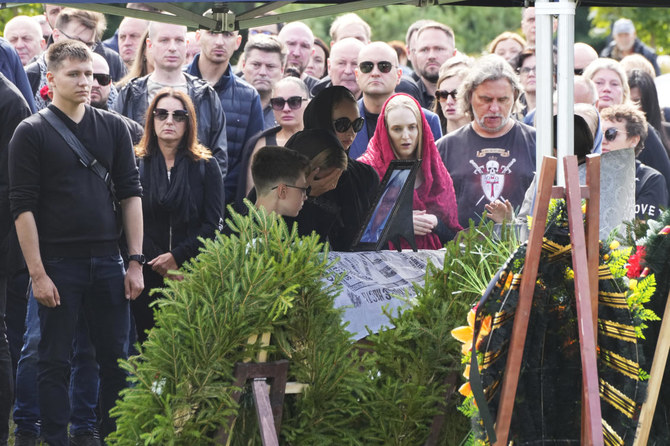
People react by the coffin of the Wagner Group’s logistics chief Valery Chekalov, killed in the plane crash, during a funeral at the Severnoye cemetery in St. Petersburg, on Aug. 29, 2023. (AP)
Short Url
Updated 29 August 2023
Follow

Russia’s Prigozhin buried privately in St. Petersburg

  • “The farewell to Yevgeny Viktorovich took place in a closed format,” his press service said in a short post on Telegram
  • Pictures published on social media showed Prigozhin’s dark granite tombstone surrounded by a sea of flowers, mostly red roses, in the cemetery on the northeast edge of his hometown

ST PETERSBURG, Russia: Russian mercenary chief Yevgeny Prigozhin was buried privately at a cemetery on the outskirts of St. Petersburg on Tuesday, six days after his death in an unexplained plane crash.
The funeral took place away from the glare of the media and in stark contrast to the brazen, self-publicizing style with which Prigozhin had fanned his reputation far beyond Russia for ruthlessness and ambition.
“The farewell to Yevgeny Viktorovich took place in a closed format. Those who wish to say goodbye may visit Porokhovskoye cemetery,” his press service said in a short post on Telegram.
Pictures published on social media showed Prigozhin’s dark granite tombstone surrounded by a sea of flowers, mostly red roses, in the cemetery on the northeast edge of his hometown.
Secrecy had surrounded the funeral arrangements for the Wagner mercenary boss who was killed in a plane crash on Aug. 23, two months to the day since staging a mutiny in the biggest challenge to President Vladimir Putin’s rule since he rose to power in 1999.
It meant the event could not be turned into a large-scale public show of support for Prigozhin, a brutal figure who was nevertheless admired by some in Russia for throwing his fighters into the fiercest battles of the war in Ukraine and speaking openly about the shortcomings of the Russian military and its leadership.
In recent days admirers had heaped flowers on makeshift shrines to Prigozhin in Moscow, St. Petersburg and elsewhere.
The Kremlin has rejected as an “absolute lie” the suggestion that Putin ordered his death in revenge for the June mutiny. It said earlier on Tuesday that the president would not attend the funeral.
Two other top Wagner figures, four Prigozhin bodyguards and three crew members were also killed when his Embraer Legacy 600 private jet crashed north of Moscow.
It is still unclear what caused the plane to crash but villagers near the scene told Reuters they heard a bang and then saw the jet plummet to the ground.

MUTINOUS MERCENARY
After months of insulting Putin’s top brass with a variety of crude expletives and prison slang over their perceived failure to fight the Ukraine war properly, Prigozhin took control of the southern city of Rostov in late June.
He then marched toward Moscow before turning back 200 km (125 miles) from the capital. Putin initially cast Prigozhin as a traitor whose mutiny could have tipped Russia into civil war, though he later did a deal with him to defuse the crisis.
The day after the crash, Putin sent his condolences to the families of those killed and said he had known Prigozhin for a very long time, since the chaotic years of the early 1990s.
“He was a man with a difficult fate, and he made serious mistakes in life,” Putin said, while describing him as a talented businessman.
Before the mutiny, Prigozhin had quipped that his nickname should have been “Putin’s butcher” rather than “Putin’s chef” — a moniker acquired after his catering company won Kremlin contracts. He always professed loyalty to Putin, though he said his defense minister, Sergei Shoigu, was so incompetent he should executed for his treachery.
After Prigozhin’s death, Putin ordered Wagner fighters to sign an oath of allegiance to the Russian state — a step that Prigozhin had opposed due to his anger at the defense ministry that he said risked losing the Ukraine war.
Investigators said on Sunday that genetic tests had confirmed the identities of all 10 people killed in the crash, who also included two pilots and a flight attendant.
Earlier on Tuesday, Valery Chekalov, the head of Wagner logistics, was buried at another St. Petersburg cemetery. His family was joined by dozens of people, some of whom Reuters identified as Wagner mercenaries and employees from Prigozhin’s business empire.
A Russian Orthodox priest said prayers and swung a censer before Chekalov’s coffin as family, friends and former colleagues, some holding bunches of flowers, bade farewell, Reuters video showed.
Some, including women and children in sunglasses, came forward to kiss his coffin. Unidentified mourners at the funeral ordered a Reuters videographer and photographer to stop filming.


Geoeconomic confrontation tops global risks in 2026: WEF report

Updated 4 sec ago
Follow

Geoeconomic confrontation tops global risks in 2026: WEF report

  • Also armed conflict, extreme climate, public polarization, AI
  • None ‘a foregone conclusion,’ says WEF’s MD Saadia Zahidi

DUBAI: Geoeconomic confrontation has emerged as the top global risk this year, followed by state-based armed conflict, according to a new World Economic Forum report.

The Global Risks Report 2026, released on Wednesday, found that both risks climbed eight places year-on-year, underscoring a sharp deterioration in the global outlook amid increased international competition.

The top five risks are geoeconomic confrontation (18 percent of respondents), state-based armed conflict (14 percent), extreme weather events (8 percent), societal polarization (7 percent) and misinformation and disinformation (7 percent).

The WEF’s Managing Director Saadia Zahidi said the report “offers an early warning system as the age of competition compounds global risks — from geoeconomic confrontation to unchecked technology to rising debt — and changes our collective capacity to address them.

“But none of these risks are a foregone conclusion.”

The report assesses risks across three timeframes: immediate (2026); short-to-medium term (next two years); and long term (next 10 years).

Economic risks show the largest overall increase in the two-year outlook, with both economic downturn and inflation jumping eight positions.

Misinformation and disinformation rank fifth this year but rise to second place in the two-year outlook and fourth over the 10-year horizon.

The report suggests this reflects growing anxiety around the rapid adoption of artificial intelligence, with adverse outcomes linked to AI surging from 30th place in the two-year timeframe to fifth in the 10-year outlook.

Uncertainty dominates the global risk outlook, according to the report.

Surveyed leaders and experts view both the short- and long-term outlook negatively, with 50 percent expecting a turbulent or stormy global environment over the next two years, rising to 57 percent over the next decade.

A further 40 percent and 32 percent, respectively, describe the outlook as unsettled across the two- and 10-year timeframes, while just 1 percent anticipate a calm global outlook in either period.

Environmental risks ease slightly in the short-term rankings. Extreme weather fell from second to fourth place and pollution from sixth to ninth. Meanwhile, critical changes to Earth systems and biodiversity loss dropped seven and five positions, respectively.

However, over the next decade, environmental threats re-emerge as the most severe, with extreme weather, biodiversity loss, and critical changes to Earth systems topping the global risk rankings.

Looking ahead over the next decade, around 75 percent of respondents anticipate a turbulent or stormy environmental outlook, making it the most pessimistic assessment across all risk categories.

Zahidi said that “the challenges highlighted in the report underscore both the scale of the potential perils we face and our shared responsibility to shape what comes next.”

Despite the gloomy outlook, Zahidi signaled a positive shift in global cooperation.

 “It is also clear that new forms of global cooperation are already unfolding even amid competition, and the global economy is demonstrating resilience in the face of uncertainty.”

Now in its 21st year, the Global Risks Report highlights a core message: global risks cannot be managed without cooperation.

As competition intensifies, rebuilding trust and new forms of collaboration will be critical, with the report stressing that today’s decisions will shape future outcomes.

The report was released ahead of WEF’s annual meeting, which will be held in Davos from Jan. 19 to 23.