Ex-PM Khan's appeal against graft conviction to be decided by Islamabad High Court today

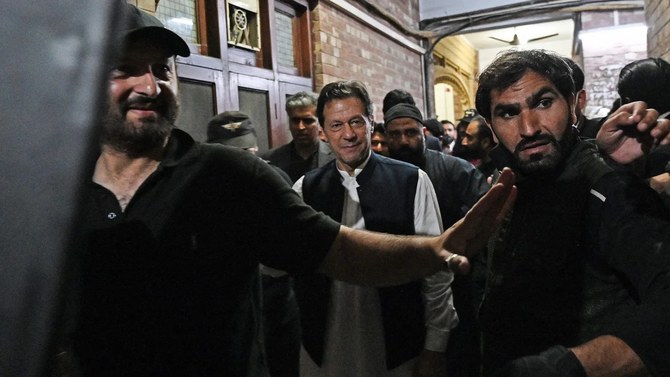
Security personnel use a bullet proof shield to protect former Pakistan's Prime Minister Imran Khan as he leaves after appearing at the high court in Lahore on March 17, 2023. (AFP/File)
Short Url
Updated 29 August 2023
Follow

Ex-PM Khan's appeal against graft conviction to be decided by Islamabad High Court today

  • Khan was sent to jail for three years this month on charges of unlawfully selling state gifts he acquired as PM
  • Under Pakistani law, convict cannot run for public office for period of up to five years starting from conviction date

ISLAMABAD: The Islamabad High Court (IHC) on Monday reserved its verdict on former Prime Minister Imran Khan's plea seeking the suspension of a three-year jail sentence in a case involving the sale of state gifts, with his party saying the judgment would be announced today, Tuesday.

Khan was convicted and jailed by a trial court earlier this month on charges of unlawfully selling state gifts that he and his family acquired during his tenure from 2018 to 2022. He was subsequently barred by the election regulator from politics for five years on Aug. 8.

Under Pakistani law, a convicted person cannot run for any public office for a period defined by the ECP, which could be up to a maximum of five years starting from the conviction date. The 70-year-old former cricket hero says he was convicted without being given a right to defence.

“Judgement is reserved,” his lawyer Naeem Panjutha said in a post on messaging platform X, formerly known as Twitter about the graft case, adding that the court will announce the ruling on Tuesday.

“11am tomorrow morning [Tuesday],” a member of Khan’s media team said in a text message to reporters when asked when the verdict would be announced.

A two-member IHC bench comprising Chief Justice Aamer Farooq and Justice Tariq Mehmood Jahangiri heard the case on Monday, as the Election Commission of Pakistan's lawyer, Amjad Parvez, presented his closing arguments. Khan’s lawyer, Latif Khosa, completed his arguments last week.

The PTI’s petition against the conviction has called the ruling "without lawful authority, tainted with bias," and said Khan, 70, had not received an adequate hearing. It said the court had rejected a list of witnesses for the defence a day before reaching its verdict, calling this a "gross travesty of justice, and a slap in the face of due process and fair trial".

Khan has been at the heart of political turmoil since he was ousted as prime minister in a vote of no-confidence last year, raising concern about Pakistan's stability as it grapples with an economic crisis.

With Khan out of the political picture for now, all eyes should be turning to an upcoming election due in November but widely expected to be delayed, fueling fears of more public anger and political uncertainty.


Pakistan reviews austerity measures amid Middle East crisis, urges strict nationwide implementation

Updated 11 March 2026
Follow

Pakistan reviews austerity measures amid Middle East crisis, urges strict nationwide implementation

  • Deputy Prime Minister Ishaq Dar chairs review meeting of austerity steps
  • Officials briefed on salary cuts, school closures, four‑day week, petrol conservation

ISLAMABAD: Pakistan’s government on Wednesday assessed progress on a sweeping set of austerity measures introduced to mitigate the country’s economic strain from sharply rising global oil prices and supply disruptions linked to the ongoing war in the Middle East.

Prime Minister Shehbaz Sharif this week announced a series of austerity steps, including a four‑day work week for government offices, requiring 50  percent of staff to work from home, cutting fuel allowances for official vehicles by half, grounding up to 60  percent of the government fleet and closing all schools for two weeks to conserve fuel amid the global oil crisis.

The measures were unveiled in response to global oil market volatility triggered by the conflict involving the United States, Israel and Iran, which has disrupted supply routes such as the Strait of Hormuz and pushed crude prices sharply higher, straining Pakistan’s heavily import‑dependent energy sector.

“The meeting stressed the importance of strict and transparent adherence to the austerity measures, promoting fiscal responsibility and prudent use of public resources,” Deputy Prime Minister and Foreign Minister Senator Mohammad Ishaq Dar said in a statement.

He was chairing a meeting of the Committee for Monitoring and Implementation of Conservation and Additional Austerity Measures, constituted under the directions of the PM, bringing together federal and provincial officials to review execution of the broad cost‑cutting plan. 

Dar emphasized the government’s commitment to enforcing the PM’s austerity steps nationwide. The committee’s review also covered reductions in departmental expenditure, deductions from salaries of senior officials earning over Rs. 300,000 ($1,120), and coordination with provincial administrations to ensure uniform implementation of the plan.

Participants at the meeting reiterated that all ministries and divisions must continue strict monitoring and reporting, with transparent oversight mechanisms, as Pakistan navigates the economic pressures from the prolonged Middle East crisis and its fallout on global energy and trade markets.