Pakistan army chief reaffirms military’s support to caretaker government for economic revival

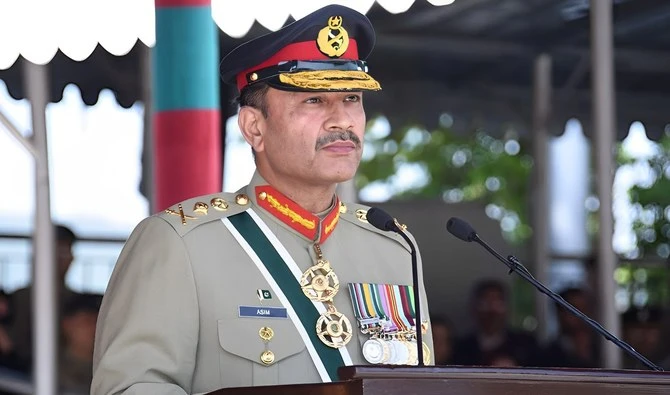
Pakistan Army Chief General Asim Munir addresses the passing out parade at the Pakistan Military Academy in Kakul, Pakistan, on April 29, 2023. (Photo courtesy: ISPR/File)
Short Url
Updated 28 August 2023
Follow

Pakistan army chief reaffirms military’s support to caretaker government for economic revival

  • Special Investment Facilitation Council holds fourth Apex Committee Meeting, first one under caretaker PM Kakar
  • SIFC is civil-military forum aimed to fasttrack economic development by attracting investment from foreign nations

ISLAMABAD: Chief of Army Staff (COAS) Gen. Asim Munir on Monday reaffirmed the military’s support to the caretaker government of Prime Minister Anwaar-ul-Haq Kakar to revive the economy, particularly through projects under the newly established Special Investment Facilitation Council (SIFC).

The SIF is a hybrid civil-military forum aimed to fasttrack economic development by attracting investment from foreign nations, particularly Gulf countries. 

A notification dated June 17 from then Prime Minister Shehbaz Sharif’s Office said SIFC would seek investments in the energy, IT, minerals, defense and agriculture sectors from GCC countries. The body, which has the army chief and other military leaders in key roles, aims to take a “unified approach” to steer the country out of economic crisis.

“COAS reaffirmed Pakistan Army’s all out support to Caretaker Government for continuity of policies in a bid to revive country’s economy and steer Pakistan toward progress and prosperity,” the prime minister’s office said in a statement after the fourth Apex Committee Meeting of SIFC was held on Monday, the first one under PM Kakar.

“Prime Minister appreciated the efficient functioning of SIFC through a collaborative “Whole of Government Approach” for achieving horizontal and vertical synergy,” PMO said.

“The Apex Committee appreciated SIFC’s outreach strategy to achieve global traction and ongoing engagements with brotherly / friendly countries including productive visits of high-level delegations from the Kingdom of Saudi Arabia and Islamic Organization for Food Security.”

Earlier this month, a delegation from Saudi Arabia arrived in Pakistan to explore investment opportunities in the mining sector, aiming to tap into Pakistan’s $6 trillion estimated worth of mineral deposits. The Saudi delegation attended Pakistan’s first dedicated summit on minerals in Islamabad, organized under the umbrella of the SIFC.

In July, Pakistan established a Land Information and Management System, Center of Excellence ((LIMS-CoE) to modernize its agricultural sector, with Saudi Arabia providing an initial $500 million investment to set up the facility.

Continued economic and investment support from Saudi Arabia and other allies is key for Pakistan, as economic stabilization is a major challenge for PM Kakar, who took oath this month, with the $350 billion economy on a narrow recovery path after an ongoing $3 billion International Monetary Fund bailout averted a sovereign debt default. Economic reforms have already fueled historic inflation and interest rates.
Security forces kill four militants in Pakistan’s volatile southwest, military says

Updated 13 January 2026
Follow

Security forces kill four militants in Pakistan’s volatile southwest, military says

  • Balochistan, Pakistan’s largest province by land area bordering Iran and Afghanistan, has long been the site of a low-level insurgency
  • The Balochistan government has recently established a threat assessment center to strengthen early warning, prevent ‘terrorism’ incidents

ISLAMABAD: Pakistani security forces gunned down four militants in an intelligence-based operation in the southwestern Balochistan province, the military said on Tuesday.

The operation was conducted in Balochistan’s Kalat district on reports about the presence of militants, according to the Inter-Services Public Relations (ISPR), the Pakistani military’s media wing.

The “Indian-sponsored militants” were killed in an exchange of fire during the operation, while weapons and ammunition were also recovered from the deceased, who remained actively involved in numerous militant activities.

“Sanitization operations are being conducted to eliminate any other Indian-sponsored terrorist found in the area,” the ISPR said in a statement.

There was no immediate response from New Delhi to the statement.

Balochistan, Pakistan’s largest province by land area bordering Iran and Afghanistan, has long been the site of a low-level insurgency involving Baloch separatist groups, including the Balochistan Liberation Army (BLA) and the Balochistan Liberation Front (BLF).

Pakistan accuses India of supporting these separatist militant groups and describes them as “Fitna Al-Hindustan.” New Delhi denies the allegation.

The government in Balochistan has also established a state-of-the-art threat assessment center to strengthen early warning and prevention against “terrorism” incidents, a senior official said this week.

“Information that was once scattered is now shared and acted upon in time, allowing the state to move from reacting after incidents to preventing them before they occur,” Balochistan Additional Chief Secretary Hamza Shafqaat wrote on X.

The development follows a steep rise in militancy-related deaths in Pakistan in 2025. According to statistics released by the Pakistan Institute for Conflict and Security Studies (PICSS) last month, combat-related deaths in 2025 rose 73 percent to 3,387.

These included 2,115 militants, 664 security forces personnel, 580 civilians and 28 members of pro-government peace committees, the think tank said.