

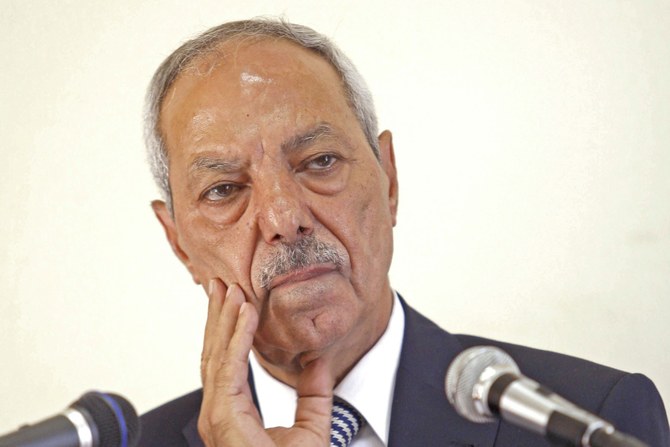
Lebanese press figures mourn death of veteran editor and publisher Talal Salman

Salman is known for his interviews with the majority of Arab presidents. (AFP/File)
Short Url
Updated 26 August 2023
Follow

Lebanese press figures mourn death of veteran editor and publisher Talal Salman

  • Talal Salman founded in 1974 the daily As-Safir, which became a leading newspaper in Lebanon

BEIRUT: The press in Lebanon have said farewell to the former publisher and veteran editor-in-chief of As-Safir newspaper, Talal Salman, following his death in his hometown of Shmustar, in the Bekaa Valley, at the age of 85.

Salman, who was a Lebanese journalist, founded the daily As-Safir in 1974.

The newspaper carried the slogan “Lebanon’s newspaper in the Arab world and the Arab world’s newspaper in Lebanon.”

Salman’s project was one he initiated after years of experience working in journalism. Through the decades he became a world-renowned media figure in Arab and Lebanese affairs, influencing public opinion.

He was known for his probing interviews with the majority of Arab presidents, leaders and officials.

Among his most influential pieces were his editorials, called “On the Road,” which consistently supported the Palestinian cause and the issue of Arabism.

As the country became mired in civil war, As-Safir became a leading newspaper in Lebanon as it went head-to-head with the established An-Nahar.

It continued printing daily despite the Israeli siege of Beirut in 1982.

As-Safir was the voice of the Lebanese left wing, and the Palestinian national movement. It helped preserve a secular national identity within a prevailing sectarian reality, and also had to deal with the Syrian presence in Lebanon.

There was a failed attempt on Salman’s life in 1984, while further incidents involved attempts to blow up his home and bomb his newspaper’s printing presses.

Salman remained editor-in-chief of the paper until it closed at the end of 2016, in the face of alternative media and changes in the delivery of news.

Among his many accolades were the Posuvalyuk International Prize for reporting on events in the Middle East, and the Arab Media Forum’s 2009 Media Personality of the Year.

He also received an honorary doctorate from the Lebanese University in 2010 in recognition of his unique role in journalism, media and journalistic literature.

Former Prime Minister Fouad Siniora said Salman “was a unique and respected reference in the Lebanese and Arab press, and he was an example of courage in carrying the progressive Arab banner.”

He added: “When he realized that the circumstances no longer allowed the continuation of As-Safir on the same level it was issued, he had the courage to take the bitter decision to close the newspaper that was dearest to his heart.”

In its obituary, the Press Syndicate said: “He was betrayed by old age, but not by his pen, nor by his quest for the truth. For more than 60 years, he was a free person and a defender of freedom and liberation until the last drop of ink and blood.”

Head of the Lebanese Press Editors’ Syndicate Joseph Al-Qusaifi wrote: “Talal Salman succeeded in establishing a journalism school that was distinguished by its leadership.

“It mobilized within its building and offices creative journalists, specialists and reporters recognized for their experience, professionalism and the ability to penetrate closed fences and provide accurate information, so that his newspaper became one of the references to rely upon when searching for accurate news.”


Foreign media group slams Israel for refusing to lift Gaza press ban

Updated 07 January 2026
Follow

Foreign media group slams Israel for refusing to lift Gaza press ban

  • Foreign Press Association expresses 'profound disappointment' with Israeli government’s response to a Supreme Court appeal
  • Israel has barred foreign journalists from independently entering the devastated territory since the war started

JERUSALEM: An international media association on Tuesday criticized the Israeli government for maintaining its ban on unrestricted media access to Gaza, calling the move disappointing.
The government had told the Supreme Court in a submission late Sunday that the ban should remain in place, citing security risks in the Gaza Strip.
The submission was in response to a petition filed by the Foreign Press Association (FPA) — which represents hundreds of journalists in Israel and Palestinian territories — seeking immediate and unrestricted access for foreign journalists to the Gaza Strip.
“The Foreign Press Association expresses its profound disappointment with the Israeli government’s latest response to our appeal for full and free access to the Gaza Strip,” the association said on Tuesday.
“Instead of presenting a plan for allowing journalists into Gaza independently and letting us work alongside our brave Palestinian colleagues, the government has decided once again to lock us out” despite the ceasefire in the territory, it added.
Since the outbreak of the Gaza war in October 2023, triggered by an attack on Israel by the Palestinian militant group Hamas, the government has barred foreign journalists from independently entering the devastated territory.
Instead, Israel has allowed only a limited number of reporters to enter Gaza on a case-by-case basis, embedded with its military inside the blockaded Palestinian territory.
The FPA filed its petition in 2024, after which the court granted the government several extensions to submit its response.
Last month, however, the court set January 4 as a final deadline for the government to present a plan for allowing media access to Gaza.
In its submission, the government maintained that the ban should remain in place.
“This is for security reasons, based on the position of the defense establishment, which maintains that a security risk associated with such entry still exists,” the government submission said.
The government also said that the search for the remains of the last hostage held in Gaza was ongoing, suggesting that allowing journalists in at this stage could hinder the operation.
The remains of Ran Gvili, whose body was taken to Gaza after he was killed during Hamas’s 2023 attack, have still not been recovered despite the ceasefire.
The FPA said it planned to submit a “robust response” to the court, and expressed hope the “judges will put an end to this charade.”
“The FPA is confident that the court will provide justice in light of the continuous infringement of the fundamental principles of freedom of speech, the public’s right to know and free press,” the association added.
The Supreme Court is expected to issue a ruling on the matter, though it is unclear when a decision will be handed down.
An AFP journalist sits on the board of the FPA.