

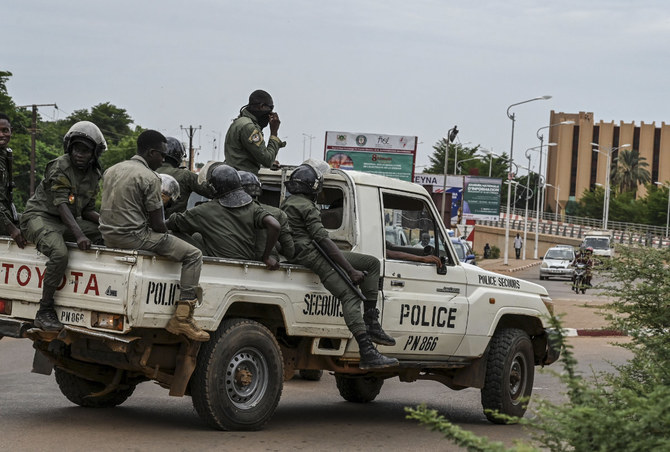


NIAMEY: Niger’s junta, which seized power in a coup on July 26, said on Friday it had ordered French ambassador Sylvain Itte to leave the country within 48 hours, as relations between the West African country and its former colonial ruler deteriorated further.
Like recent coups in neighboring Burkina Faso and Mali, the military takeover in Niger came amid a growing wave of anti-French sentiment, with some locals accusing the European country of interfering in their affairs.
In a statement, the junta-appointed foreign ministry said the decision to expel the ambassador was a response to actions taken by the French government that were “contrary to the interests of Niger.”
It said these included the envoy’s refusal to respond to an invitation to meet Niger’s new foreign minister.
The French foreign ministry did not immediately reply to a request for comment.
Official-seeming statements were shared widely online on Friday that appeared to show Niger ordering the US ambassador and German ambassador to leave the country in similar terms to the statement about the French envoy.
The US State Department on Friday said Niger had informed it this had not been issued by its foreign ministry. “No such request has been made to the US government,” it said.
The United States has been pressing for a diplomatic resolution of the crisis that erupted on July 26 when Niger military officers seized power, deposed President Mohamed Bazoum and placed him under house arrest.
The new US Ambassador to Niger Kathleen Fitzgibbons only arrived in the capital, Niamey, earlier this month.
A source in the junta and a Nigerien security source said only the French ambassador had been asked to leave.
The ultimatum against the French envoy was quickly rejected by Paris, which repeated that it did not recognize the military rulers’ authority, according to a report by AFP.
“The putschists do not have the authority to make this request, the ambassador’s approval coming solely from the legitimate elected Nigerien authorities,” the AFP report quoted the French foreign ministry as saying on Friday.
The coup has pushed Niger’s long-standing relationship with France to breaking-point and this latest move raises further doubts about the future of joint military efforts to fight an Islamist insurgency in the conflict-torn Sahel region.
France has called for President Mohamed Bazoum to be returned to office following his ouster and has said it would support efforts by West African regional bloc ECOWAS to overturn the coup.
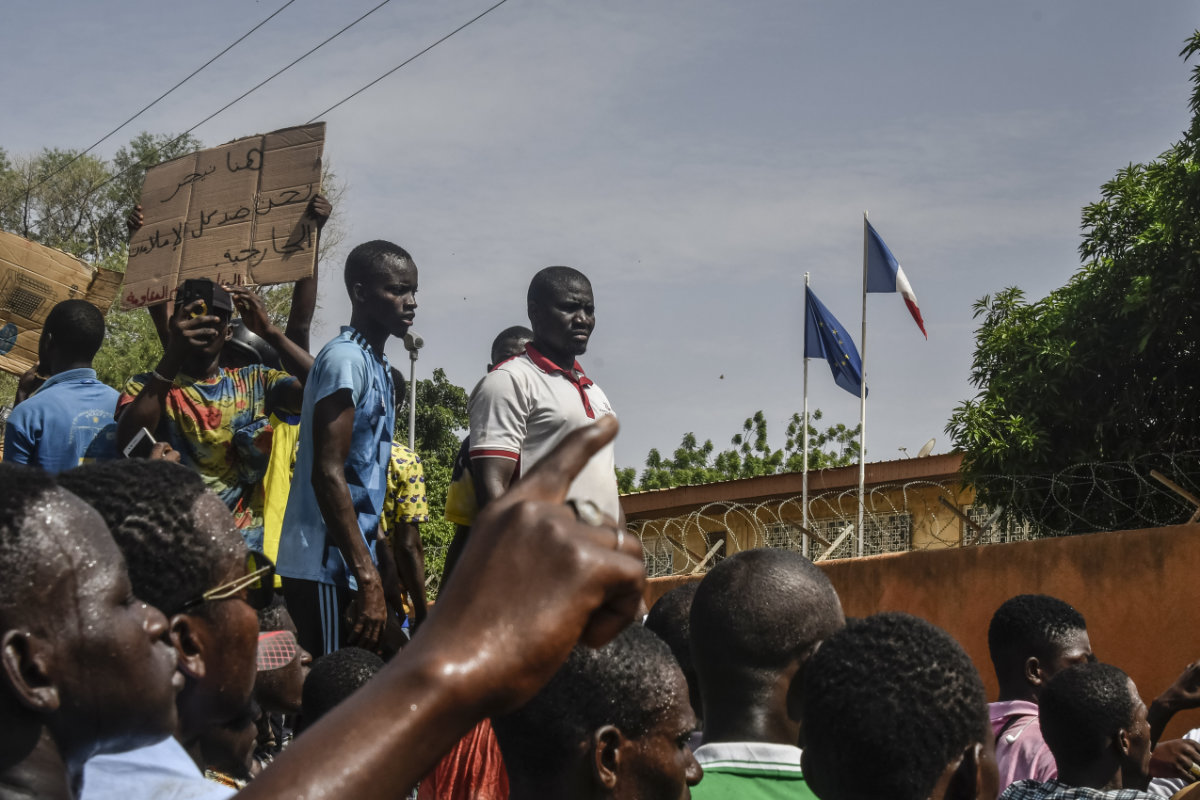
Protesters gather in front of the French Embassy in Niamey during a demonstration that followed a rally in support of Niger's junta in Niamey on July 30, 2023. France has said it does not recognize the authority of the military junta that grabbed power. (AFP file)
It has also not officially recognized a decision by the junta in early August to revoke a raft of military agreements with France, saying these had been signed with Niger’s “legitimate authorities.”
The deterioration in Niger-France relations echoes post-coup developments in Mali and Burkina Faso, which have booted out French forces and severed long-standing ties.
France has 1,500 soldiers based in Niger who had been helping Bazoum in the fight against jihadist forces that have been active in the country for years, while the United States has around a thousand military personnel in the country.
Niger has strategic significance as one of the world’s biggest producers of uranium and as a base for French, US and other foreign troops that are helping to fight Islamist militant groups in the region.
Earlier Friday, West Africa’s bloc ECOWAS urged Niger’s coup leaders to reconsider their position and pushed for a return to civilian rule, with the threat of force still “very much on the table.”
While the generals who ousted Bazoum have called for a three-year transition period, the Economic Community of West African States demands the immediate return to constitutional order.
With delegations shuttling into Niamey, ECOWAS said negotiations remained its priority as defense chiefs prepared a standby mission for a possible “legitimate use of force” to restore democracy if needed.
“Even now, it is not too late for the military to reconsider its action and listen to the voice of reason as the regional leaders will not condone a coup d’etat,” ECOWAS commission president Omar Alieu Touray told reporters in Abuja.
“The real issue is the determination of the community to halt the spiral of coup d’etats in the region.”
ECOWAS has already applied sanctions against Niger to pressure the new regime.
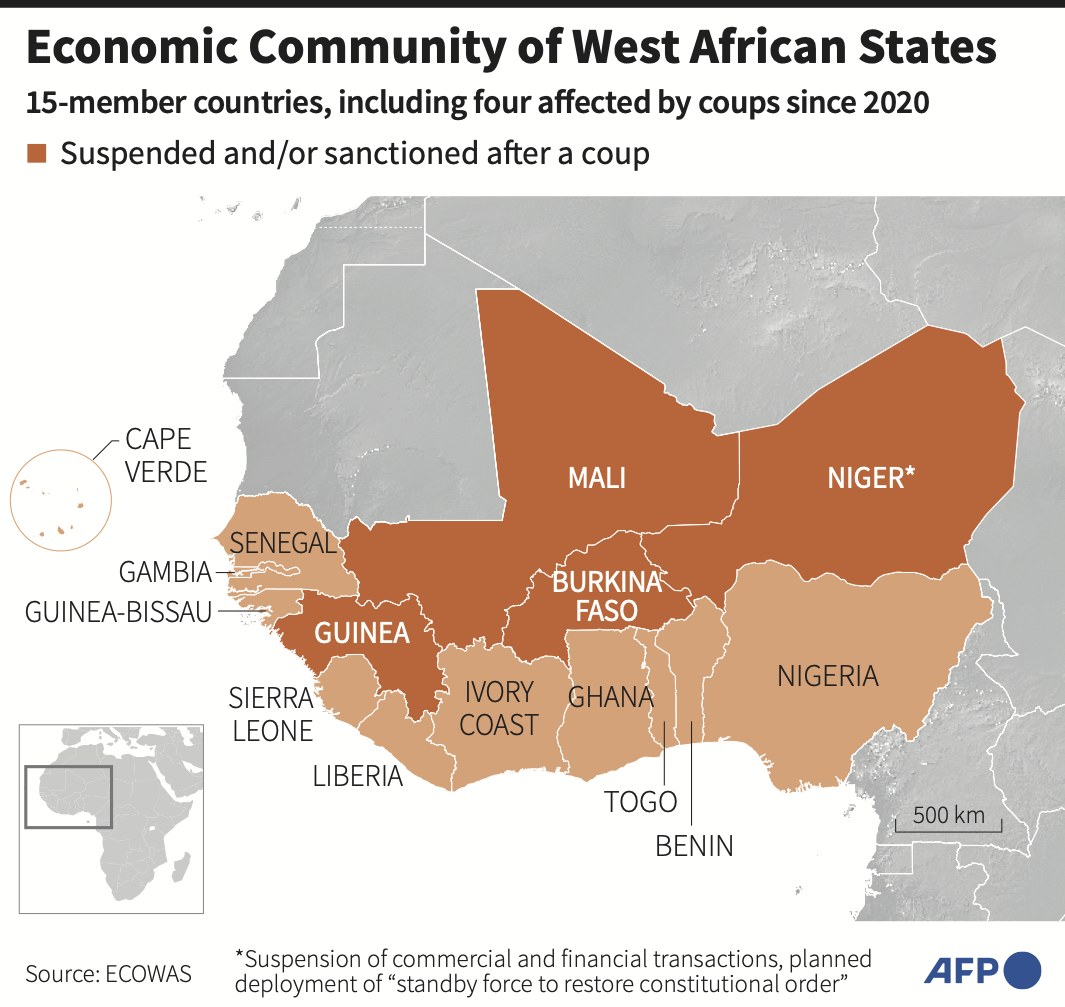
The Niger coup has heightened tensions in the Sahel region, where three other governments have fallen to military rebellions since 2020, and jihadists control swathes of territory.
ECOWAS leaders are already negotiating with military administrations in Mali, Burkina Faso and Guinea who are all working toward transitions to democracy after their own coups.
After initially balking, Niger’s new rulers have said they remain open to negotiations.
But they have sent mixed messages, including a threat to charge Bazoum — who remains detained at the official residence with his family — with treason.
Niger’s military leaders have also warned against any intervention, accusing ECOWAS of preparing an occupying force in league with an unnamed foreign country.
Niger on Thursday agreed with the regimes in neighboring Mali and Burkina Faso to let their troops into its territory in case of an aggression.
But Touray dismissed plans for ECOWAS “declaring war” or an “invasion” of Niger, insisting the standby mission would be a legitimate force allowed under ECOWAS statutes agreed by members.
“The instruments include the use of force. So it is very much on the table, as are other measures we are working on,” he said.
“If peaceful means fail, ECOWAS cannot just fold its hands.”
ECOWAS has intervened militarily in past crises, including in civil wars. Few details of the new standby force have emerged.
But preparations for any possible use of military force in Niger are risky and already face political resistance in northern Nigeria, a key player in ECOWAS and the region.
Niger’s northern neighbor Algeria has also warned of disastrous consequences for the region from an intervention.
Foreign Minister Ahmed Attaf this week toured West African countries to try to find a solution to a crisis in which Algiers firmly opposes any military option.
“There is a time for everything and we are currently in the time of finding peaceful solutions,” he said on a visit to Benin.
“Let’s put all our imagination into giving every chance to a political solution.”


