

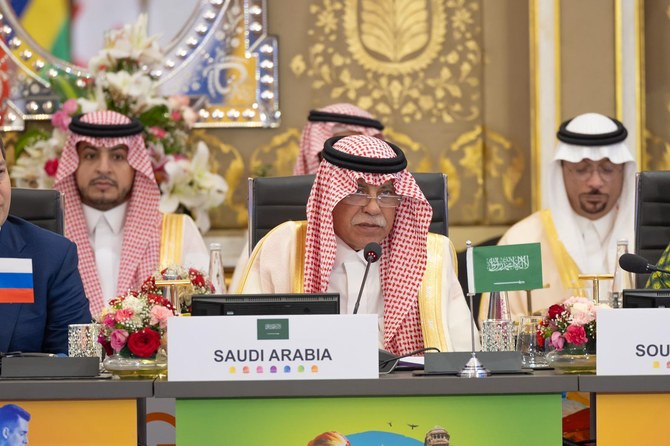
Saudi commerce minister showcases Vision 2030 at G20 trade and investment meeting in India

Saudi Arabia’s minister of commerce Majid bin Abdullah Al-Qasabi held 12 meetings with ministers and officials of the G20 countries in India over the past two days. (Twitter/@malkassabi)
Short Url
Updated 29 August 2023
Follow

Saudi commerce minister showcases Vision 2030 at G20 trade and investment meeting in India

RIYADH: Saudi Arabia’s Minister of Commerce, Majid bin Abdullah Al-Qasabi, held meetings with ministers and officials of G20 countries in India over the past two days, Saudi Press Agency reported.

Al-Qasabi, who is also chairman of the board of directors at the General Authority of Foreign Trade, held 12 bilateral meetings on the sidelines of the G20 Trade and Investment Ministers’ meeting, which ended on Friday.

The meetings touched on developing relations, and enhancing trade and economic cooperation and investment opportunities, SPA said.

Al-Qasabi met with Indian Minister of Commerce and Industry Piyush Goyal, Korean Minister of Trade Dukgeun Ahn, Indonesian Minister of Trade Zulkifli Hasan, Singaporean Minister of Trade and Industry Gan Kim Yong, Turkish Minister of Trade Omer Bolat, and Bangladeshi Minister of Commerce Tipu Munshi.

He also held talks with British Secretary of State for Business and Trade Kemi Badenoch, Director-General of the World Trade Organization Ngozi Okonjo-Iweala, Chinese Vice Minister of Commerce Wang Shouwen, US Trade Representative Katherine Tai, Argentinian Secretary for International Economic Relations Cecilia Todesca, and Executive Secretary of the Brazilian Ministry of Development and Industry Marcio Rosa.

During the session on “Trade for Growth and Prosperity and WTO Reforms,” Al-Qasabi reviewed the impact of Vision 2030 reforms on the Saudi economy.

He said the Kingdom’s foreign trade grew by $172 billion in the past year, while the volume of non-oil exports rose by 40 percent between 2018-2022, amounting to $28.7 billion. The value of loans provided by the Saudi Export-Import Bank stood at $4.6 billion.

The minister added that there are now 1.2 million small and medium enterprises in the Kingdom, and that annual growth of e-commerce reached 33 percent between 2016-2022.

Al-Qasabi said the Kingdom has enhanced its competitiveness, as shown by its ranking of second among G20 countries in digital competitiveness, according to the Digital Riser 2021 report. It also ranked sixth among 50 emerging countries in the “Agility” index for emerging markets for 2022.

This year’s G20 meeting will be hosted in India next month under the theme “One Earth, One Family, One Future.”


Saudi Arabia launches initiative to reroute Gulf cargo to Red Sea ports

Updated 13 March 2026
Follow

Saudi Arabia launches initiative to reroute Gulf cargo to Red Sea ports

  • The initiative comes as shipping through the Strait of Hormuz has been severely disrupted by the widening conflict in the region
  • Since the US and Israel struck Iran last month, Tehran has moved to restrict passage through the waterway


RIYADH: Saudi Arabia has launched an initiative to redirect shipping from ports in the Arabian Gulf to its Red Sea ports amid the ongoing US-Israel-Iran war.

Transport Minister Saleh Al-Jasser, who also chairs the Saudi Ports Authority (Mawani), launched the Logistics Corridors Initiative alongside Zakat, Tax and Customs Authority Governor Suhail Abanmi, Mawani President Suliman Al-Mazroua, and other officials, the Saudi Press Agency reported.

The initiative will establish dedicated operational corridors to receive containers and cargo redirected from ports in the Kingdom's Eastern Region and other Gulf Cooperation Council states to Jeddah Islamic Port and other Red Sea coast ports.

Al-Jasser said the Kingdom was committed to ensuring supply-chain stability and the smooth flow of goods through global trade routes. Jeddah Islamic Port and other west coast ports, he added, were already playing a key role in accommodating shipments redirected from the east, while also linking Gulf cargo to regional and international markets.

The initiative comes as shipping through the Strait of Hormuz has been severely disrupted by the widening conflict in the region. Iran has long threatened to close the strait — the world's most critical oil and gas chokepoint, through which roughly a fifth of global oil supplies pass — in the event of a war.

Since the US and Israel struck Iran last month, Tehran has moved to restrict passage through the waterway, sending freight rates soaring and forcing shipping companies to seek alternative routes.

Saudi Arabia's Red Sea ports offer a viable bypass, connecting Gulf cargo to global markets without passing through the strait.