

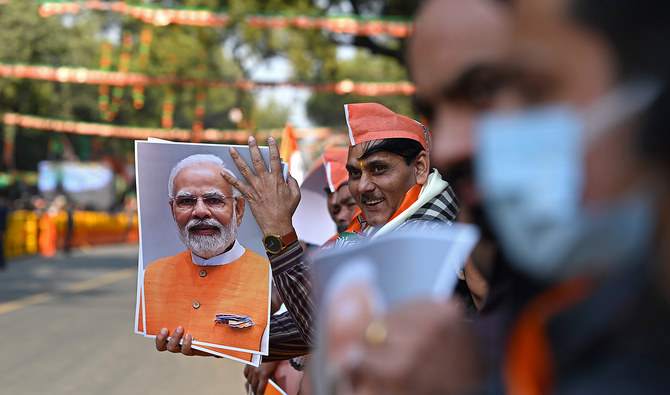

NEW DELHI: Indian voters are growing unhappy with Prime Minister Narendra Modi’s government due to high inflation and unemployment but he is still on track to comfortably win a third term in elections next year due to his personal popularity, a key survey said.
The popularity of main opposition leader Rahul Gandhi has risen and a new, 26-party opposition alliance called “INDIA” is expected to do well, the “Mood of the Nation” survey by India Today magazine said on Friday.
Modi, however, is far ahead of Gandhi with a 36-point lead as the candidate best-suited to be India’s next prime minister and his Bharatiya Janata Party (BJP) will win 287 seats in the 542-member lower house of parliament if elections are held now, it said.
National elections are due by May 2024, though several state polls are expected to be held before then.
Promising change, Modi swept to power in 2014, and he has consolidated his hold since with welfare economics, a focus on boosting infrastructure and aggressive Hindu nationalism.
Rivals say the government has ensured that the BJP’s line dominates mainstream newspapers, television news channels and social media with its combativeness, often drowning out critical voices.
India’s sticky retail inflation hit a 15-month high of 7.44 percent in July, pushed by soaring food price inflation which rose to 11.5 percent, its highest in more than three-and-a-half years.
India is the world’s fastest growing large economy but an unemployment rate that has stayed around 8 percent in recent months is considered a major challenge.
Economists say India needs to create 70 million new jobs over the next 10 years but only 24 million will likely be created.
The India Today survey, conducted twice a year, said 59 percent of the more than 160,000 people polled between July 15 and Aug. 14 said they were satisfied with the performance of Modi’s government, down from 67 percent in the previous survey in January.
Similarly, 63 percent said Modi’s performance as prime minister was good, down from 72 percent in January. And 22 percent said his performance was poor, up from 16 percent in January.
BOOST FOR GANDHI
Whenever inflation rises dissatisfaction numbers go up, said Yashwant Deshmukh, psephologist with C-Voter agency which conducted the India Today poll.
“But these are remarkable numbers,” Deshmukh said, referring to Modi’s personal popularity after nine years in power.
“There is a sense of trustworthiness, voters are looking at his efforts,” he said, adding that the bad news is not hurting his numbers too much.
Congress party leader Gandhi, the survey said, got his highest approval rating in four years with 32 percent saying he is best-suited to revive the fortunes of his party.
It also said Gandhi is the best-suited opposition leader to become prime minister with a 24 percent backing, up from 13 percent in January when he was the third choice.
Gandhi quit as Congress president after leading it to one of its worst performances in the 2019 elections.
He is, however, seen to have revived his image after a five-month-long “unify India march” across the country that he set out on in September last year.
The INDIA alliance led by Congress includes powerful regional parties with a strong base in the south and east, where the BJP is weak.


