

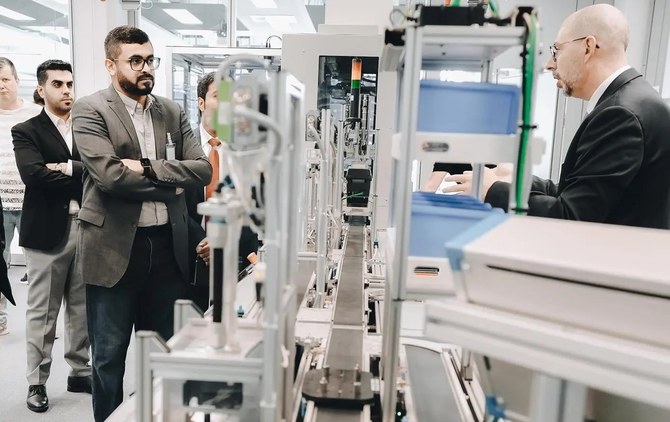
Saudi delegation explores industry cooperation with German firms 

Alongside Porsche, the Saudi delegation also held discussions with representatives from Schüller, Festo, and KSB — German companies operating in diverse sectors. (SPA)
Short Url
Updated 25 August 2023
Follow

Saudi delegation explores industry cooperation with German firms 

RIYADH: A high-level delegation from Saudi Arabia’s Ministry of Industry and Mineral Resources embarked on a mission to bolster cross-border collaboration with Germany, focusing on human capacity development in the industrial and mining sectors.  

The delegation, led by the Deputy Minister of Industry and Mineral Resources for Human Capability Development, initiated a significant dialogue with prominent German companies during their official visit to the European country, the Saudi Press Agency reported. 

In partnership with the Human Capability Development Program, the Saudi delegation engaged in strategic discussions with key players in the German business landscape.  

Meetings were held at the heart of the automotive industry, including a session at the headquarters of the German automobile manufacturer Porsche. Talks during this session revolved around strengthening cooperation between the two nations in the areas of industry advancement and human resource development, the SPA reported. 

Alongside Porsche, the Saudi delegation also held discussions with representatives from Schüller, Festo, and KSB — German companies operating in diverse sectors. These interactions centered on identifying synergies and avenues for collaboration, as well as exploring targeted initiatives and programs aimed at honing human capacities within the industrial and mining sectors. 

A central topic of discussion was the expansive opportunities offered by Saudi Arabia’s National Industry Strategy. This strategy, which spans various industrial sectors, emerged as a major catalyst for advancing human capabilities within these domains. 

Beyond the exploration of collaborative projects, the discussions aimed to underscore the commitment of both nations toward reinforcing bilateral relations. The deliberations highlighted the shared vision and mutual interests that underpin the Saudi-German partnership. 

The outcome of these discussions holds the potential to shape the future landscape of industry and mining collaboration between Saudi Arabia and Germany, bringing to the forefront a renewed focus on human capacity development and cooperative ventures. 

This comes after the Saudi Minister of Industry and Mineral Resources Bandar Alkhorayef visited Germany in June to hold talks with Roland Weigert, vice minister in the Bavarian Ministry of Economic Affairs, Regional Development and Energy, as part of his official tour. 

The pair discussed ways to enhance the Saudi-German partnership and exchange expertise, as well as focusing on the promising investment opportunities between the two countries, according to the SPA. 

Alkhorayef’s visit to Germany was aimed at boosting the Kingdom’s industrial and mining sectors, which are among the major pillars of the Saudi Vision 2030 initiative to diversify the economy away from oil and attract foreign investment.


Industry leaders highlight Riyadh’s Metro, infrastructure as investment catalysts

Updated 29 December 2025
Follow

Industry leaders highlight Riyadh’s Metro, infrastructure as investment catalysts

RIYADH: Saudi Arabia’s capital, Riyadh, is experiencing a transformative phase in its real estate sector, with the construction market projected to reach approximately $100 billion in 2025, accompanied by an anticipated annual growth rate of 5.4 percent through 2029.

The Kingdom is simultaneously advancing its data center capacity at an accelerated pace, with an impressive 2.7 GW currently in the pipeline. This expansion underscores the critical role of strategic land and power planning in establishing national infrastructure as a cornerstone of economic growth.

These insights were shared by leading industry experts during JLL’s recent client event in Riyadh, which focused on the city’s macroeconomic landscape and emerging trends across office, residential, retail, hospitality, and pioneering sectors, including AI infrastructure and Transit-Oriented Development.

Saud Al-Sulaimani, Country Lead and Head of Capital Markets at JLL Saudi Arabia, commented: “Riyadh is positioned at the forefront of Saudi Arabia’s Vision 2030, offering unparalleled opportunities for both investors and developers. National priorities are continuously recalibrated to ensure strategic alignment of projects and foster deeper collaboration with the private sector.”

He added: “Recent regulatory developments, including the introduction of the White Land Tax and the rent freeze, are designed to stabilize the market and are expected to drive renewed focus on delivering premium-quality assets. This dynamic environment, coupled with evolving construction cost considerations in select segments, is fundamentally reshaping the market landscape while accelerating progress toward our national objectives.”

The event further underscored the transformative impact of infrastructure initiatives. Mireille Azzam Vidjen, Head of Consulting for the Middle East and Africa at JLL, highlighted Riyadh’s transit revolution. She detailed the Riyadh Metro, a $22.5 billion investment encompassing 176 kilometers, six lines, and 84 stations, providing extensive geographic coverage, with a depth of 9.8 km per 100 sq. km. This strategic development generates significant TOD opportunities, with properties in proximity potentially commanding a 20-30 percent premium. JLL emphasized the importance of implementing climate-responsive last-mile solutions to enhance mobility and accessibility, particularly given Riyadh’s extreme temperatures.

Gaurav Mathur, Head of Data Centers at JLL, emphasized the rapid expansion of the Kingdom’s AI infrastructure, signaling a critical area for technological investment and innovation.

Focusing on the construction sector, Maroun Deeb, Head of Projects and Development Services, KSA at JLL, explained that the industry is actively navigating complexities such as skilled labor availability, material costs, and supply chain dynamics.

He highlighted the adoption of Building Information Modeling as a key driver for enhancing operational efficiency and project delivery.