

Pakistan allows Iraq's national airline to operate extra flights for Arbaeen pilgrims

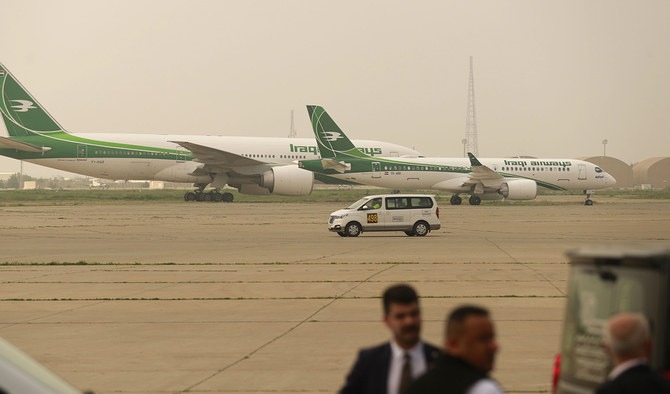
Iraqi Airways aeroplanes sit at the tarmac at Baghdad International Airport on March 14, 2023. (AFP/File)
Short Url
Updated 24 August 2023
Follow

Pakistan allows Iraq's national airline to operate extra flights for Arbaeen pilgrims

  • Iraq's ambassador to Pakistan Hamid Abbas Lafta calls on PM's adviser on aviation
  • Thousands of Pakistanis each year travel to Iraq to take part in the religious event

ISLAMABAD: Pakistan on Thursday accepted Iraq's request and allowed its flag carrier to facilitate pilgrims by operating extra flights to the country during the Arbaeen event, Pakistan's aviation minister said in a statement. 

Arbaeen is one of the largest annual religious events in the world during which millions of Shia Muslims gather at Karbala to mark the end of the 40-day mourning period of the killing of Prophet Muhammad's (PBUH) grandson. Thousands of Pakistanis also attend the Arbaeen festival each year in Iraq which takes place during the Islamic month of Safar. 

Iraq's Ambassador to Pakistan Hamid Abbas Lafta called on the advisor to the Pakistani prime minister on aviation, Air Marshal (retired) Farhat Hussain Khan to discuss the upcoming religious event, the aviation ministry said. 

"Request was extended by the Iraqi side to allow Iraqi Airways extra flights to facilitate Zaireen [pilgrims] during Arbaeen," the statement read. "The airline was given permission for extra flights," it said, adding that both sides also agreed to enhance cooperation in the aviation sector. 

During the meeting, the two sides also exchanged views on bilateral relations between Iraq and Pakistan, the aviation ministry said, adding that both countries enjoy a cordial relationship based on religion and culture. 

Relations between Pakistan and Iraq have received a boost with a number of ministerial-level exchanges in recent years. Earlier this month, former interior minister Rana Sanaullah visited Iraq during which the Iraqi government increased the quota of Pakistani Arbaeen pilgrims to 100,000 from 50,000. 


Pakistan says defense pact with Saudi Arabia elevated brotherly ties to ‘new heights’

Updated 25 February 2026
Follow

Pakistan says defense pact with Saudi Arabia elevated brotherly ties to ‘new heights’

  • Pakistan, Saudi Arabia signed strategic defense pact last year pledging aggression against one will be treated as attack on both
  • Deputy PM Ishaq Dar says enduring bonds with Islamic and Arab nations form vital pillar of Pakistan’s foreign policy 

ISLAMABAD: Deputy Prime Minister Ishaq Dar said on Wednesday that Pakistan’s defense pact with Saudi Arabia elevated its brotherly ties with the Kingdom to “new heights,” stressing that close ties with Arab and Islamic nations form a key pillar of Islamabad’s foreign policy. 

Pakistan and Saudi Arabia signed a Strategic Mutual Defense Agreement on Sept. 17 last year, pledging that aggression against one country would be treated as an attack on both, enhancing joint deterrence and formalizing decades of military and security cooperation.

Both nations agreed in October 2025 to launch an economic cooperation framework to strengthen trade and investment ties. 

“In the Middle East, our landmark Strategic Mutual Defense Agreement with Saudi Arabia has elevated our brotherly ties to new heights,” Dar said while speaking at the Pakistan Governance Forum 2026 event in Islamabad. 

The Pakistani deputy prime minister was speaking on the topic “Navigating International Relations Amidst Changing Geo-Politics.”

Dar noted that Pakistan has reinforced partnerships with other Middle Eastern nations such as the UAE, Qatar, Jordan, Oman, Egypt and Bahrain. He said these partnerships have yielded “concrete agreements” in investment, agriculture, infrastructure, and energy sectors. 

“Our enduring bonds with Islamic and Arab nations form a vital pillar of our foreign policy, and we will continue to expand our partnerships across Asia, Latin America, and Africa,” he said. 

Dar pointed out that the presidents of Kazakhstan, Uzbekistan and Kyrgyzstan have undertaken visits to Pakistan in recent months, reflecting Central Asian nations’ desire to boost cooperation with Islamabad.

On South Asia, the Pakistani deputy PM said Pakistan has successfully transformed its fraternal ties with Bangladesh into “a substantive partnership.”

“Similarly, the trilateral mechanism involving China, Pakistan, and Bangladesh has been launched with a view to expanding and deepening regional cooperation and synergy,” the Pakistani minister said. 

He said Islamabad has strengthened its “all-weather” partnership with China via the second phase of the multi-billion-dollar China-Pakistan Economic Corridor agreement and “unwavering support” from both sides for each other’s core interests. 

Dar said Pakistan had also reinvigorated its partnership with the US, advancing cooperation in trade, technology, investment, and regional stability. 

“This calibrated approach has enhanced our ability to navigate complexity with skill and confidence, ensuring that our national interests are served without compromising our core foreign policy principles,” he said.